Exit interview with former 47th Ward COS Josh Mark: For bike and bus upgrades to be successful, “they need to be thorough and complete.”

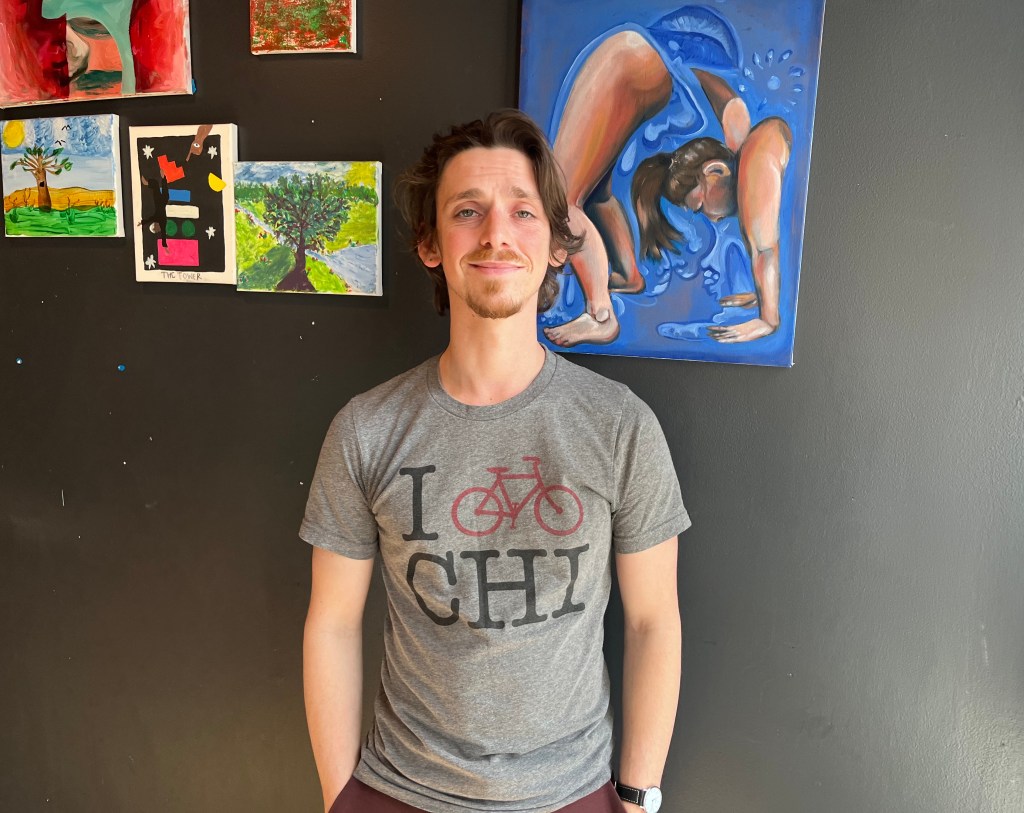
Recently, Josh Mark stepped down as chief of staff for the 47th Ward, represented by Ald. Matt Martin. The North Side district contains parts of North Center, Lincoln Square, Uptown, and Lakeview, and Martin is one of Chicago’s most sustainable transportation-friendly City Council members. Many walking, biking, transit, and equitable TOD projects have happened in the ward since he took office in May 2019. Especially in recent years when Mark served as COS, he’s been a key lieutenant to the alder who helped get those things done.
Streetsblog caught up with Mark before he moves back to France, where he was raised. We discussed his accomplishments, and some of the issues involved with trying to create livable streets and communities. The interview has been edited for clarity and brevity.
John Greenfield: The ward has been known for a lot of sustainable transportation, safe streets, and affordable housing initiatives. I would classify Ald. Martin as one of the more livable streets-friendly alders in town. You’ve been the point person for a lot of the infrastructure, CTA and bike / pedestrian stuff. So we’ve had a lot of interactions. You’ve given me a lot of tips on stuff that was going on. So tell me about why you stepped down from the job, In a nutshell.
Josh Mark: It was very much a personal and private decision. My partner and I are going to be moving to Paris. I grew up in France, have been in Chicago for 11 years, so it’s very much a private move to be closer to family. That said, I was working with Matt for close to seven years, seven years if you include the campaign, and that took a toll.
Working in this job, when you are aiming to change things, aiming to make real differences, involves a lot of effort and a lot of conflict, and so it was quite a stressful time. I enjoyed a lot of it, but I’m pretty pleased to also take a break from from the stress and responsibility after seven years of work.
John Greenfield: Have you figured out what you’re going to be doing in Paris?
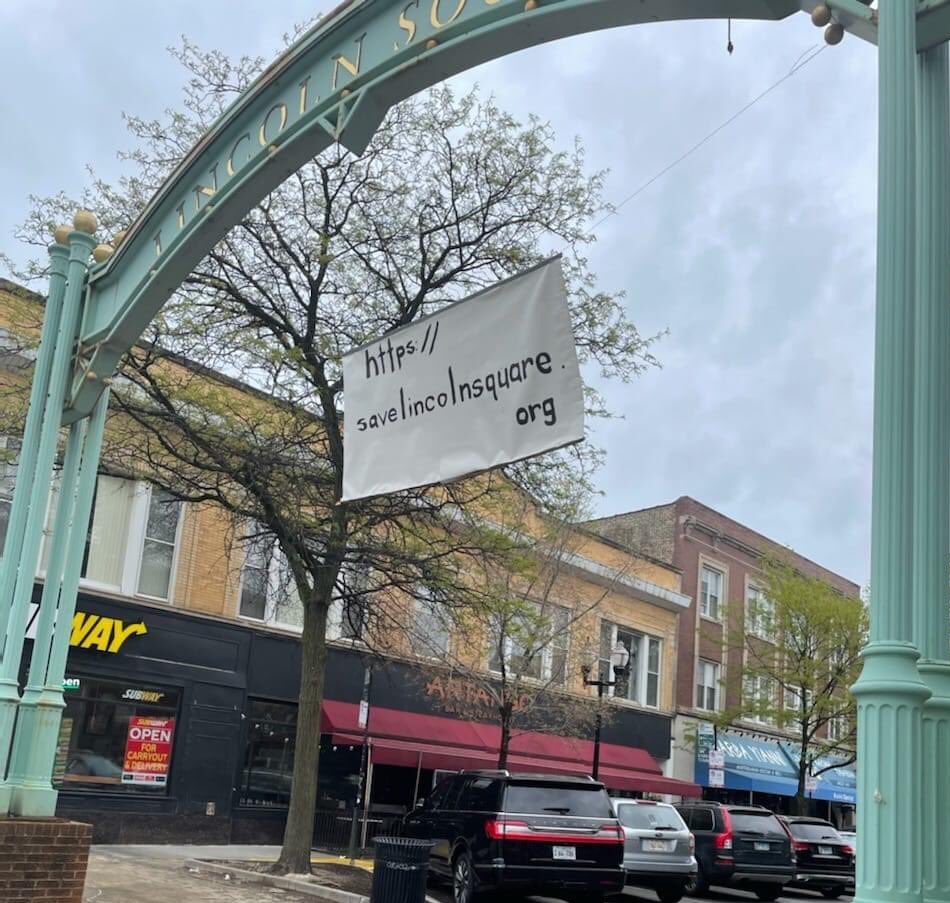
JM: Not the details, but I want to stay in the urbanism space, but probably focus on affordable housing. That was another aspect of my portfolio working with Matt. We got three fully affordable developments approved. One of them was funded at Leland and Western [avenues] the Canvas [at Leland Plaza], 63 units of affordable housing. I know you covered the sometimes toxic fight on that topic.
We got two other buildings approved as well that I’m very excited about. So the affordable housing work was, I think, what I found most exciting out of a lot of exciting work. And so that’s what I’m hoping to stick with.
JG: So yeah, let’s talk about the conflicts a little bit. That must have been the stressful part of your job, when you folks had relatively progressive initiatives that were getting pushback. One of the ringleaders for that was Inside Publications, led by my good friend Ron Roenigk. I’m just kidding, we’ve had a lot of conflicts, but he’s an interesting character.
Would you say [Canvas at Leland Plaza] was one of the main sources of opposition you folks got? What other things did you have in mind – just hostile community meetings?
JM: I think hostility comes in a variety of forms. And to be clear, hostility does not necessarily involve lasting enmity. It’s not necessarily that every hostile interaction is just someone who will write us off and hates us for good. I think for the most part, it has to do with hostile or stressed reactions to a number of changes that we either propose or make. Keeping in mind that I think one thing that’s important is that you will get much more pushback before a project is implemented than after, very often, because people won’t necessarily know what they expect, they won’t necessarily know what the project is going to entail.
And so a lot of the job was to explain projects to people, explain the purpose and the benefit of a project. And I think that’s something that we as an office and myself, if I say so myself, did rather well over the years was to educate people and bring them along as to the need for certain improvements, and then the benefits of those improvements. That didn’t make those interactions any less heavy, when you’re talking to people who are, if nothing else, very emotional.
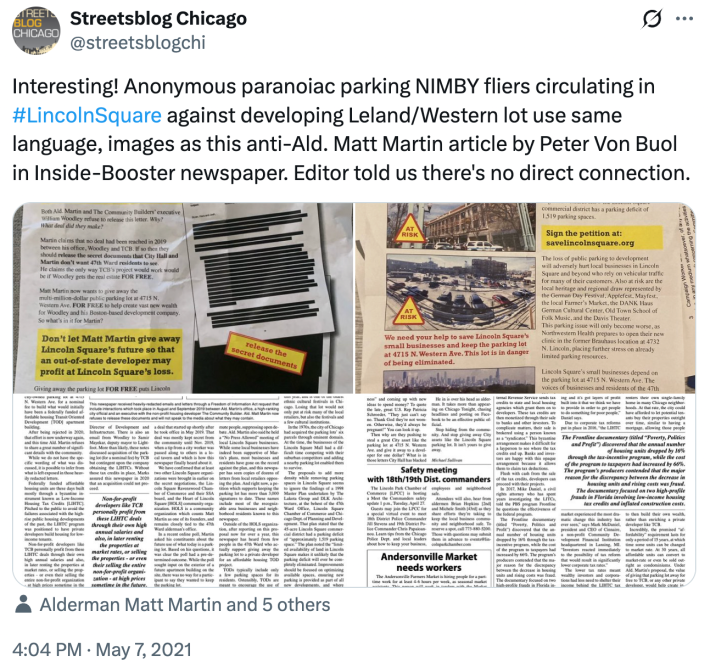
That said there were interactions like the ones you described with the Inside Booster, and specifically around this affordable housing, that I would describe as very much hostile. And that particular proposal was probably the major proposal of Ald. Martin’s first term. And it was a fight, and we won it, right? We won the public discourse narrative. We won the people. And I think there are few people who remain upset about this project.
But the fact that people were upset was in large part, if not in whole, due to the Booster, and perhaps the larger Booster ecosystem, that I think in the end proved to be a rather small subset of the community that was really opposed to change for a variety of reasons. One was just, I think, base reactionary opposition to change. And there were very much, you know, racist, anti-affordable housing reactions which did not in any way reflect the majority of the community. But as is often the case, they were the loudest voices in the room.
JG: What are your other proudest accomplishments in terms of sustainable transportation and Safe Streets stuff in the ward, walk/bike/transit?
JM: If I pick one of each, I think as far as transit is concerned, the extension of the [#9] Ashland bus. That was a project that was very personal to me, because I used to live near the Metra station, and not having access to an Ashland bus was something that made it more difficult to get around. So think the Ashland bus extension was a very exciting project, and also one of the things that we did that was the most well-received. We continued to receive congratulations up until my last day in office.
As far as cycling, I’d have to say broadly, the fact that we doubled the size of our biking network. And if you look just at the low-stress biking network, so greenways and protected bike lanes, we multiplied that by six in six years.
JG: Can you list those for me, the ones in your ward?
JM: As far as low-stress, so we built the first protected bike lanes [in the 47h Ward]. I think that’s probably what I’m most proud about. The two part project. I know your friends who grade all the cities on bikability [People for Bikes’ annual City Ratings report] were upset about the first step of the Clark Street project, kind of ending nowhere, the Irving Park Road to Montrose Avenue protected bike lanes.
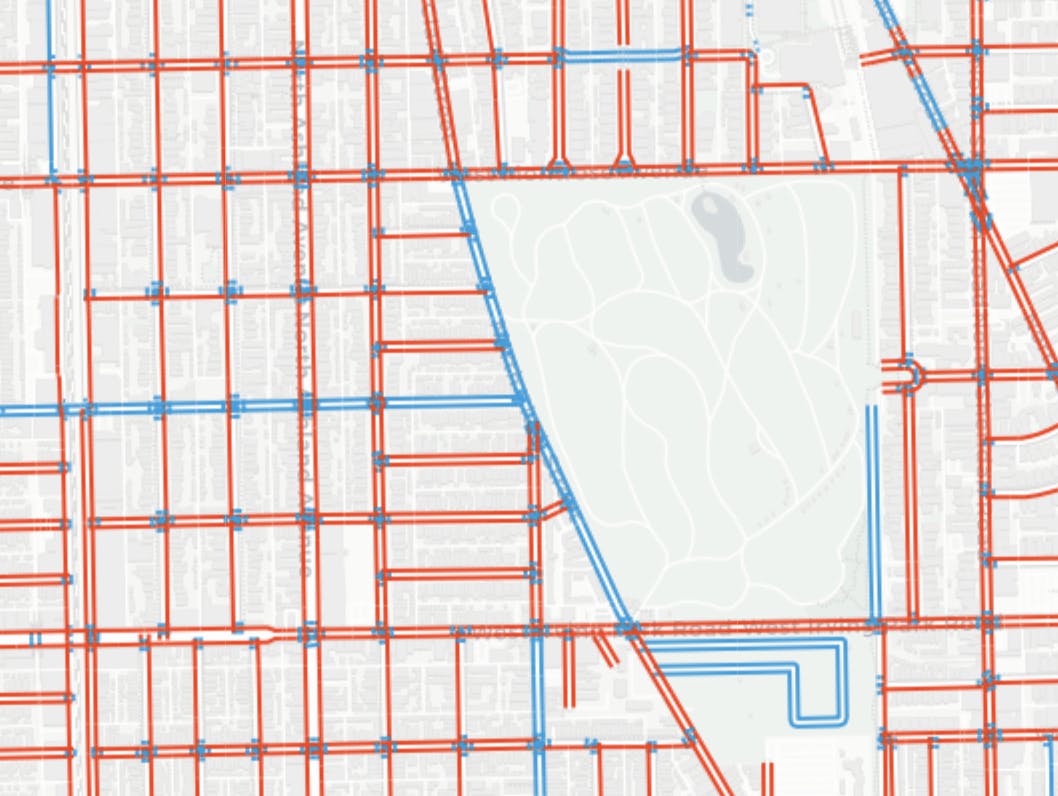
The map used in People for Bikes’ recent blog post about Chicago, featureing Graceland Cemetery. Red streets are supposedly “high stress” and blue ones are designated as “low stress.” “A protected bike lane on Clark Street begins and ends on a high-stress road, making it difficult to connect to other parts of Chicago’s bike network,” People for Bikes stated.
But we always meant to come back and add to that. So I think what I’m most proud about is this protected bike lane on Clark now from Irving Park to Winnemac Avenue.
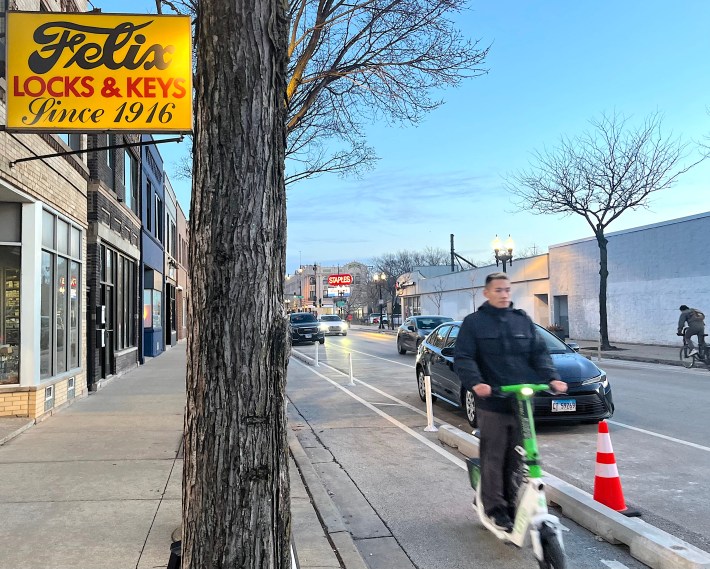
We also have a protected bike lane that runs on Roscoe and Campbell, west of Western connecting to the Belmont protected bike lane. And there’s small sections of protected bike lane that are being built, the Leland Greenway portion, some intersections at Lincoln Avenue and Montrose [and Leavitt Street]; at Lincoln, Damen Avenue, and Irving Park; and at Leland and Western.
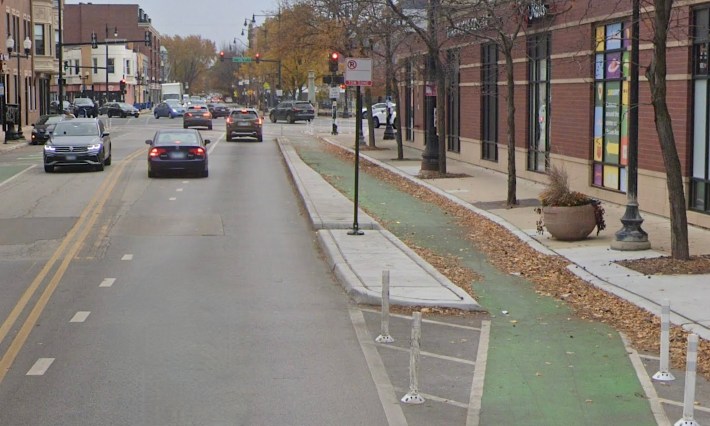
And then greenways. We have Berteau Avenue, which already existed, but we extended it. Portions of Grace Street where Grace was a one way. We did the entirety of Leavitt. I was quite proud that I got the 40th Ward to the north and the 32nd Ward to the south to join us on this so that when we did Leavitt, it wasn’t just the 47th Ward. It was three miles of Leavitt from Bowmanville down to the river.
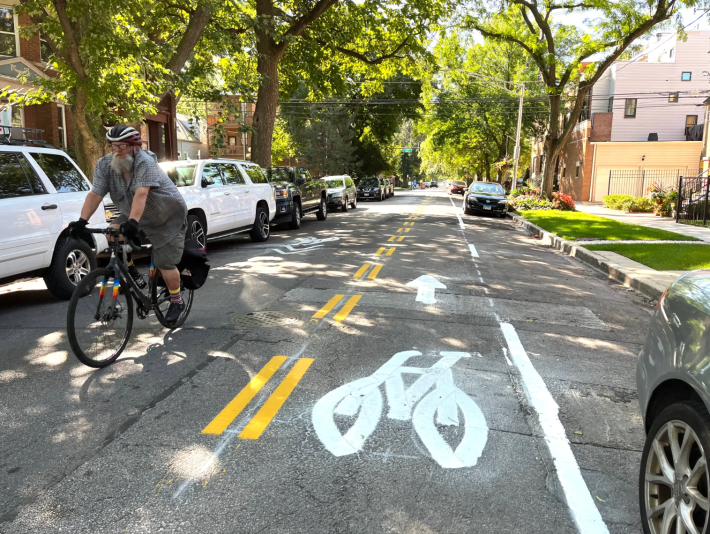
We did the Winnemec Greenway, the Leland Greenway. We did bits of School Street and Ravenswood Avenue when that was in our ward. And the Ravenswood Greenway from Wilson Avenue running north. We also have bike lanes on residential streets around Waters Elementary school at Campbell and Maplewood avenues.
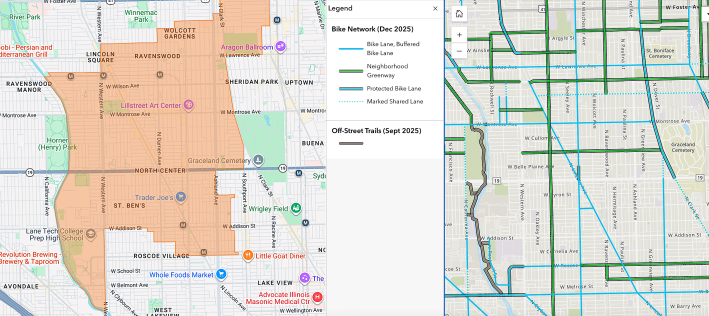
JG: That reminds me, a good example of when you dealt with hostility from the public was, I remember being at a community meeting for the Ravenswood Greenway where people were upset because some parking was goin to be converted for it. So that project’s done now. How’s that working out?
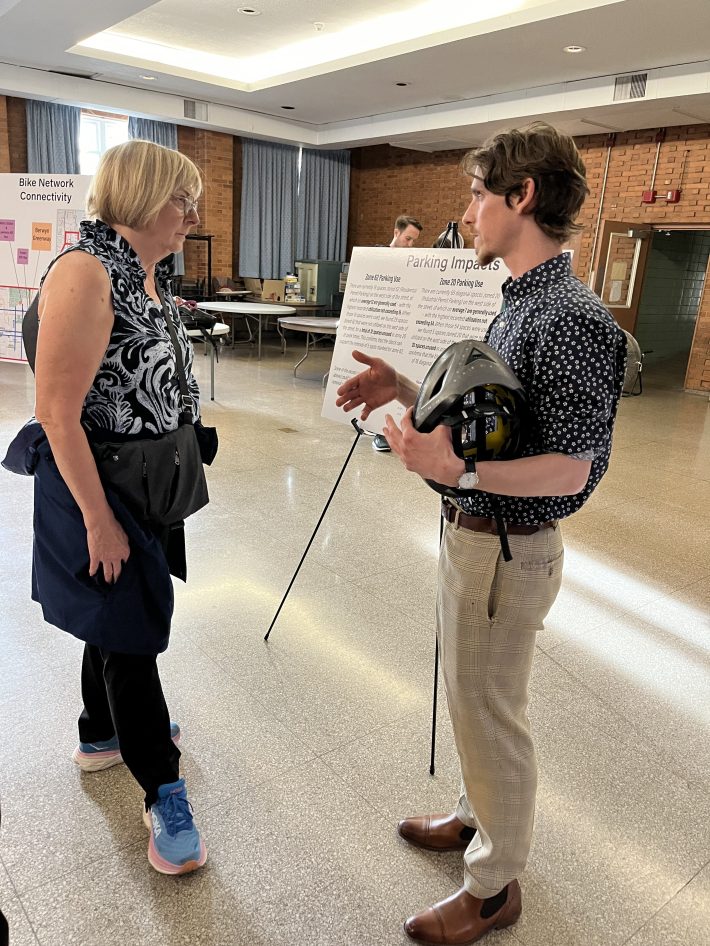
JM: As far as I know it’s working out well, I’ll say a couple of things. That project was one I was super excited about. The bike lane component of it removed maybe 25 parking spaces, and another few dozen were removed when diagonal parking was converted to parallel parking to make way for a community garden project I’m very excited about.
Thinking back to the community meeting in question, I don’t think that that was a particularly hostile meeting. I remember two individuals in particular who had concerns, very possibly legitimate concerns, about their difficulty accessing parking as is, and so why are we more parking? So, as meetings go, not the most hostile, but I do distinctly remember that meeting, and I remember those conversations.
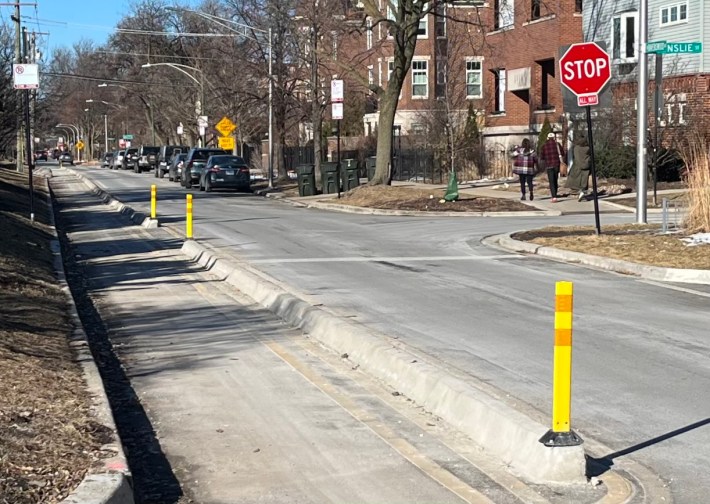
I think what was important to us was that we were comfortable with the data that we used to justify the change. I cannot guarantee that there is no negative impact, that we’re not making it slightly tighter for people to park, but I think the tradeoff is worth it.
JG: Maybe a good place to end is to talk about the fact that Chicago really needs a cohesive bikeway system. We really need it to be something where you don’t have to think a whole lot about routes, because the bike network is protected, connected, and citywide.
So a good role model for Chicago is Paris. They went from being a city that was not particularly bike friendly to having a network of low stress routes. What lessons do you think that has for Chicago, as we try to do that?
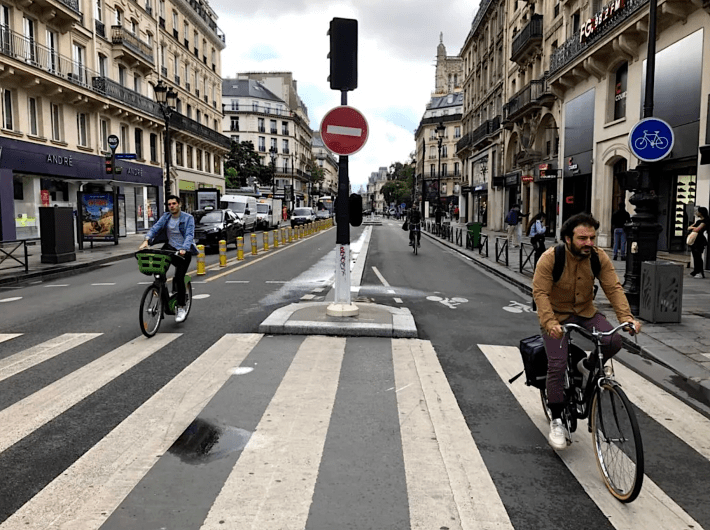
JM: Paris in the last five to seven years has changed dramatically. They’ve built protected bike lanes all over the place, hundreds of kilometers of it, to the point that today there are more bike riders traveling in Paris than there are drivers, and I saw a data point yesterday saying that, I think it’s one in two Parisians bikes at least weekly.
If nothing else, it shows that if you lean in through the pain [of things like “road diets” and parking space conversions to make room for bikeways], let’s say, there’s a real payout on the other side. And what I mean by that is they faced the same sorts of criticism that bike lanes everywhere do, right? You’re removing parking, you’re making it harder for people to drive. There’s criticisms involving ADA access and access to businesses. And all of those are, of course, legitimate issues that need to be looked at as it relates to ADA and business delivery.
But by really leaning in and doing all of it, they end up in a place where [Paris has] created a strong enough network that they have permanently changed transportation habits, to the point that Paris is going through a mayoral campaign right now, and the conservative candidate, who is not at all pro-bike, her position is that she will not remove any bike lanes, and that she will continue to increase the size of the network, but she will do so in a good way, in a way that is better than how the left did it. I don’t know that I believe that she will actually continue to extend the network. That’s not her constituency. But I think she and many other conservative electeds in Paris have seen the writing on the wall and, given how much people’s transportation habits have changed, it’s no longer a viable position to be anti-bike, in the way that on Archer Avenue, it is an electable position to say, “I’m going to remove what’s been done,” because it’s been done, but not thoroughly enough that a strong constituency relies on it.
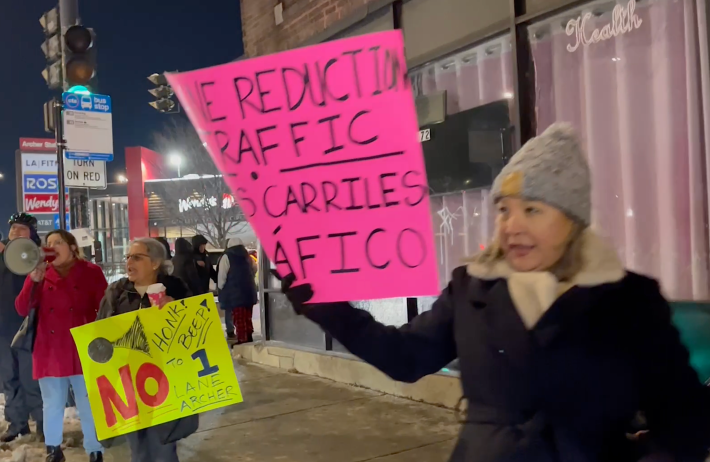
Chicago and Paris are different. Chicago has six times the [square mileage] of Paris with the same population, so it’s harder to make it as bikable a city. But I think that is really the main lesson, that elected officials and city planners who want to implement both bike and bus improvements need to learn is that in order for these improvements to be successful, they need to be thorough and complete.
Because if you do a bus lane that isn’t fully enforced or enforceable, you’re going to piss off everyone, without the benefits necessary to build yourself a constituency that will fight for preserving what you built and expanding it. The same is true with protected bike lanes. If all you do is a [short segment of] Archer and then you never build anything else, you’re going to piss off people. You’re going to do that regardless, but you’re not going to create enough of benefit that you’ll build this new constituency that relies on what you’re building. That’s the primary lesson.

On November 12, SBC launched our 2026 fund drive to raise $50K through ad sales and donations. That will complete next year’s budget, at a time when it’s tough to find grant money. Big thanks to all the readers who have chipped in so far to help keep this site rolling all next year! Currently, we’re at $29,027 with $20,973 to go, ideally by the end of March.
If you value our livable streets reporting and advocacy, please consider making a tax-exempt gift here. If you can afford a contribution of $100 or more, think of that as a subscription. That will help keep the site paywall-free for people on tighter budgets, as well as decision-makers. Thanks for your support!
– John Greenfield, editor

Read More:
Streetsblog has migrated to a new comment system. New commenters can register directly in the comments section of any article. Returning commenters: your previous comments and display name have been preserved, but you'll need to reclaim your account by clicking "Forgot your password?" on the sign-in form, entering your email, and following the verification link to set a new password — this is required because passwords could not be carried over during the migration. For questions, contact tips@streetsblog.org.