Stay in your lane or pay the fine

By Dan Gentile
Dan Gentile is a lifelong Chicagoland resident who works as a civil engineer in Chicago.
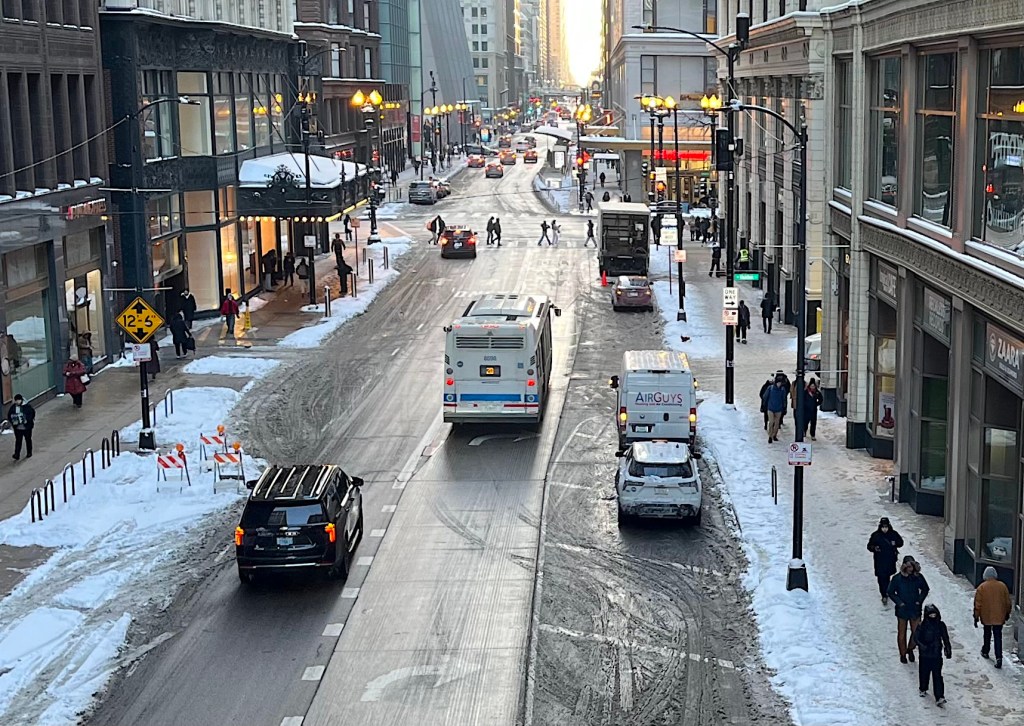
In November 2024, the City of Chicago launched the Smart Streets pilot, using cameras to enforce legislation against illegal standing and parking in bus stops, and bus and bike lanes. The program, spearheaded by the Chicago Department of Transportation and the Department of Finance, started off with a 30-day warning period, enforced in the Central Business District.
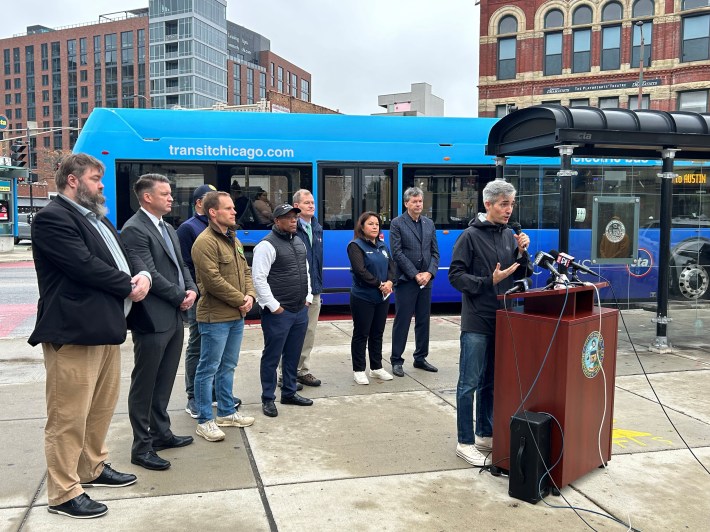
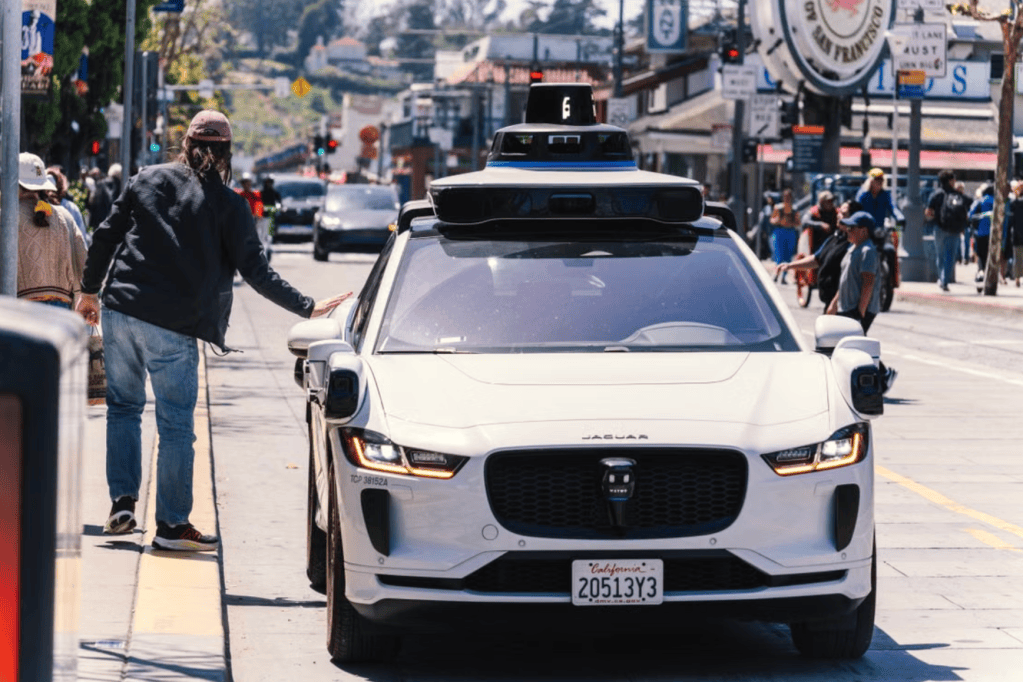
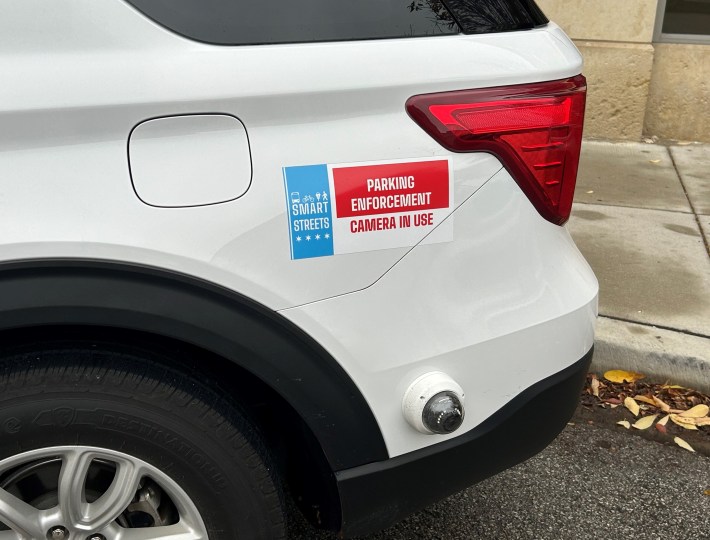
The pilot uses Automated Bus Lane Enforcement systems attached directly to buses, initially used on eight CDOT and DOF vehicles. In October 2025, the CTA announced that the program was being expanded to six of its buses. “The program aims to improve safety for people walking, biking, and using transit, improving parking compliance, and enhancing the reliability and efficiency of public transit,” the agency said in a press release.
The CTA shared the technological background and first set of data results with the Young Professionals in Transportation Group during a recent virtual lunch and learn regarding the program. Since the launch, data has been collected about the violation distribution, potential service implications, and next steps for the program. Enforcement is needed to make sure bus and bike lanes are clear for their intended use, so the data so far is crucial for advocating for the program’s continuation and expansion.
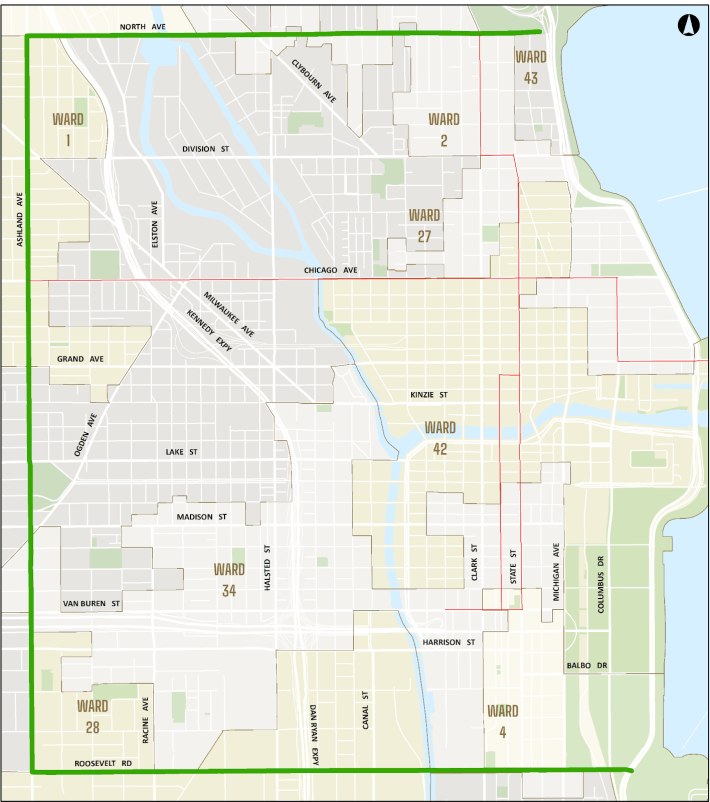
As it stands, the pilot is limited to the central city, bounded by Roosevelt Road to the south, North Avenue to the north, Ashland Avenue to the west, and Lake Michigan to the east. It includes three buses on the #66 Chicago Avenue route and three on the #36 Broadway route. There are plans to expand the enforcement zone of the program north to Irving Park Road and south to 26th Street early this year.
The data and implications
The Hayden AI cameras are mounted to the buses to automatically record violations and send out tickets. There is precedent for this technology, already in use by other agencies like New York’s MTA, Philadelphia’s SEPTA, and Washington’s WMATA. In Illinois, new state legislation would be needed to allow for camera enforcement of illegal driving in bus and bike lanes.
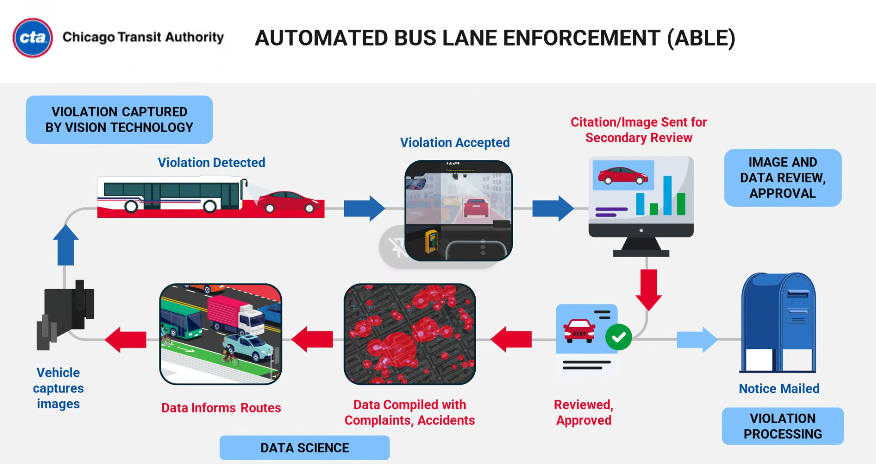
The bus-mounted cameras launched on Oct 15, 2025, again with a 30-day warning-only period. Violations with a fine began on November 14, after a first no-cost warning.
The CTA said that from from Nov 14 to Dec 31, 2025, there were over 2,200 warnings and violations from bus-mounted enforcement alone. Here is the data from both CDOT/DOF vehicle-mounted cameras and CTA bus-mounted cameras for that period.
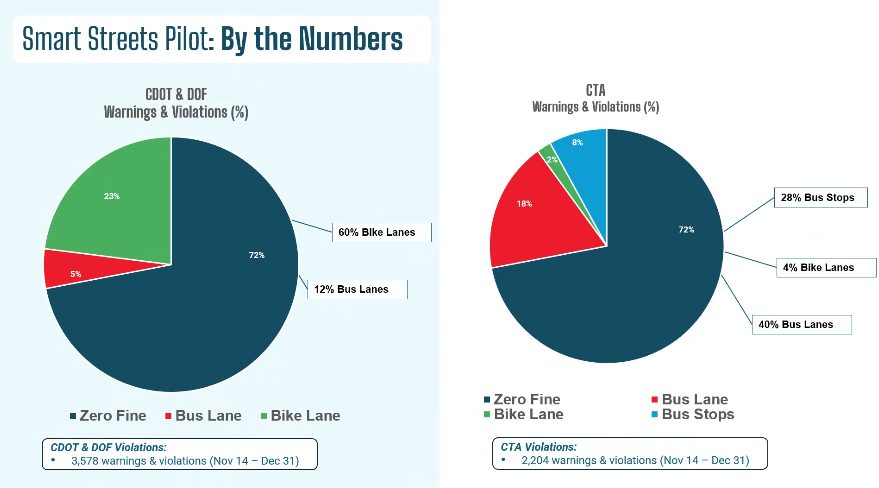
Although most initial enforcement were no-cost warnings, the bus cameras captured 2,204 incidents, 617 of which came with a fine, dictated by violation type. The City netted $65,000 in the period, half a million dollars if extrapolated to a full year at the same rate. Scaled up on more routes and more of the city, the program would have no problem paying for itself.
“The cost to deploy the system on the first six buses is $315,852 including equipment and ongoing services; the contract includes the option to purchase up to 94 additional cameras,” said a March 2025 CTA news release, previewing the launch later that year. Currently, the transit agency is not retaining the revenue. Other cities with the program at larger scale have revenue sharing. this would allow the CTA to use ticket fees to implement more dedicated bus lanes, and make other transit improvements.
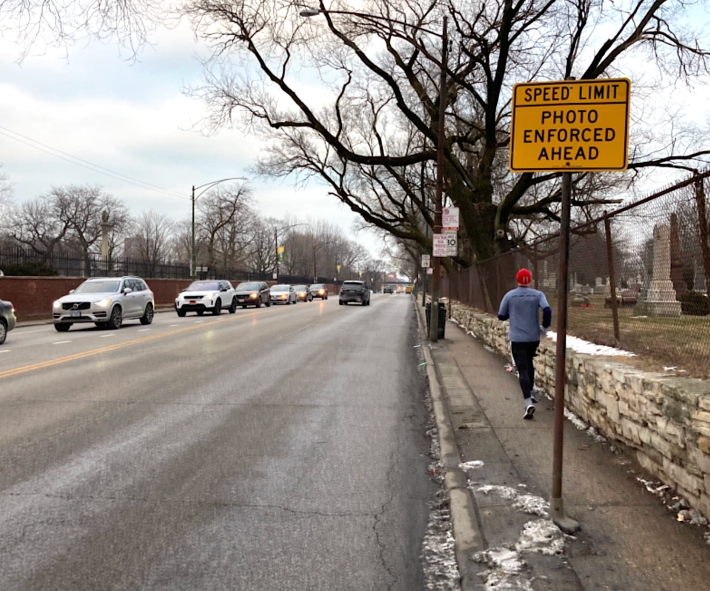
Ticket cost burden has been a constant criticism of other similar endeavors for safety, like red light and speed cameras. It’s true that a set fee for a violation is regressive towards lower-income people.
To mitigate this, in April 2022, the City launched the Clear Path Relief Program, which provided 50 percent discounts on traffic fines and debt forgiveness programs for low-income residents. Unfortunately, in fall 2024, a City official told Streetsblog, “The Clear Path Relief program is still around and offers debt relief as outlined on the website. But it no longer offers the 50 percent cost reduction in new tickets.” Since Mayor Brandon Johnson has stated that he prioritizes economic equity, it would make sense for him to reinstate the discount.
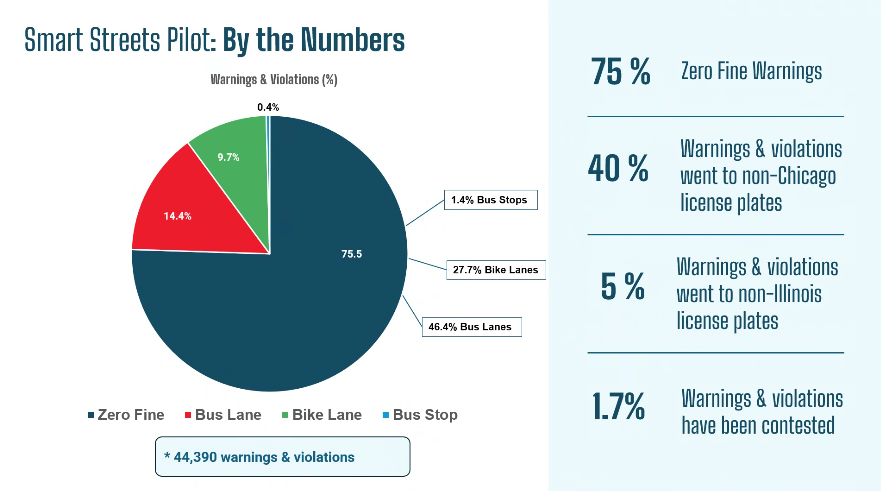
Overall, the Smart Streets program total has issued 44,390 warnings and violations. To reiterate, this is only with eight DOF vehicles and 6 buses equipped with the technology, indicating how common this really is. The intent is to dissuade this behavior for the benefit of all users, primarily the most vulnerable like pedestrians and cyclists.
Safety-driven program goals
According to the CTA and CDOT, ticket revenue is not the main priority of this program, but rather safety, and improved bus service and bike access. During the November 2024 launch, then-CDOT commissioner Tom Carney stated, “This pilot program is a critical step in making our streets more efficient, accessible and safe for everyone.”
The data indicates that, by creating a real disincentive for illegally standing and parking in bus and bike facilities, the program is effective for reducing repeat offense. Of the drivers who have received warnings sent since the pilot began, 87 percent have not be ticketed for another violation. While some may label the cams a cash grab, first-time warnings and high no-repeat citations rate suggest the program is about behavior change, not endless ticketing. Combined with a PSA campaign across the city, Smart Streets will hopefully change drivers’ perceptions of proper curbside manner.
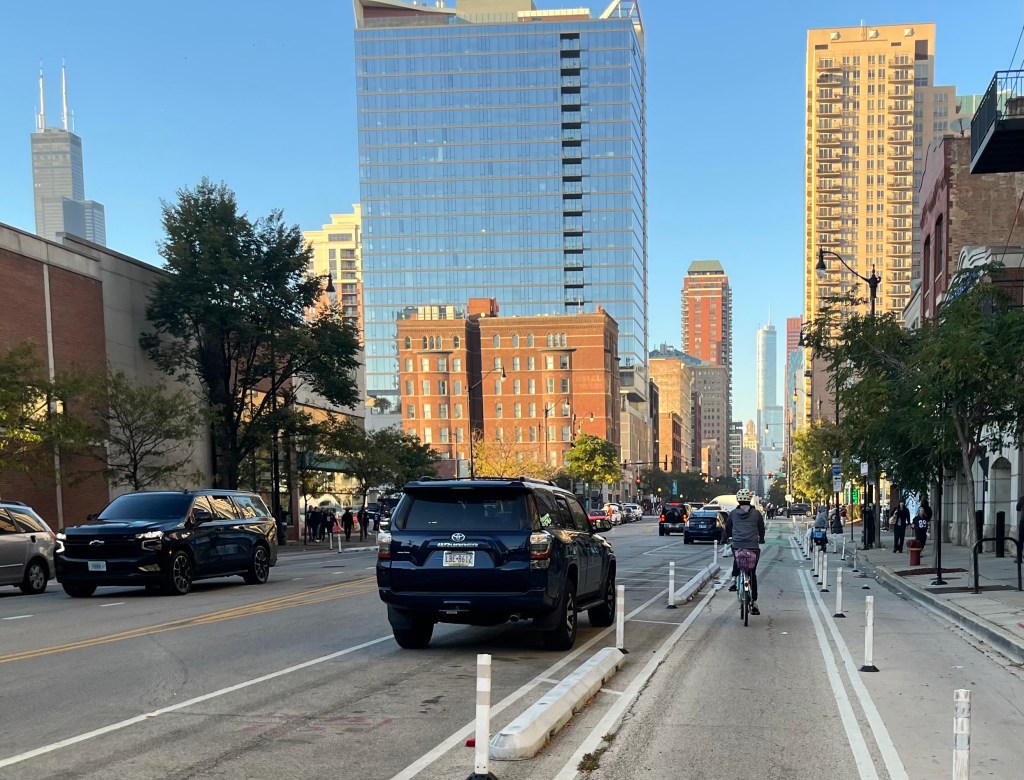
This will help address safety issues. Drivers illegally parked in bus stops force CTA customers to walk to the middle of the street to board, and riders with disabilities can’t use accessibility features like kneeling and ADA ramps. And motorists blocking bikeways require cyclists to merge into the mixed-traffic lane to get around them, which can be dangerous.
Reducing conflicts between people on foot, bikes, and buses, and in delivery and passenger vehicles, is not easy in tight spaces. The pilot area is home to many businesses, homes, and amenities. With so much activity, it’s not surprising the area sees over 12,000 crashes a year. A renewed focus on safety can’t bring back the four vulnerable road users who were fatally struck in the CBD in 2025. But it can pave the way for a safer future.
This data is well visualized with the Chicago Crash Dashboard, created by Michael McLean from Strong Towns Chicago. He estimated that downtown collisions resulted in roughly $240 million in economic costs.
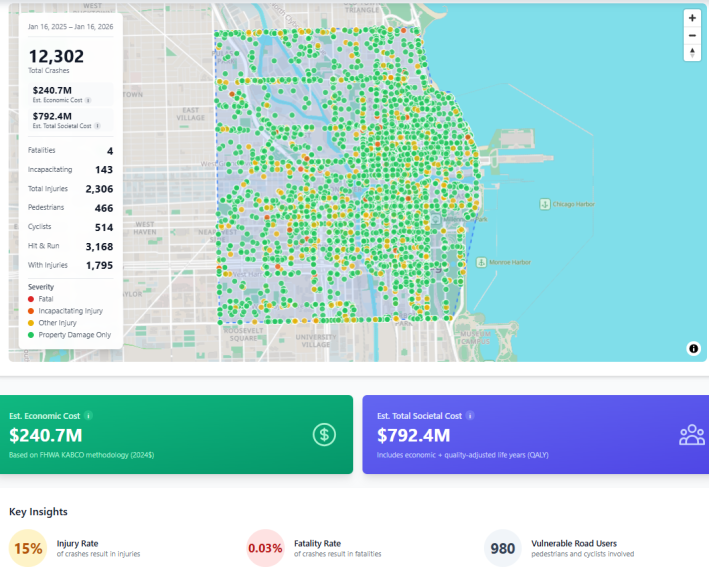
Crash data gives us a rearview-mirror view of traffic safety problems that must be addressed. But the new camera-provided data offers realtime feedback on existing infrastructure. Together, they offer compelling evidence of locations where improvements are needed. Not only do the cams passively collect this data, but they inform agencies of violation specifics, like the type of vehicle involved. Especially in areas with concentrated commercial activity, the CTA noted many delivery vehicles for stores, restaurants, and other businesses were documented blocking bus and bike lanes.
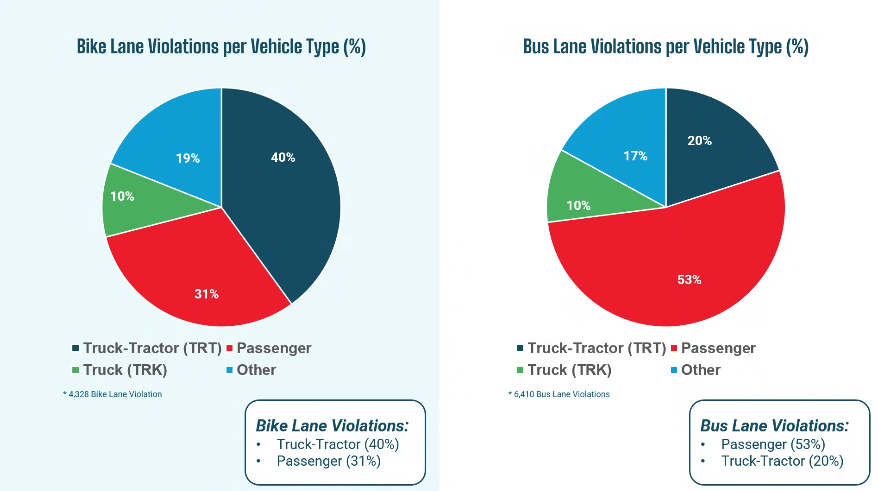
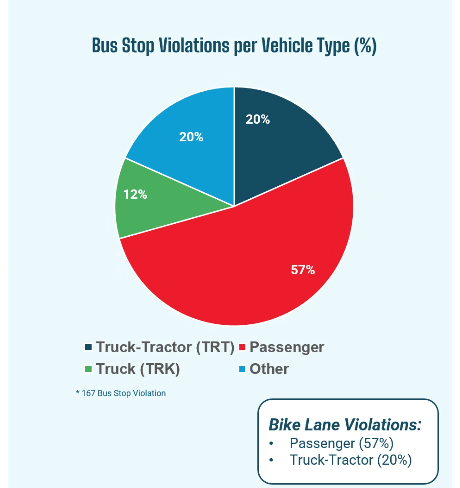
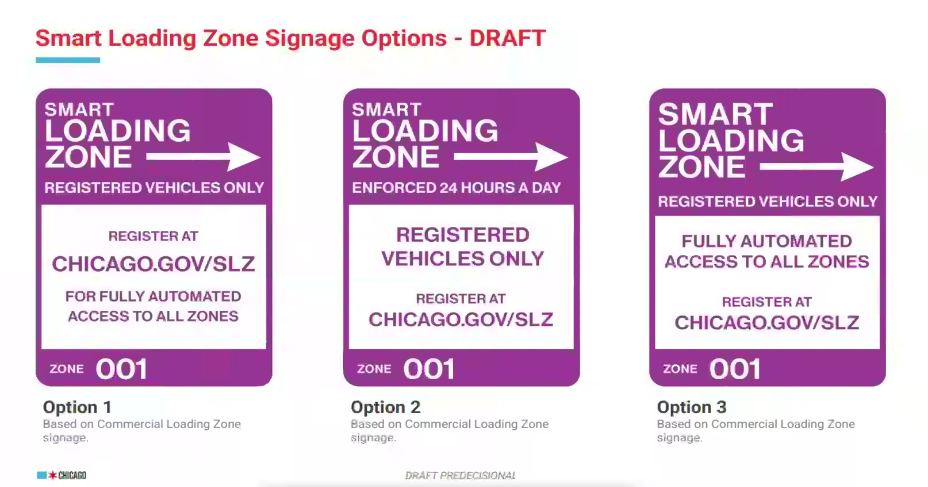
Chicago needs to be a place where business can thrive, so fining delivery workers for illegal parking in locations where there are few legal options can create a prohibitive cost of doing business. To mitigate business pushback while facilitating commerce, the City is also implementing a Smart Loading Zone pilot, currently in the early development stages. Based on the collected data, the City estimates that providing drivers with practical alternatives to blocking bus and bike facilities would reduce violations by 20-40 percent.
Future implications on bus priority
With limited data on only two bus routes so far, a longer time horizon is needed to fully understand the implications of the Smart Streets pilot on transit service. It’s important to note for data collection that the Chicago Avenue bus is currently rerouted due to the bridge rehab at Halsted Street for the construction of the new Bally’s casino.
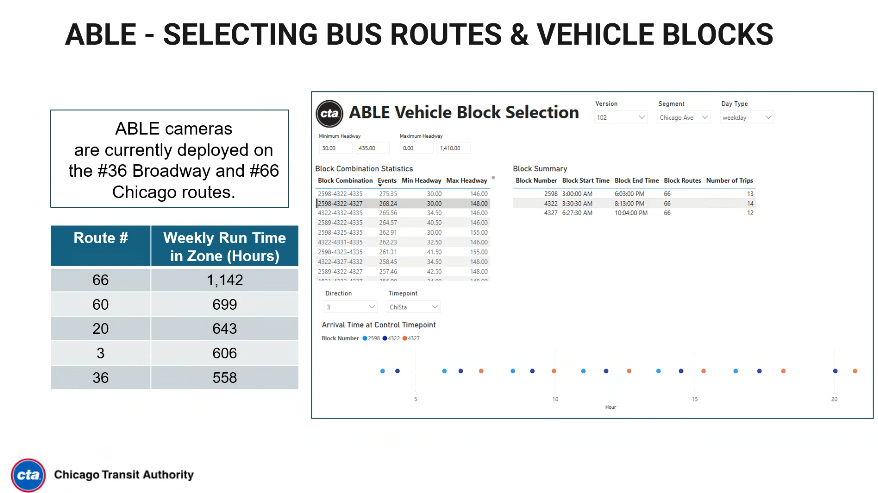
Similarly, nowadays the Broadway bus has to detour around the under-construction State Street bridge. CTA planners are confident the data will show that, in the future, the bus lane enforcement program will result in consistently faster, more reliable transit service. Analysis with ABLE Vehicle block algorithms, set with control points on the route, are being collected to demonstrate an improvement in speeds and decline of blockage incidents.
Unfortunately, Chicago’s previous attempt at creating a high-speed bus route fell flat on its face. In 2013, the CTA and CDOT proposed the Ashland Avenue Bus Rapid Transit route with center-running dedicated lanes, prepaid boarding, limited stops, and other time-saving features, from 95th Street to Irving Park Road. Studies showed this would be 50 percent more reliable than the local bus with an 83 percent increase in bus speeds. The project faced stiff “Not In My Backyard” resistance and was permanently shelved. It seems the CTA learned a lesson about introducing projects at large-scale, now starting efforts elsewhere with iterative improvements and pilot programs.
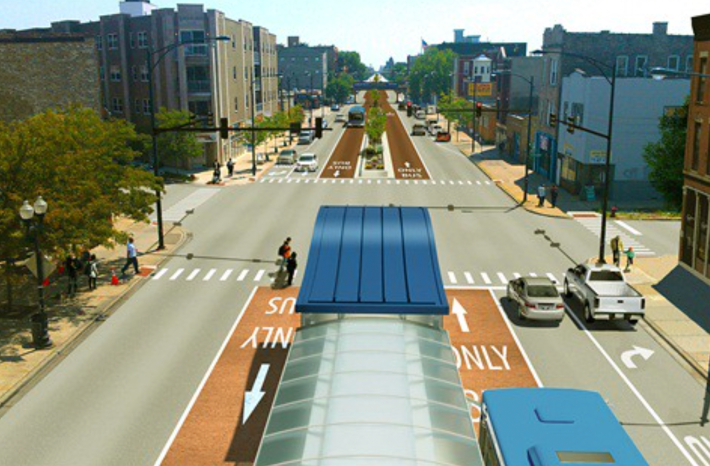
Chicago now lags behind peer cities in bus-priority infrastructure, with only about 15 total miles of dedicated lanes, most of which only designated for weekday rush hour. In contrast, New York City has over 100 miles, and in 2019, the City announced a plan to add 10-15 miles each year. Arguably Chicago has better reason to improve bus routes, with a higher bus-train ridership ratio of 1.4 bus trips for every 1 train ride. The CTA and CDOT have launched new efforts to improve transit service through the Better Streets for Buses Program and the new Bus Priority Corridor Study, both aiming to add dedicated infrastructure.
The pilot area and routes are really the only options for studying enforcement. More than a quarter of our city’s existing bus lane mileage, four continuous miles, are on Chicago Ave between Michigan and Grand Avenues, with just over half of that distance located within the pilot area. Other local bus lanes segments include the Loop Link “BRT lite” route, and short stretches near chokepoints on other major arterials like Western Avenue and 79th Street. This inherently limits the extent of data collection. With a small data set of dedicated lanes and only six buses with cameras, the results may not be conclusive.
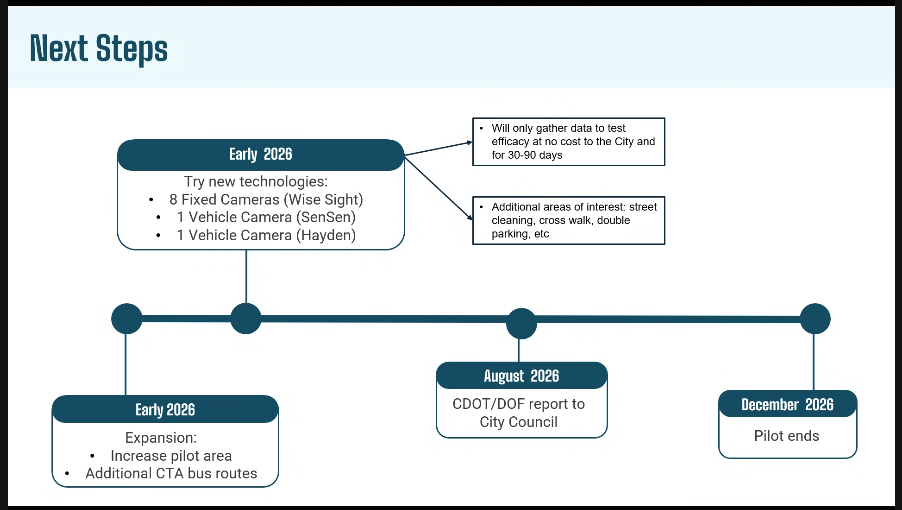
The council approved the pilot in 2023 under the Lori Lightfoot administration, with the late 2024 implementation due to procurement issues. At the end of the pilot period in December 2026, the City Council will have the choice of whether to renew or cancel the program based on its performance. From there, the bounds of enforcement and route configurations can be expanded and policy codified. Hopefully over the pilot period, the data will accumulate and nevertheless illustrate the importance of dedicated lanes and improvements due to enforcement.
Here’s hoping that the program will eventually expand citywide. Then it will become common knowledge that if you don’t want to get ticketed, bus stops, and bus and bike lanes, are not parking spots.

On November 12, SBC launched our 2026 fund drive to raise $50K through ad sales and donations. That will complete next year’s budget, at a time when it’s tough to find grant money. Big thanks to all the readers who have chipped in so far to help keep this site rolling all next year! Currently, we’re at $19,872 with $30,128 to go, ideally by the end of February.
If you value our livable streets reporting and advocacy, please consider making a tax-exempt gift here. If you can afford a contribution of $100 or more, think of it as a subscription. That will help keep the site paywall-free for people on tighter budgets, as well as decision-makers. Thanks for your support!
– John Greenfield, editor
Streetsblog has migrated to a new comment system. New commenters can register directly in the comments section of any article. Returning commenters: your previous comments and display name have been preserved, but you'll need to reclaim your account by clicking "Forgot your password?" on the sign-in form, entering your email, and following the verification link to set a new password — this is required because passwords could not be carried over during the migration. For questions, contact tips@streetsblog.org.