Inside CTA HQ, board discussed Revised Security Enhancement Plan. Outside, rallying bus drivers chanted “Respect us, protect us, pay us.”

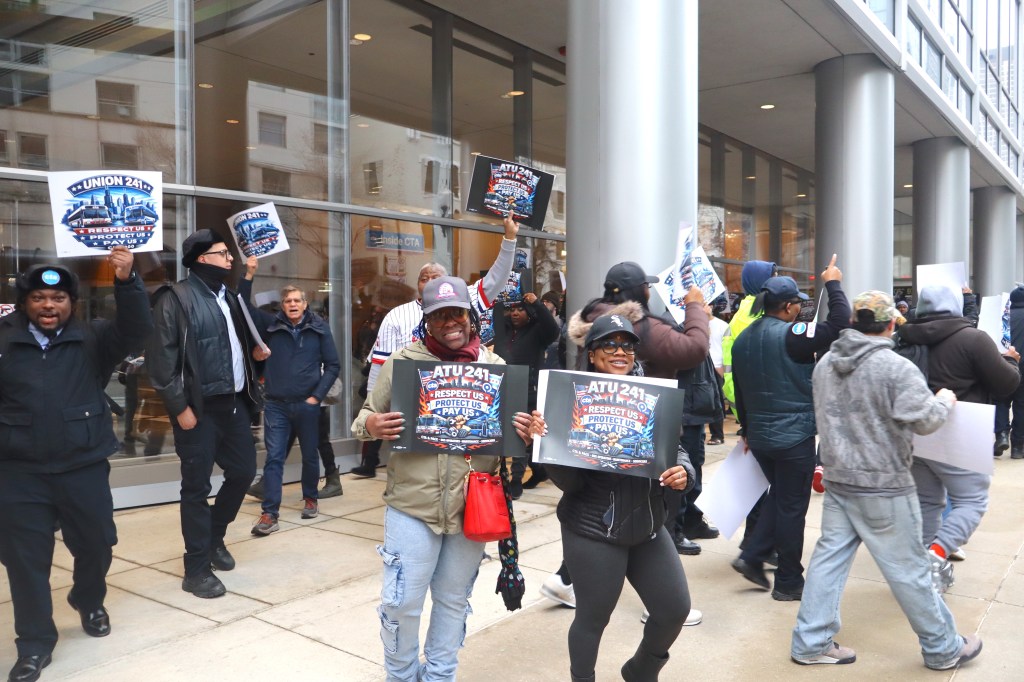

It was perhaps fitting that much of the March 11 meeting of the CTA’s board was held to the chanting and shouts from a rally taking place right outside.
Amalgamated Transit Union Local 241, which represents CTA bus drivers and mechanics (and drivers and mechanics at Pace’s West Division, but that isn’t relevant here), called for better pay and driver safety improvements. The rally came a day after the CTA submitted a new security plan to the Trump-controlled Federal Transit Administration, which had threatened to withhold $50 million in funding if it wasn’t satisfied with the proposal. CTA Acting President Nora Leerhsen told the board that many aspects of the plan were already in the works before the feds issued this ultimatum.
The board also approved the purchase of the property at 2718 W. St. Georges Ct. to make room to install elevators and widen platforms that would make California Blue Line L’ station ADA-compliant. they also honored transit employees who got at least two commendations from riders, and some of these honorees got as many as ten shout-outs.
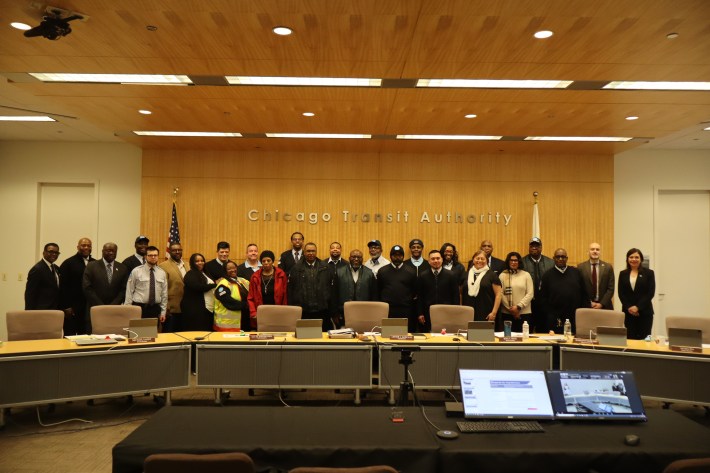
Five months after former director Michelle Lee left the board, her seat remains empty, and there is still no discussion about how to fill it. In September, the Chicagoland transit governing overhaul will take effect, and Mayor Brandon Johnson will need to decide who to appoint to the revamped board. There is nothing to prevent Johnson from filling the vacancy in the meantime but, so far, there are no signs he will take action.
Public safety
In early December, Trump’s FTA chief Marc Molinaro ordered the CTA to “update its Agency Safety Plan by the end of the month and send the plan to FTA within seven business days of approval by [the CTA board].” He also insisted that the transit agency develop a “security enhancement plan,” threatening to withhold funding if the demands weren’t met.
In late December, the CTA responded to the security enhancement plan demand by announcing a new “security surge plan,” including raising the average daily number of police in the transit system from 77 to 120. The FTA quickly dismissed that approach as “materially deficient.”
During its January meeting, the board signed off on an updated Agency Safety Plan.
The CTA submitted a “Revised Security Enhancement Plan” to the feds yesterday, in an effort to satisfy Molinaro’s “security enhancement plan demand.”
According to the CTA, the RSEP includes a “75 percent increase in monthly system policing hours, aggressive crime reduction targets, and expanded social service support.” Leerhsen said that those hours include a 34 percent increase in hours for Chicago Police Department’s transit unit, doubling the number of off-duty officers the CTA employs to provide security, and having Cook County Sheriff’s police ride the ‘L’ lines for 4,400 hours a month.
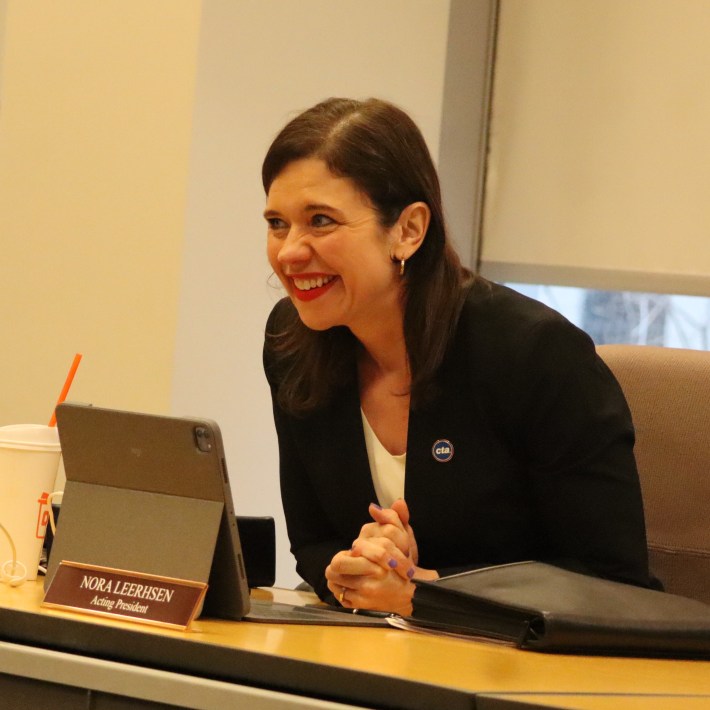
At the board meeting, Leerhsen said the plan includes new “missions” that CTA recently implemented. In January, the agency launched a Transit Rider Interaction Program, where teams of six to eight officers board trains and inspect railcars at “high-incident” stations. Leerhsen said that CPD did over 300 TRIP missions so far, and the crime at those stations dropped by 15 percent.
Leerhsen said that police also ride along on bus routes that have high numbers of crimes and other incidents, and officers are stationed at high-incident bus stops. She said they choose the routes and the stops based on both data and bus drivers’ input.
Leerhsen emphasized that the CTA is continuing “our long-standing multilayered approach” of working with social service providers to assist riders who are sheltering on the ‘L’ and/or experiencing other issues that affect their well-being. In addition to existing partnerships, the transit agency is launching a Crisis Intervention Specialists (something recommended in a guest-op by Noah Wright SBC ran on Monday) and Violence Interrupters pilot. Both deescalate volatile situations and try to connect at-risk indivuals with services. Violence Interrupters also work to, as the name implies, break the cycle of retaliation and prevent further violent incidents.
The plan also focuses on reducing fare evasions by installing higher barrier gates, another best practice Wright called for. It will also have CPD do more farecard inspection missions to prevent individuals from misusing other people’s free and reduced cards.
In addition, the agency will continue to use new data tools to study how many bus and ‘L’ passengers ride for free. Early during the meeting, CTA Chief Innovation Officer Molly Poppe said one benefit of this research is providing a better sense of actual ridership. It has already revealed that some bus routes have recovered more pre-pandemic ridership than the agency previously thought.
The responses
In his op-ed on how to improve public safety on the CTA, Wright cited Washington D.C.’s WMATA, which has recently enjoyed its lowest crime in 25 years. One District best practice he cited was combining more fare enforcement and higher gates with a new, simple-to-access reduced-fare program.
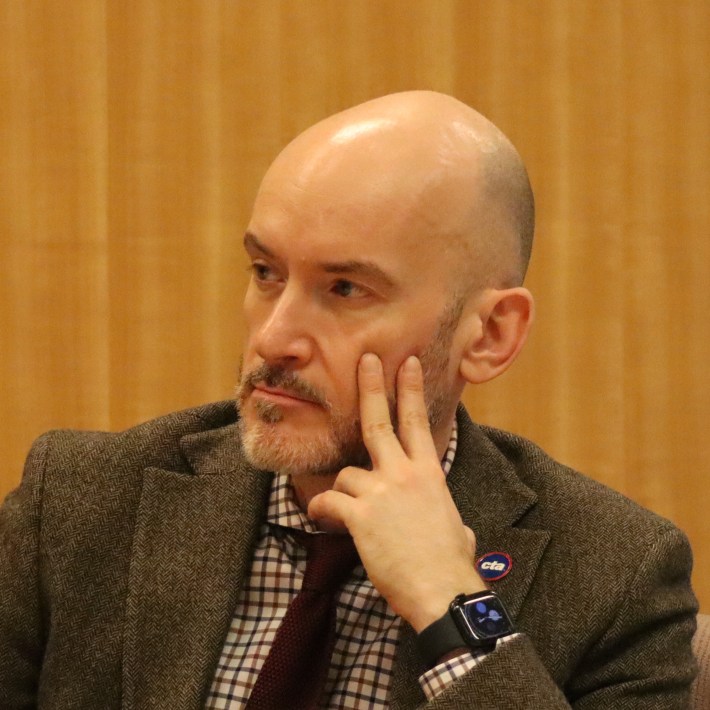
CTA board member Roberto Requejo asked Poppe about the reduced fare idea. She responded that Metra rolled out the Access Pilot Program for low-income riders who aren’t elderly or disabled as part of the February 2024 fare overhaul. She noted, CTA and Pace don’t currently have anything like that, but she would not be opposed to the concept.
In response to Leerhsen‘s report, CTA Board Chair Lester Barclay praised the agency’s collaboration with law enforcement entities. “The safety of our riders and employees is always a top priority,” he said.
Requejo said he believes one issue is that many ‘L’ stations and bus stops simply don’t look safe and welcoming at night, and that he would like to see the CTA address that beyond its rapid Refresh & Renew initiative. He also wondered when the crisis intervention and violence interruptor pilot will roll out. Poppe indicated that the goal is to launch it by July.
This led Requejo to ask if the CTA could work with social service providers to get something in place sooner as an interim measure. Poppe responded that she would look into that.
Board member Rosa Ortiz urged the CTA to work with violence reduction and social service organizations that already serve the high-incident locations the transit agency identified. “So, for some hotspots, it would be great to coordinate with those organizations, since they already do the work,” she said.
Rally in front of the CTA HQ
By the time Streetsblog arrived at the CTA headquarters a little after 10 a.m., the bus workers union rally was already well underway. Drivers, most of whom were wearing their uniforms, held up signs with one of the chants written on them: “Respect us, protect us, pay us.”
That slogan, along with the chant of “No more assault” could be audibly heard in the second floor Chicago Transit Board meeting room. At times, the chants were so loud that CTA Board Secretary Georgette Greenlee had to tell Leerhsen and some of the public commenters to speak louder. The chanting lasted most of the way through the meeting.
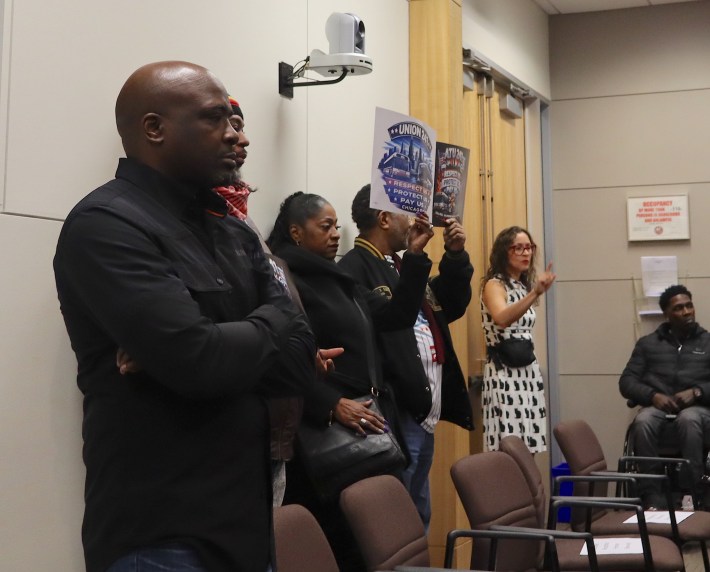
In the lead-up to the public comment period, several union members came into the room and stood by the wall, holding up signs. The transit board doesn’t allow signs and other agitprop inside the meeting room. When a CTA employee pointed that out and urged them to take their seats, they lowered their signs to chest level, but remained standing. No further action was taken against them.
When this reporter stepped outside while the CTA board was in a private executive session, the croud gathered around Local 241 President Keith Hill. He said that the order of the demands in “Respect us, protect us, pay us” was deliberate. “If you don’t respect us, as workers, as people, as human beings – [the CTA higher-ups] have no interest in protecting us,” he said.
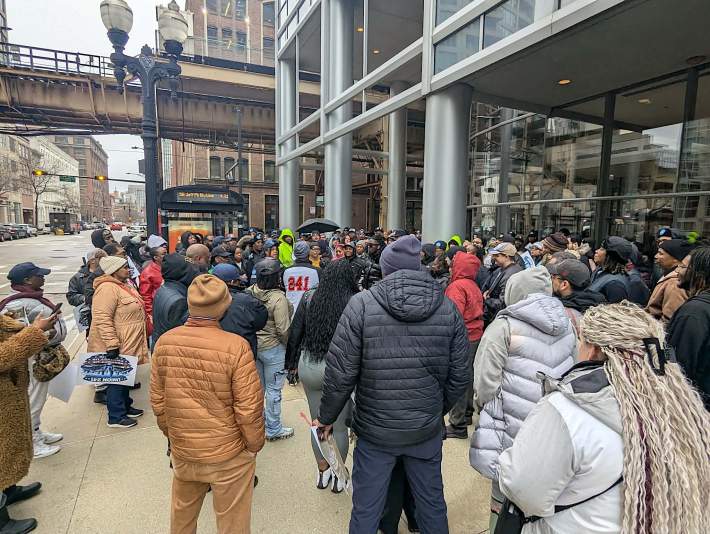
Hill gave a shoutout to the workers who were recognized before the executive session, saying that they were a great representation of Local 291. And he called the rally a “warning sign,” adding, “Next time, there better be 1,000 people.” He said he was well aware the rallying drivers were taking a day off and losing money.
But Hill argued that only continuing pressure, including including the possibility of a bus driver strike, would produce results. Therefore, “Next time, I need y’all to come.”

On November 12, SBC launched our 2026 fund drive to raise $50K through ad sales and donations. That will complete next year’s budget, at a time when it’s tough to find grant money. Big thanks to all the readers who have chipped in so far to help keep this site rolling all next year! Currently, we’re at $23,627 with $26,373 to go, ideally by the end of March.
If you value our livable streets reporting and advocacy, please consider making a tax-exempt gift here. If you can afford a contribution of $100 or more, think of that as a subscription. That will help keep the site paywall-free for people on tighter budgets, as well as decision-makers. Thanks for your support!
– John Greenfield, editor

Streetsblog has migrated to a new comment system. New commenters can register directly in the comments section of any article. Returning commenters: your previous comments and display name have been preserved, but you'll need to reclaim your account by clicking "Forgot your password?" on the sign-in form, entering your email, and following the verification link to set a new password — this is required because passwords could not be carried over during the migration. For questions, contact tips@streetsblog.org.