Riders deserve to feel safe on the CTA: Steps to a safer transit system
By Noah Wright
This piece also runs on the website A City That Works, a newsletter about public policy in the Chicago region. As a guest op-ed, it does not necessarily reflect Streetsblog Chicago staffers’ perspectives on this issue.
Here’s Streetsblog Chicago’s recent discussion of public safety issues on the CTA, including an interview with Active Transportation Alliance Campaign Organizer W. Robert Schultz III.
Noah Wright is a board member at the Chicago Growth Project. He has over a decade of experience in quantitative research, analytics, grantmaking, teaching, and management.
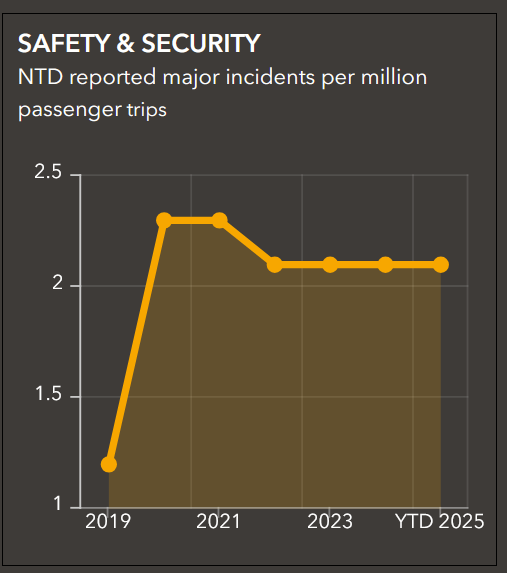
A series of horrific incidents have rocked the CTA over the last few months. Crime rates per passenger trip have remained stubbornly higher than their pre-pandemic level. And in a well-reported story earlier last week, the Sun-Times found that aggravated assaults and batteries on the system hit an all-time high last year.
The Federal Transit Administration has threatened to cut millions in CTA funding unless safety on public transit improves. The CTA has responded with a “Security Surge” to deploy more police and private security. At the same time, the recently-passed Northern Illinois Transportation Authority bill reorganizing regional transit requires the establishment of a transit ambassador program and enables the formation of a new transit police force.
In other words, fixes are on the way. But I’m afraid that some transit advocates, and the CTA itself, are missing an important parts of the problem.
Let’s get the obvious out of the way first. There will always be bad faith attacks from people who want you to believe that you take your life into your hands every time you set foot on a train. This could not be further from the truth: transit is still much safer than driving. You’re about 25 times more likely to die in a car than on a train.
But these bad faith attacks get something right which transit advocates overlook at their peril: the CTA feels unsafe. That matters. It’s hurting ridership. And we desperately need a better set of answers.
What makes the CTA feel unsafe
To understand better we first need to understand the psychological concept of “felt safety.”¹ A situation may be relatively safe (again, you’re very unlikely to die on the train), but it can still provoke a stress response. This is not a trivial distinction: Stress responses are physiological phenomena, and in extreme cases such as Post-Traumatic Stress Disorder, they lead to mental and physical health problems. Felt safety is not purely in one’s head, it is very real. Ask any regular transit rider.
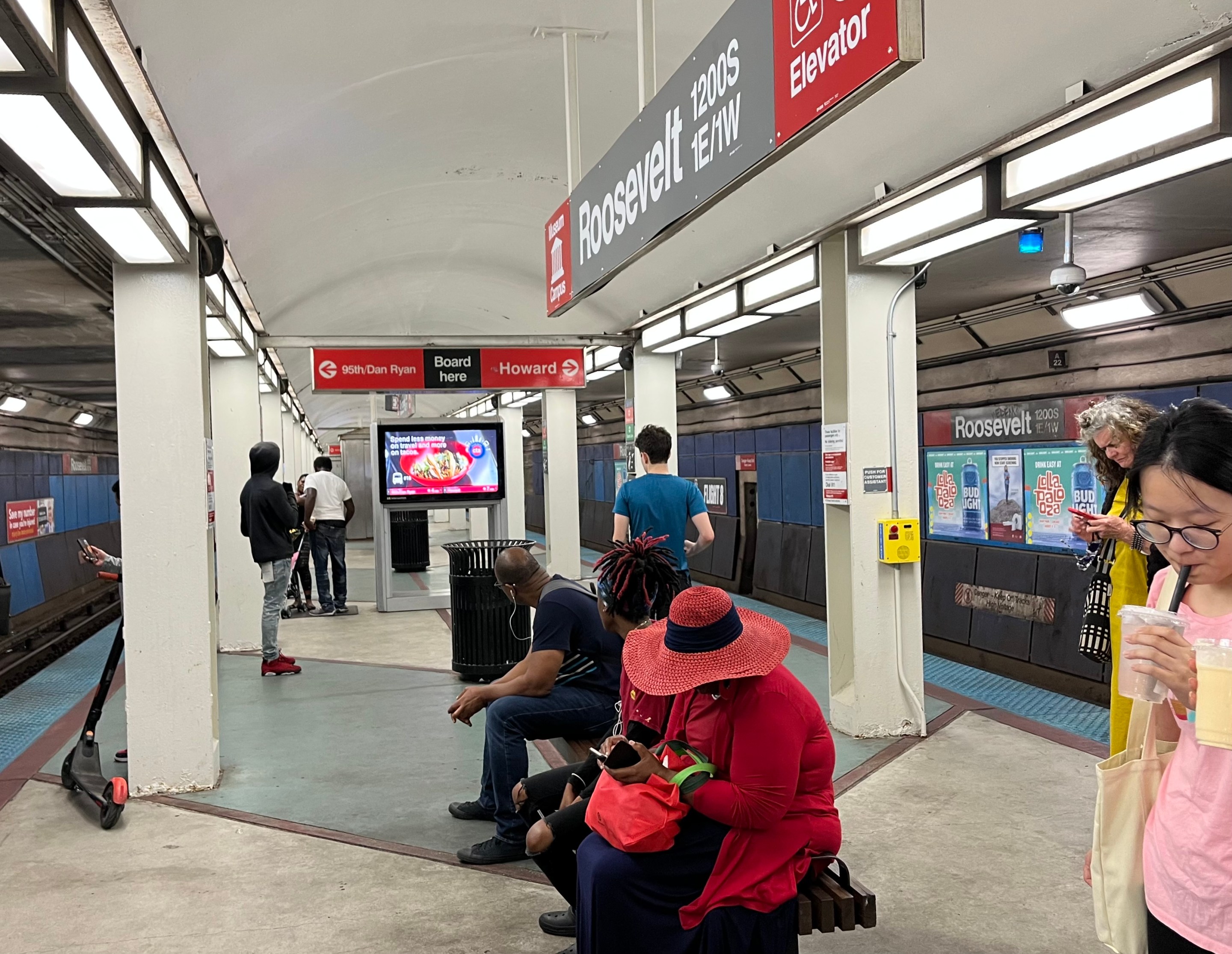
I ride the CTA regularly, but not nearly as much as my partner. She commutes two hours each weekday on the blue and red lines. At this point, she’s used to mentally ill individuals talking or shouting at nothing, men using the emergency doors to walk between train cars or hold up station departures, and cars reeking of tobacco, cannabis, or human waste.² Those are not bad days, those are the norm.
Here’s what the bad days look like: in 2025, she was spat on, flashed, and watched a man pull the emergency door release to exit a car directly onto the tracks. She’s witnessed multiple people smoking crack or meth, including during rush hour. In a particularly memorable incident, she watched a man wake up and start to vomit into a moat of sand surrounding him. CTA workers, unable to move him, had simply left him where he was and sprinkled sand around him to absorb a prior round of vomit.
These are legitimate reasons to feel unsafe. Although she was (thankfully) never physically harmed by any of these events, telling someone like her that “transit is safer than driving” feels like gaslighting. You might be less likely to die on the train than the highway, but what are the odds that someone you don’t know starts smoking crack in the front seat of your car?
Felt safety is a ridership issue
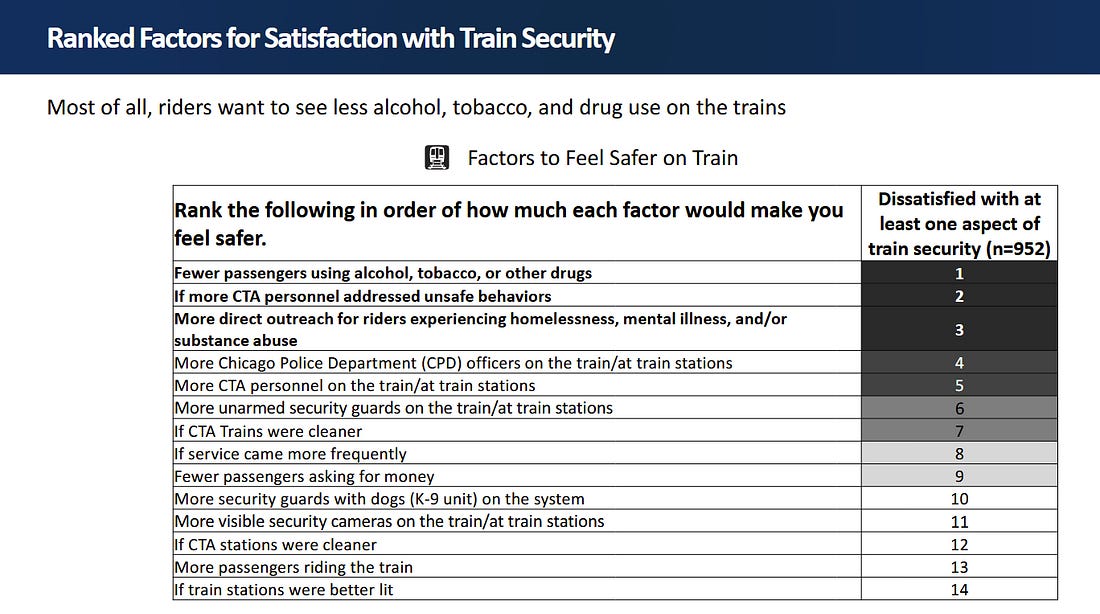
In the CTA’s most recent biannual survey, riders reported the factors that would make them feel safer on the train. The top three factors directly indicate that my partner’s experience of open drug use, unsafe behavior, and passengers in obvious distress is not an unusual one.
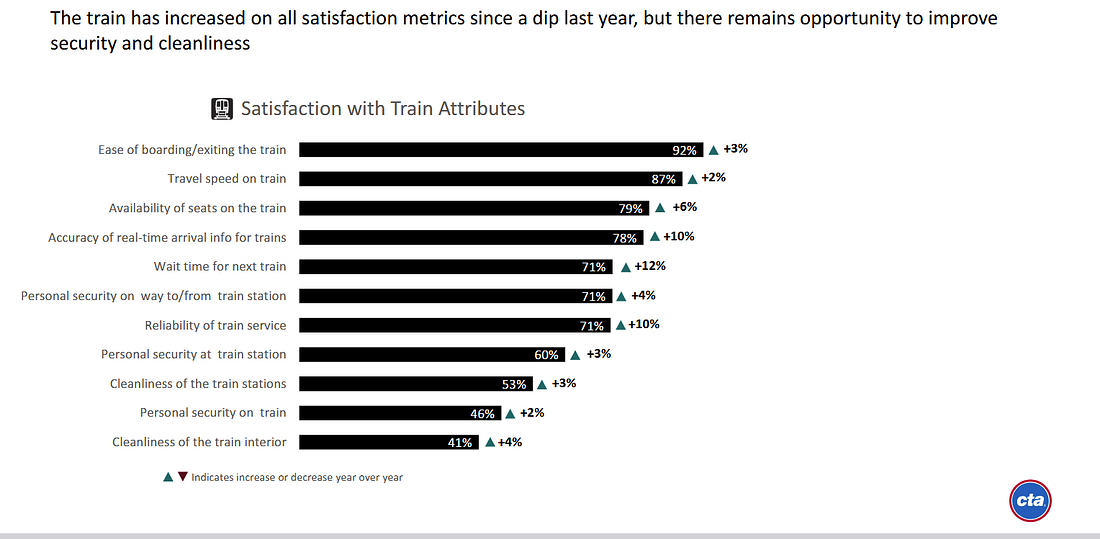
Riders consistently reported “personal security” as one of their lowest points of satisfaction with CTA trains:
People don’t use transit if they don’t feel safe using transit. A majority of riders in the 2025 Biannual Survey explicitly state that they take the train less now due to their dissatisfaction with train attributes:
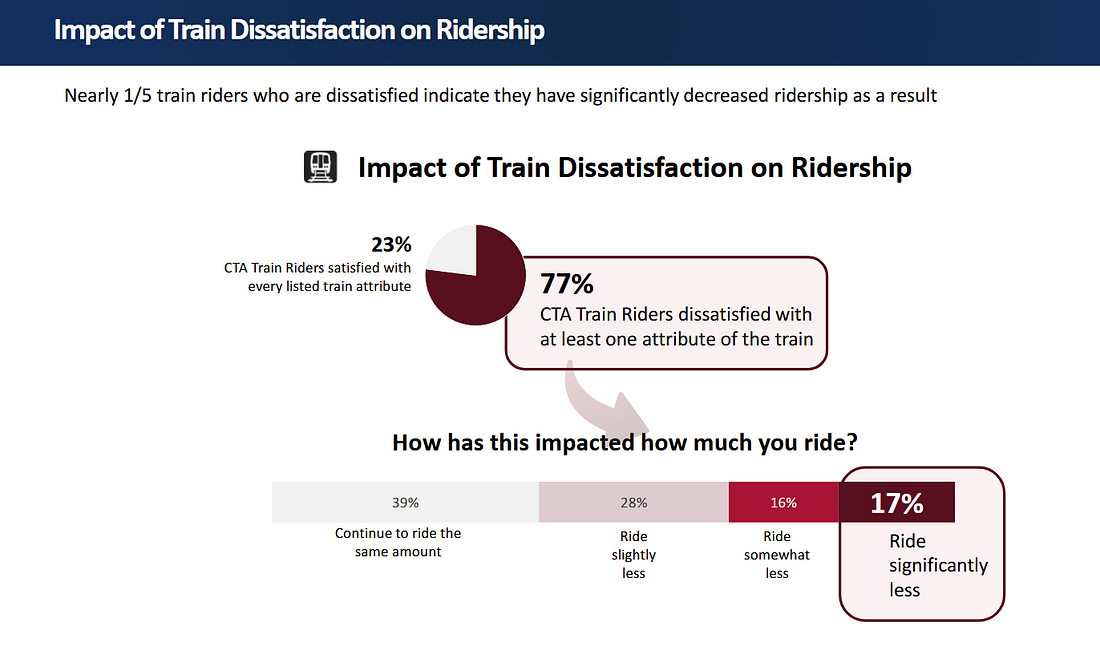
Note that that survey just counts the riders who are still trying to use the system – riders who have given up entirely aren’t counted in this data at all. The drop-off also corresponds to the fall in ridership post-COVID. In 2018, 61 percent of riders were satisfied with “personal security on train.” That number had fallen to just 46 percent in 2025.
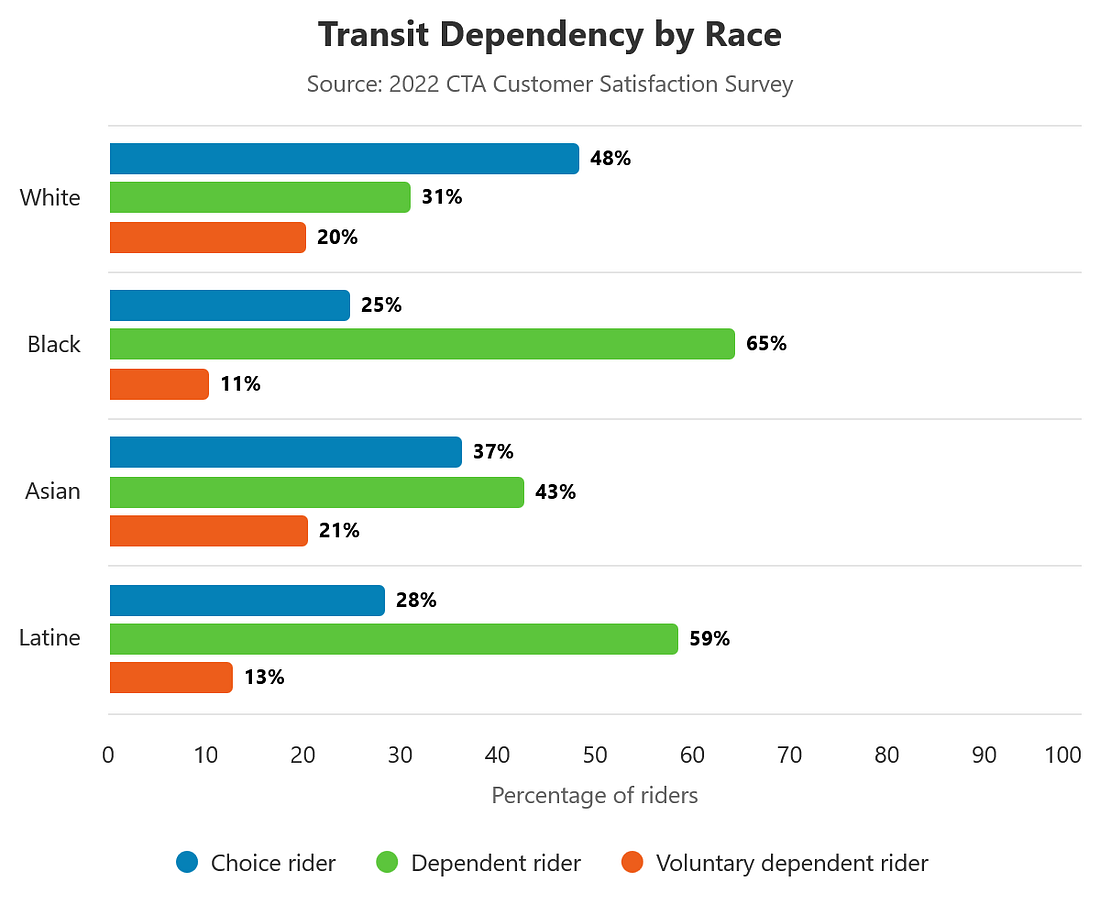
It’s also worth noting that Black and Latino riders suffer the most when safety is neglected. They’re less likely to have alternatives when transit becomes dangerous or unpleasant. A CTA focus group asked Black transit users from North Lawndale “what is the worst part of riding the bus or train?” Respondents explicitly called out smells, smokers, loud or mentally unstable people, cleanliness, and felt safety.³

Tax-deductible donations from readers help Streetsblog Chicago continue to advocate for better walk/bike/transit in the region. Thanks for your support!
How to improve felt safety
But as for how we go about making people feel safer, only one solution seems to have been proposed so far. The security surge, the ambassador program, and the transit police force are all variations of “more cops and staff”.
“More cops and staff” is not nothing. CTA riders reported “more police” as the #4 biggest factor that would make them feel safer, followed by “more CTA personnel” and “more unarmed security” at #5 and #6. But “more cops and staff” alone will not make people feel truly safe unless they actually address open drug use, dangerous behavior, and obvious, visible distress. And if they do so in overly aggressive or escalatory ways, their efforts risk making some riders feel less safe. We don’t just need staff – we need effective enforcement.
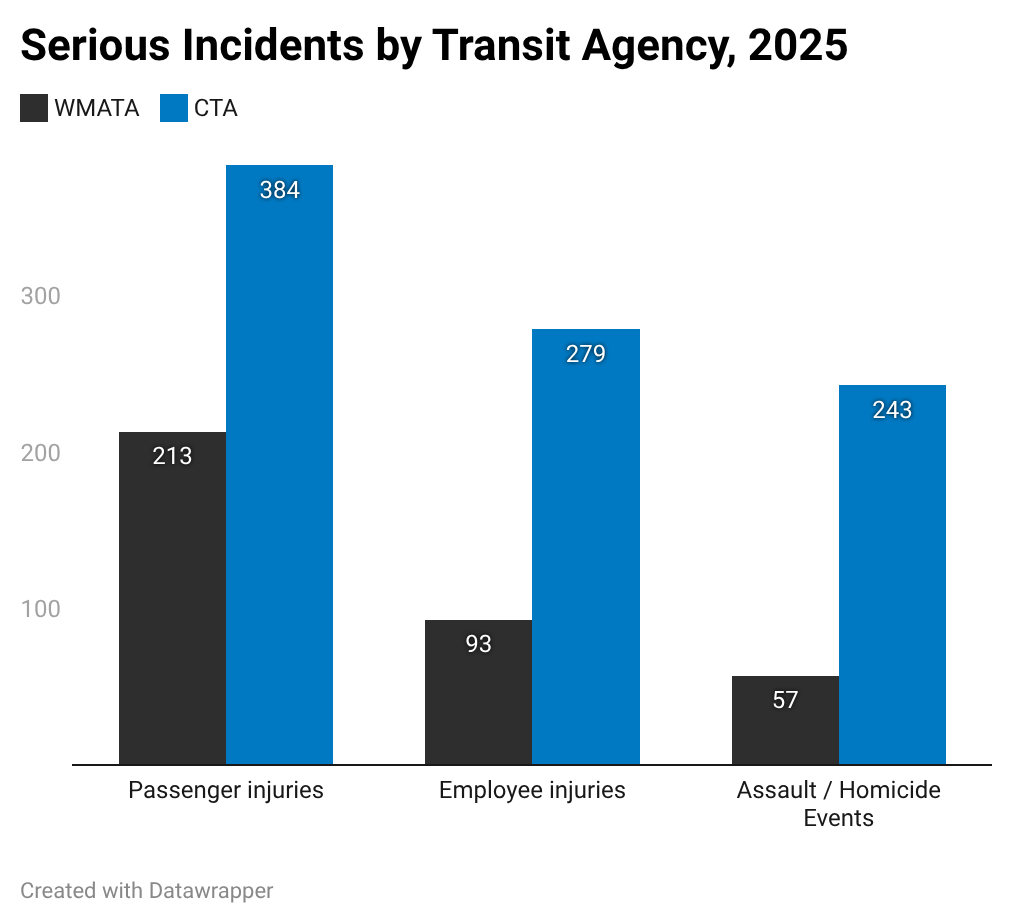
So what does effective enforcement look like? I take my cues from the Washington D.C. Metropolitan Area Transit Authority, a system of similar size and scope which just reported its lowest crime rates in 25 years. Because WMATA has similar ridership levels to the CTA, we can compare incidents directly, and it’s not even close:
Source: Safety & Security Major Event Time Series | FTA
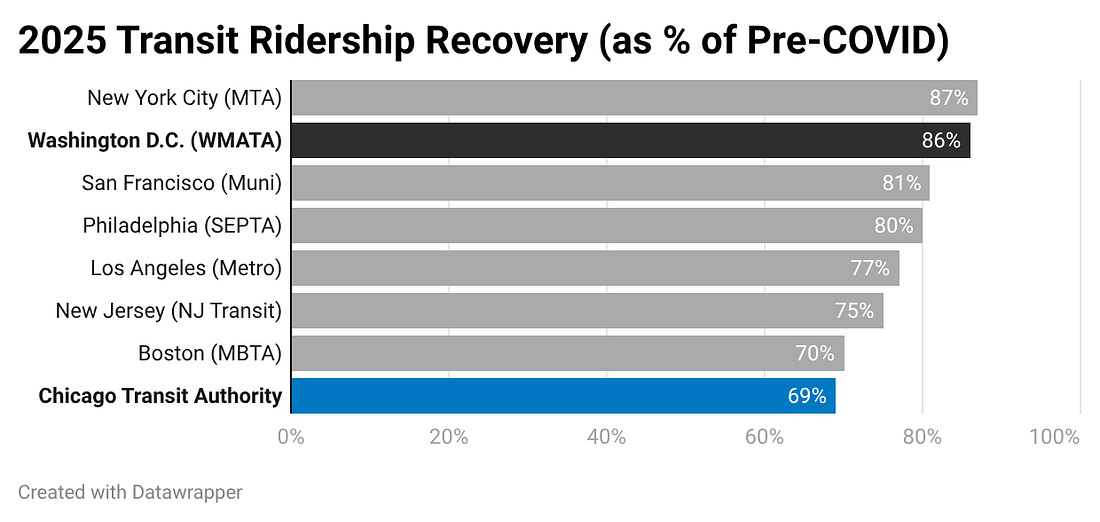
As I made clear above, crime is not the same as felt safety. However, felt safety is not directly measured in official statistics, and I’m willing to bet that a system that does a better job preventing assault, probably also does a better job preventing other dangerous behavior. Furthermore, WMATA’s ridership recovery is among the highest for transit agencies of comparable size to the CTA:
A summary of WMATA’s safety planning over the years could be its own separate article,⁴ so I’m going to focus on key enforcement strategies WMATA has implemented that the CTA currently lacks:
1. Set clear expectations, consequences, and follow-up
Reporting destructive behavior on the CTA almost never leads to any kind of action being taken. As ACTW’s Richard Day (also a Streetsblog contributor) has noted previously, the CTA’s reporting reporting systems are woefully behind peer systems. There seems to be virtually no response system for smoking, abusing emergency equipment, making excessive noise, or harassing fellow passengers. Whatever transit police, ambassadors, or other frontline staff come along with the new legislation, none of them will matter if this does not change.
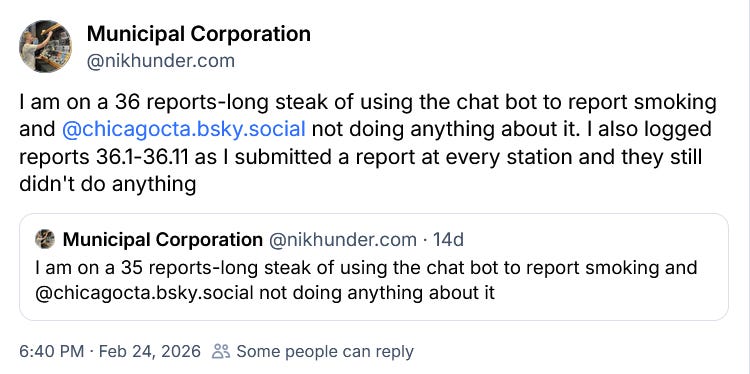
A common experience reporting smoking on the CTA
When bad behavior is identified, via a reporting app or otherwise, riders need to understand how the system will respond. What are station attendants supposed to do when someone skips a turnstile? What are K9 units supposed to do when someone smokes on a car? What are the forthcoming ambassadors supposed to do when someone plays loud, amplified music?
CTA staff, police officers, and everyone in between deserves clear instructions about what they’re expected to do and when. This should include both de-escalation training, to address problematic behavior before it turns into dangerous behavior, as well as appropriate escalation patterns. If a station attendant politely calls out a passenger for skipping a fare and that passenger spits on or threatens the attendant, that attendant needs to know that they can quickly call in support from a private security guard or police officer.
These expectations need to include swift and certain consequences. The “consequences” in question do not (and in most cases, should not) have to mean jail time, or even require police involvement. The likelihood of getting caught deters crime considerably more than severity of punishment. In most cases, kicking riders out of the system, writing tickets, or issuing a temporary ridership ban will suffice. WMATA, for example, does both: fare evaders get charged a $50-$100 fee and more serious offenses can see ridership bans ranging from 45 days to a year.⁵
Finally, riders themselves need some form of follow-up about their complaints. WMATA customers are notified of the outcome of their complaint and something similar for the CTA would go a long ways toward increasing trust in the system. Even getting told “we were unable to act on this, because of X reason” would feel better than the status quo, where complaints seem to disappear into a bottomless pit.
2. Stop fare evasion with better faregates
Stopping fare evasion saves money for transit systems, but it also makes them safer. WMATA CEO Randy Clarke attributes reduction in overall D.C. transit crime to enforcement of fare evasion, noting that “not everyone who fare-evades commits crimes, but almost universally, everyone who commits serious crimes fare-evades.” Deterring fare evasion directly keeps bad actors out of the system. And when offenders are caught, it provides an opportunity to check them for outstanding warrants or weapons.⁶
WMATA ramped up enforcement actions to catch fare dodgers. It also rolled out taller faregates that made it much harder to beat a fare. And because the goal is to punish rulebreakers, rather than low-income riders, WMATA also paired these improvements with a new, easily-accessed reduced-fare program.
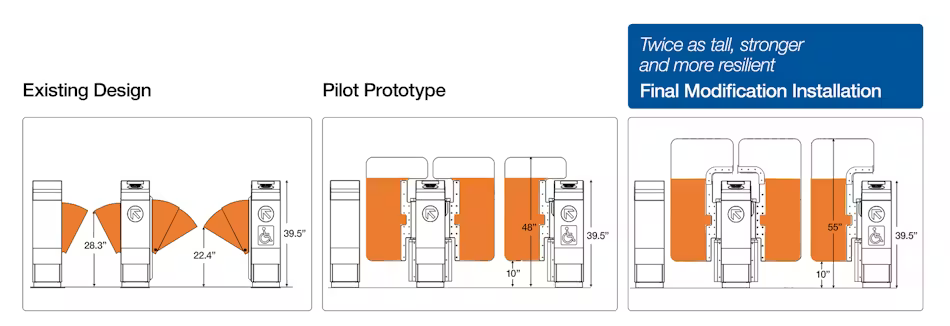
As a result, WMATA fare evasion went down by 82 percent, which more than covered the cost of the new gates. Crime declined and ridership increased. WMATA isn’t the only system that’s seen these benefits. When Bay Area Rapid Transit rolled out new faregates, the system reported millions of dollars in additional revenue, and also saw a dramatic decline in vandalism. That meant a massive decline in required maintenance.
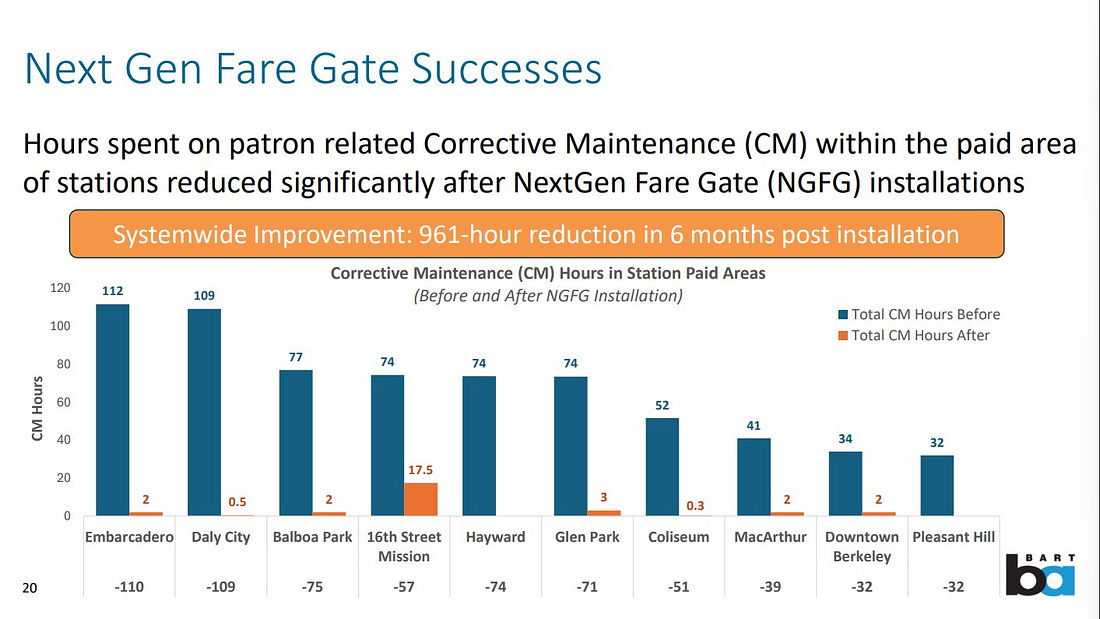
The CTA doesn’t even appear to have studied this problem.⁷ And while the agency has made improvements to some of the system’s ADA accessible gates, the turnstiles used through most of the system are easily stepped over or pushed past. Secure faregates paired with credible enforcement is a no-brainer. It’s also one of the only transit policies that pays for itself.
3. Employ specialists to intervene with riders in active crisis or distress
It is not the job of a transit agency to manage behavioral health. People engaging in extreme behaviors such as screaming, self-harm, exposing themselves, and expelling bodily fluids need to be removed from trains and buses. And it is neither realistic nor fair to expect train drivers, gate attendants, ambassadors, or even police to serve as social workers and paramedics at the same time.
WMATA addressed this problem by creating a new category of employee, a “crisis intervention specialist“, to serve as first responders for these types of incidents. Crisis intervention specialists are trained in deescalation and working with mental health issues (you can see the job requirements here), emphasizing a “gentle approach” that complements the presence of police, who accompany specialists for safety.
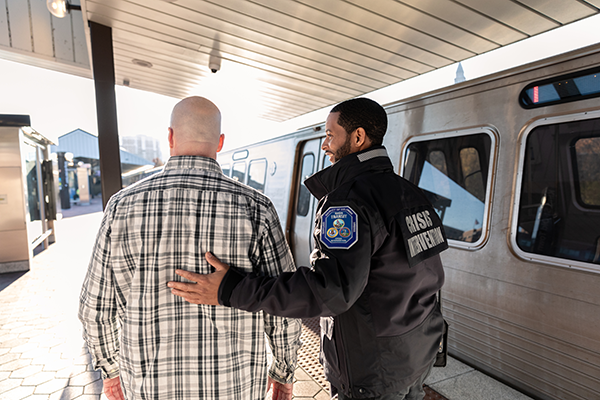
Other transit agencies, such as the MTA of New York City, have developed their own crisis intervention programs. As I write this, the CTA is soliciting and reviewing proposals for something similar. But whatever form the program takes, we should not settle for another “let’s make the smoke less harmful” solution. This has to be coupled with enforcement, for the safety of the specialists and the riders themselves. People in crisis need to be taken off of trains and buses and to the help they need.
Towards a better CTA experience
We can’t get to felt safety, much less comfort and ease, without effective enforcement. Acting CTA President Nora Leerhsen has a lot going for her over her predecessor, but her seeming inability to discuss the issue of enforcement has me concerned. Mayor Brandon Johnson notably refused to comment for a recent Sun-Times article on how he’d like security on transit to change. Saturating the system with officers, security guards, and ambassadors without clear enforcement strategy is a recipe for more personnel sitting on their hands or looking the other way rather than engaging with problems or rulebreakers.
WMATA CEO Randy Clarke emphasizes that the success of his safety plan lay in its multifaceted nature. Ultimately, it took WMATA years of comprehensive safety planning and implementation to recover so much of their ridership, and the same will be the case for us. So let’s not waste time avoiding solutions that have been proven to work just because they are difficult.
We have plenty of cause for optimism: crime is down nationwide, we have a billion dollars in new funding, and a major systemwide reform plan is underway. Now, we need to deliver a system that is, and feels safe to ride.
1 It is related to but not quite the same as perceived safety. One can perceive that a situation is unsafe but not feel it – think of someone with extensive training responding cooly to a bad situation, i.e. a fighter jet pilot seeing evidence of a mechanical problem in their aircraft and methodically addressing it. The important distinction here is that a lack of felt safety triggers a physiological stress response.
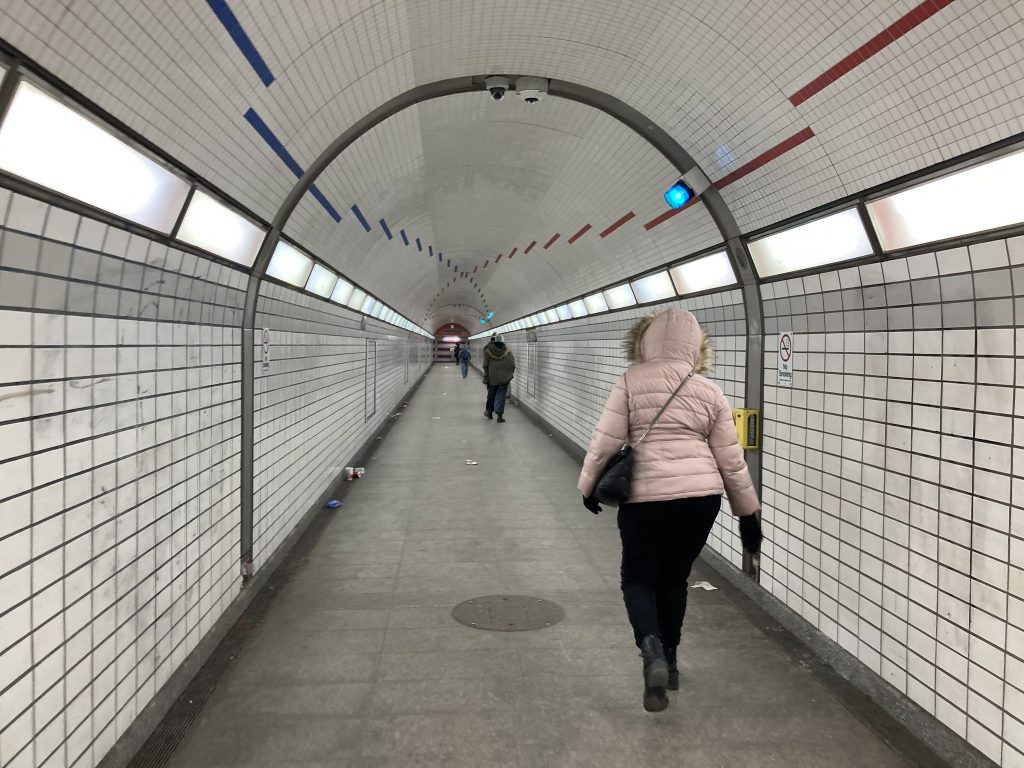
2 She has nicknamed tunnel transfer tunnel between the Jackson red and blue line stops “the piss tunnel” for its ever-present smell.
3 Literally – “Sometimes I don’t feel safe at night” reported an anonymous rider of the 82 bus.
4 Though if you’re interested, there’s a very user-friendly overview located here: https://www.wmata.com/rider-guide/safety/
5 It’s also worth noting what happens when agencies *stop* enforcing the rules. When New York stopped kicking people out of subway stations in February due to the snowstorm, transit crime jumped 18.5%. That doesn’t mean New York should’ve kicked people out into snowbanks, but it underscores the very strong link we know exists between rule enforcement and safety.
6 When New York started cracking down on fare evasion in the early 1990s, one in six people caught had an active warrant out for their arrest.
7 Notably, the MTA issues quarterly data on fare evasion for both buses and trains.
On November 12, SBC launched our 2026 fund drive to raise $50K through ad sales and donations. That will complete next year’s budget, at a time when it’s tough to find grant money. Big thanks to all the readers who have chipped in so far to help keep this site rolling all next year! Currently, we’re at $23,352 with $26,648 to go, ideally by the end of March.
If you value our livable streets reporting and advocacy, please consider making a tax-exempt gift here. If you can afford a contribution of $100 or more, think of that as a subscription. That will help keep the site paywall-free for people on tighter budgets, as well as decision-makers. Thanks for your support!
– John Greenfield, editor
Streetsblog has migrated to a new comment system. New commenters can register directly in the comments section of any article. Returning commenters: your previous comments and display name have been preserved, but you'll need to reclaim your account by clicking "Forgot your password?" on the sign-in form, entering your email, and following the verification link to set a new password — this is required because passwords could not be carried over during the migration. For questions, contact tips@streetsblog.org.