A conversation with Active Trans’ W. Robert Schultz III: We must improve public safety on the CTA. What’s the best way to accomplish that?

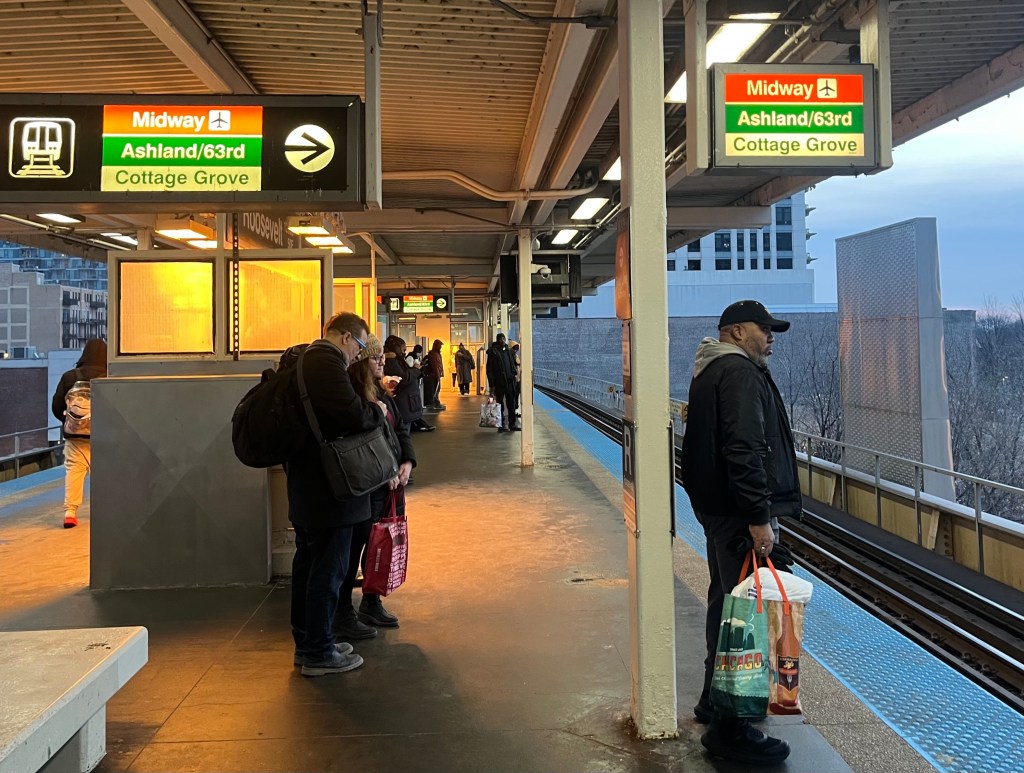
Interview by James Porter, introduction by John Greenfield
Most CTA riders would likely agree that, if we want to get ridership back to pre-pandemic levels, more needs to be done to prevent serious crime in the system. Of course, there are different opinions on the right way to achieve that goal.
Here are some recent headlines that might make potential Chicago transit customers think twice before choosing this affordable, efficient, and environmentally-friendly mode, especially at night.
• 9/2/24: Four sleeping people, 28, 60, 64, and 52 were randomly, fatally shot on the Blue Line near Forest Park Station.
• 6/25/25: A man, 42, was fatally stabbed, allegedly after refusing to share a cigarette, on the Blue Line traveling from O’Hare, near Rosemont Station.
• 11/17/25: A woman, 26, was critically injured after she was randomly doused with gasoline and set on fire on the Blue Line near Clark/Lake Station.
• 12/1/25: A man, 59, was pushed onto the ‘L’ tracks and seriously injured, allegedly after declining to give someone a dollar, at the Forest Park Branch’s Harlem Station.
• 12/16/25: A man, 62, was beaten and critically injured, reportedly as he was giving someone money, on a bus near the Forest Park Branch’s Cicero Station.
• 12/23/25: A man, 44, was fatally shot, and a man, 23, was shot and injured, following an altercation with another person on the Pink Line near Washington Station.
The following stabbing cases all happened this month.
• 1/2/26: A man, 39, was stabbed and critically injured, again at or near the Forest Park Branch’s Cicero Station.
• 1/5/26: A woman, 37, and a man, 24, were stabbed and injured after a reported altercation with another person at the Red Line’s 69th Street Station.
• 1/10/26: A man, 37, sleeping on the Blue Line, was randomly, fatally stabbed by an attacker, again at Clark/Lake Station, who allegedly took cell phone video of the assault.
• 1/11/26: A man, 34, was stabbed and seriously injured after a reported altercation, again at the Red Line’s 69th Street Station.
Obviously, these incidents raise valid concerns about CTA safety. But on the afternoon of last New Years Eve, Ald. Jim Gardiner (45th) posted on Facebook that residents should “avoid using CTA public transportation after sundown until noticeable improvements are made.” That’s absurd advice for most transit commuters, since the sun currently sets before 5 p.m.
In an article about Gardiner’s statement last Friday, Block Club Chicago reported that the Chicago Police Department recently confirmed that reported crimes on CTA property dropped from 6,387 in 2019, to 4,413 in 2025.
That may sound encouraging. But the lower number of violations last year reflected the fact that CTA ridership was still only about 60 percent of what it was in 2019, before COVID-19 struck.
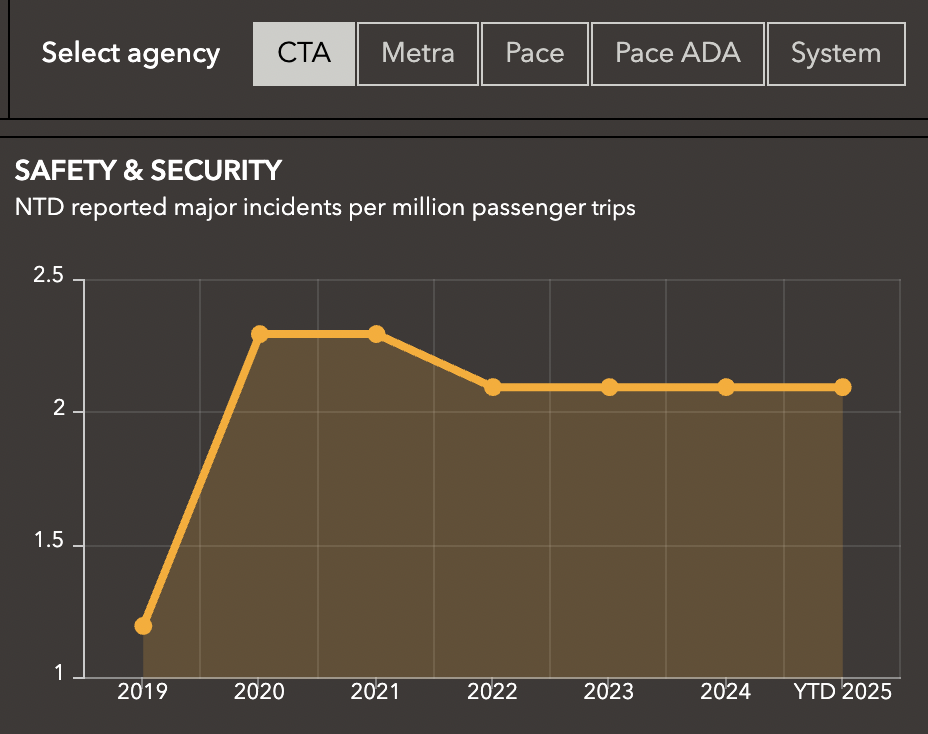
What’s troubling is that the rate of crime on the CTA is still currently much worse than it was before the pandemic. According to the Regional Transportation Authority, the number of National Transit Database-reported major incidents per million CTA passenger trips skyrocketed after COVID hit and ridership plummeted. That figure has fallen somewhat since then, as customers have returned to the system, but the crime rate is still roughly twice as high as it was in 2019.
As Streetsblog discussed yesterday, the Trump administration has taken advantage of the CTA’s recent disturbing violence cases to once again threaten a “blue” city with funding cuts. Last month, the Federal Transit Administration announced that if the Chicago agency did non submit a satisfactory plan to reduce crime, $50 million in federal grant money would be slashed.
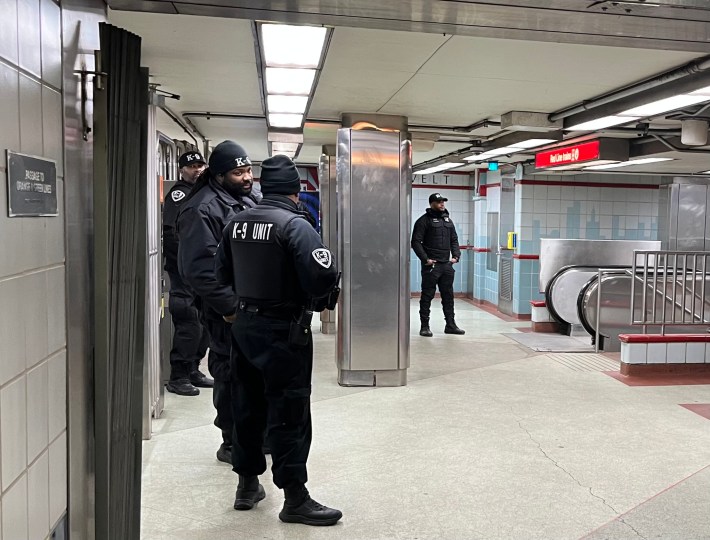
So far, the CTA has responded by announcing a new “security surge plan,” which includes boosting the average daily number of police officers in the system from 77 to 120. The FTA immediately dismissed that approach as “materially deficient.”
While many Chicagoans support deploying more officers in the transit system, others are concerned about the possibility of over-policing. Notably, in February 2020, then-mayor Lori Lightfoot responded to a transit crime wave with plans to have 50 more CPD officers patrol the system. Days later police tried to detain Ariel Roman, 33, for illegally walking between Red Line cars, and ultimately shot up the escalator of crowded Grand Station as he fled, critically wounding him.
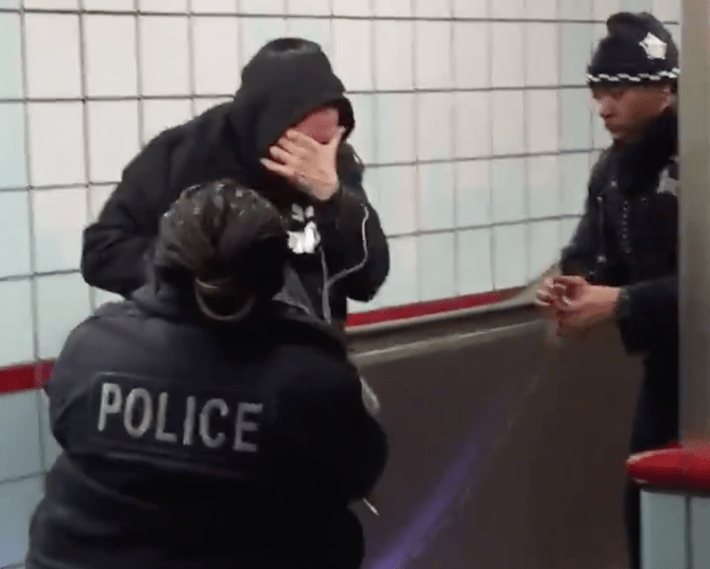
The Illinois transit reform/funding bill that passed in October includes mandates for improving public safety on public transportation. Here’s a summary of what’s in the legislation, written by Streetsblog contributing writer Austin Busch.
- Allows [Northern Illinois Transit Authority, the new agency to oversee CTA, Metra, and Pace] to establish a traffic law enforcement program in jurisdictions without adequate local enforcement, enabling violations for stopping in bus lanes or at bus stops.
- Requires a real-time function to report safety concerns through a mobile app within 6 months, similar to Metra’s COPS app.
- Establishes a new cross-jurisdictional law enforcement task force, an Office for Transit Safety and Experience, and a Chief Executive Transit Safety Officer. Within one year, the new NITA board will vote on recommendations to implement sworn law enforcement on transit.
- Enables reimbursement for emergency responders called to CTA stations in Rosemont, Oak Park, Forest Park, and River Forest.
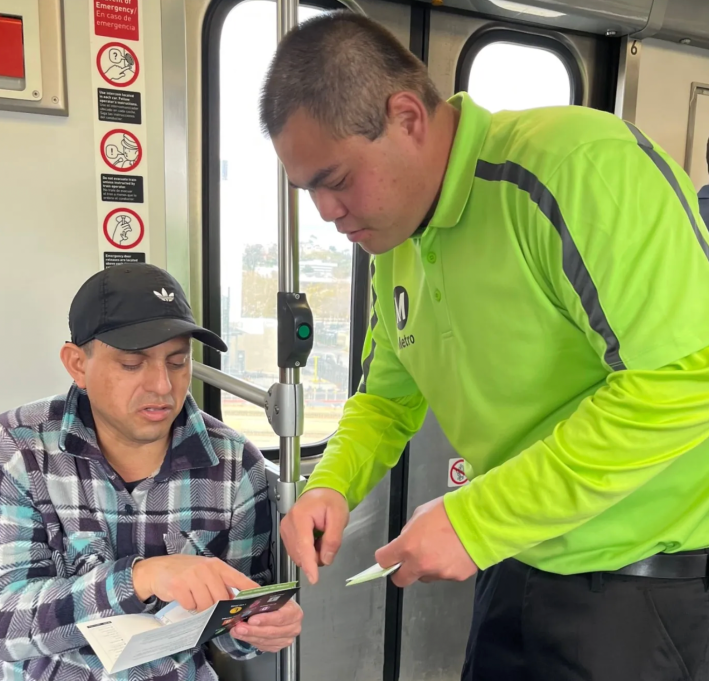
- Establishes a transit ambassador program (a strategy that has shown promise in systems like LA Metro and BART), made up of trained, unarmed personnel on buses, bus stops, trains, and stations. This will include CTA station attendants and customer-facing staff on Metra, who will be re-trained for new duties.
I recently asked SBC contributor James Porter to interview Active Transportation Alliance Campaign Organizer W. Robert Schultz III about his views on the best strategies to address the CTA’s public safety challenges. Schultz has previously been outspoken about the need for any transit crime prevention and enforcement efforts to be carried out equitably.
The interview has been edited for clarity and brevity.
– John Greenfield, editor
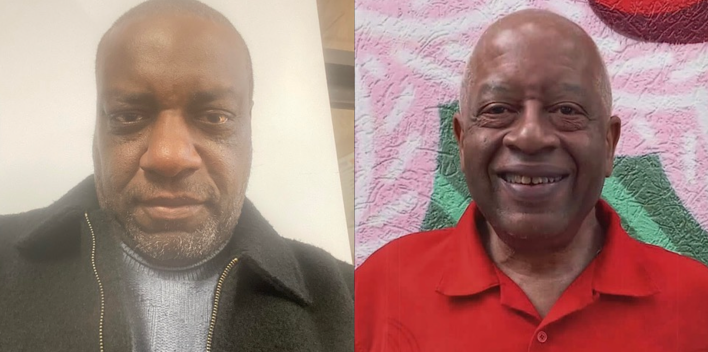
James Porter: The new state transit bill includes requirements for improving safety. How effective do you think these measures will be?
W. Robert Schultz III: There are two things that are in there with regard to safety. One is a calling for a task force of law enforcement, which I learned about during the whole legislative process, interacting with the various legislators and our lobbyists. “Task force” is practically a term of art within the law enforcement. We might think of a certain thing but it means coming together to try and cross different agencies to achieve some solutions nad intervene. [Transit bill co-sponsor] Rep. Eva-Dina Delgado referenced a task force, which was effective in addressing carjackings, and so based on that explanation and the fact that there’s a time limit, I think that’s perhaps a good thing. There is a role for law enforcement. I think the issue is: What is that role? And what are they going to do? And how are they going to execute it?
JP: It’s almost like famous last words. We say we want [law enforcement], but our definition and their definition might be different.
RS: The other thing that’s in the legislation is transit ambassadors. Both are a response to the issues that everybody either sees or perceives. Everybody talks about safety, but from my perspective, there’s not an agreement on what that means. Safety may mean one thing for one group of people, and something else for another group of people.
JP: A lot of times what they consider safe may be unnecessary profiling.
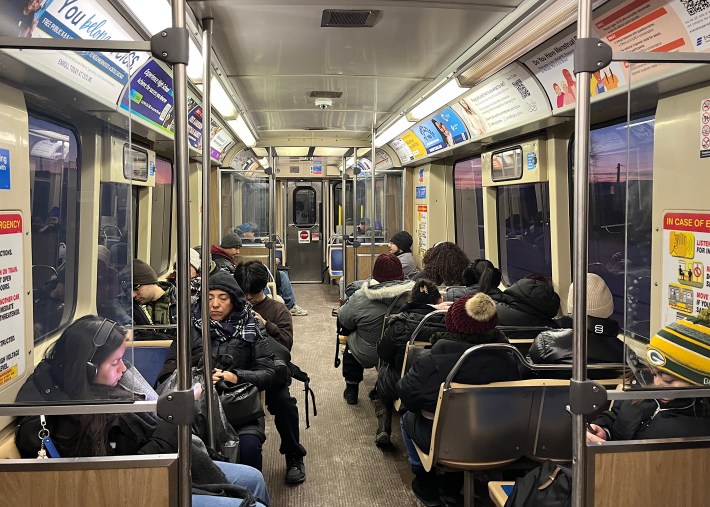
RS: Safety in my mind, as a transit advocate, involves the moment you step out of your house, whether you can get down your block safely. Once you arrive at a bus stop or a train station, do you feel safe walking to where you’re going to. And then, do you feel safe waiting? Do you feel safe boarding that mode of transportation?
The other thing that’s out there is that we’re really poor judges of risk, of safety. People perceive different things. I always cite the example of a friend of my mother, rest in peace. She was visiting from Michigan and we were at the plaza by the old Water Tower. She felt uncomfortable, and that’s one of the most busiest places in town! [Laughs.] That’s the perception thing. Some people are very uncomfortable in crowds. There was nothing unusual about that situation. It could be the open space, the number of people, so we’ve got to acknowledge that safety means different things to different people. Not everybody’s going to have that feeling of safety at all times in all situations. We can’t achieve that. The best we can do is try to intervene in the best way possible.
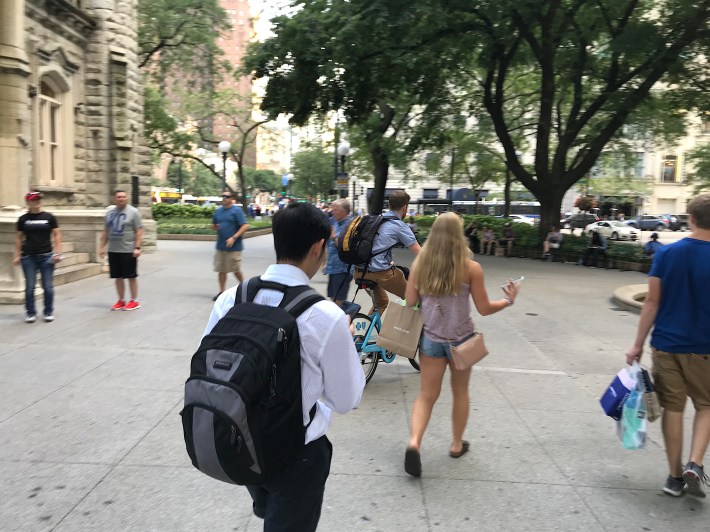
For me, as an advocate, what I see in the street is what are the physical things we can do to make people safe. I have a friend who’s uncomfortable even walking across the street at certain intersections because he’s partly disabled so he walks slower. There are other people like that.
The other thing that I try to illustrate is the condition of stations. I live [in Belmont Cragin] pretty much an equal distance between choosing to go to the Loop on the Green Line or going on the Blue Line. I’m familiar with both stations. The Cicero Green Line station always sort of gives me the willies because it’s not well taken care of. There’s rust, there is a liquor store across the street that’s actually open until five in the morning. The station is elevated, so that any customer assistant is upstairs. No one’s downstairs, so you sort of feel isolated.
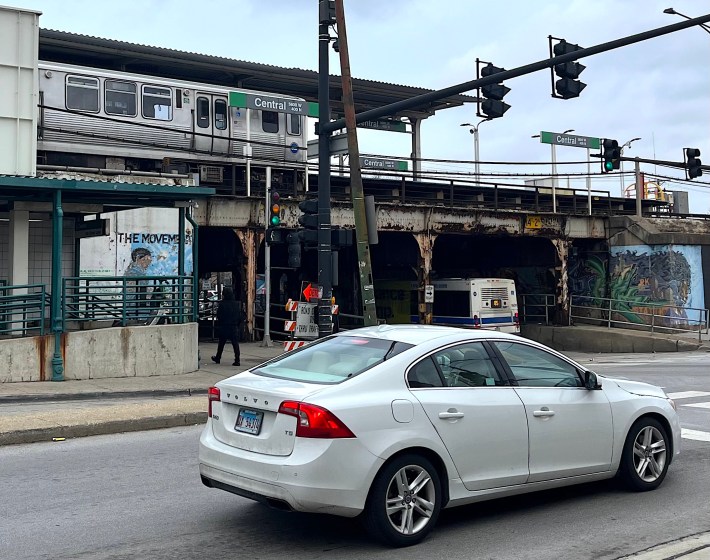
Whereas, with the Central Station on the Green Line, and the Pulaski Station, the community sort of hangs out. There’s a lot of folderol, but you feel safer because people are out there. But there are some things that happen. One time I was at the Central station on the Green Line and a driver pulled up to the stop light – there’s a bus stop there with a shelter – and a gun fell out of the car. I’m aware that not every neighborhood is safe. I’ve lived in Chicago and a lot of other cities, high-income areas, impoverished areas, and that’s the first time I’ve ever seen something like that happen.
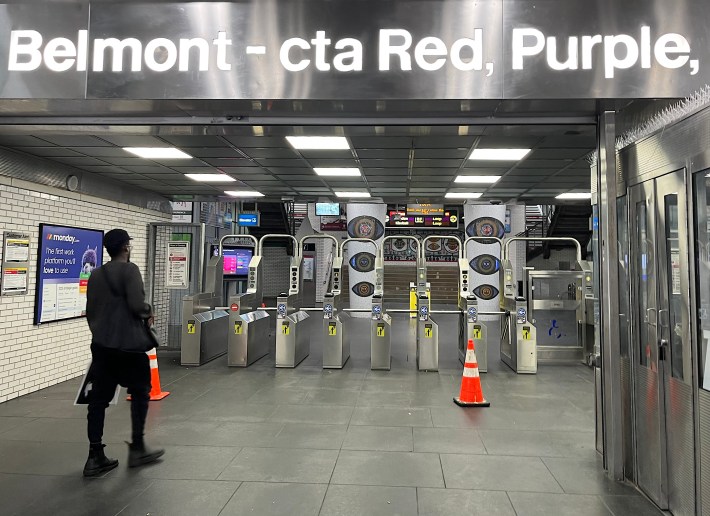
The other thing is, we have different kinds of crime occurring. We have poverty crimes, we have assaults, we have sexual battery. All of these need to be addressed in different ways. Different things are happening in different stations at different times. People feel comfortable standing at the Belmont Red Line Station at three in the morning because there’s still a lot of activity going on, and its pretty well-lit. The buses are still coming, the trains are still coming, and there’s a lot of activity.
We have instances of young people doing crazy things and we react different ways to those people. I’m thinking of a couple of instances where you see a group of young Black men sort of misbehaving or testing the social boundaries. We may think they’re gangbangers: “We really need to bring in some cops and crush ’em really hard.”
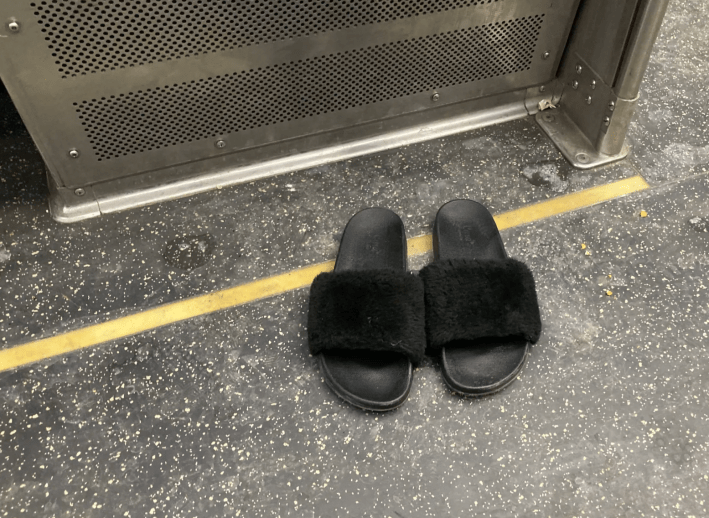
Whereas I’ve had times where I’ve been on that train – this one time on the Green Line, I don’t know if it was the holidays or whatever, but it was a group of young white men of equivalent age. They were carrying on and one puked on my shoe and I just go [sarcastically], “Oh, those are just college kids DRUNK!” But its still socially disruptive behavior.
Another time I saw one guy urinating in between the cars! [Laughs.] We racialize some of our reactions, so if a bunch of white kids do something, they’re just misbehaving. If the Black kids do the same thing, it’s gangbanging. I just want to acknowledge that its a complex issue and it has many different layers. There is no one-size-fits-all solution. People who lean into “Let’s just bring in more cops” aren’t really understanding what’s going on, or maybe haven’t even ridden the system.
I hope that with the law enforcement we will be able to determine where the hot spots are, and what should be the responses. We want the [CTA] workers to feel safe. Are things happening at certain stations, and are they happening at certain times?… We have some idea about what we’re trying to respond to. Part of the theory of public transportation is you want to get people to use it, and more egos are out there. So if we’re spending a lot of money on police, that’s less money for operations.
Chicago has had a bad history of keeping our law enforcement accountable. So it would be horrible to have some breach of… constitutional policing that incurs liability… such that the transportation agency is responsible and takes that hit.
I’ve lived in a lot of different towns, large and small [Schultz has been a Chicago resident for 35 years] and I can only think of one instance where there was an Officer Friendly in my lifetime, who really slowed down and interacted with people. That was when I lived in Logan Square. She made a point of speaking to me every time I was out and about. That’s the way an officer should be. They should know the neighborhood. They shouldn’t be driving by, and you can’t enforce things from a windshield. It would be nice if there was more technology, so if you see something going awry, you can do something about it quickly.
JP: What would ATA like to see done to better address the issue of people experiencing homelessness, mental illness and/or addiction sheltering on trains?
RS: One thing that could be improved is that the [Forest Park Branch of the] Blue Line, west of the Illinois Medical District is exceedingly slow… With the poor quality of the tracks, you’re creeping along, so if there’s some issue and you feel uncomfortable with somebody in your car, [what would normally be] a one- or two-minute ride between stations is a four- or five-minute ride.
Once when I came home on the [O’Hare Branch of the] Blue Line, there was a woman having issues and speaking out loud, saying some real crazy stuff. Two or three stations later she was off the train. That was only eight minutes of craziness. If we were on the Forest Park branch, that would have been a really long time!

On November 12, SBC launched our 2026 fund drive to raise $50K through ad sales and donations. That will complete next year’s budget, at a time when it’s tough to find grant money. Big thanks to all the readers who have chipped in so far to help keep this site rolling all next year! Currently, we’re at $13,518 with $36,482 to go, ideally by the end of February.
If you value our livable streets reporting and advocacy, please consider making a tax-exempt gift here. If you can afford a contribution of $100 or more, think of it as a subscription. That will help keep the site paywall-free for people on tighter budgets, as well as decision-makers. Thanks for your support!
– John Greenfield, editor

Read More:
Streetsblog has migrated to a new comment system. New commenters can register directly in the comments section of any article. Returning commenters: your previous comments and display name have been preserved, but you'll need to reclaim your account by clicking "Forgot your password?" on the sign-in form, entering your email, and following the verification link to set a new password — this is required because passwords could not be carried over during the migration. For questions, contact tips@streetsblog.org.