This year People for Bikes’ City Ratings ranked Chicago as tied with El Paso for the worst large U.S. city for biking. Here’s CDOT’s response.


Check out People For Bikes’ 2026 City Ratings report here.
Check out their 2026 ratings for Chicago here.
Here at Streetsblog Chicago, we’ve gotten used to the Boulder-based, bike industry-funded nonprofit People for Bikes ranking our hometown near the bottom of the barrel of large U.S. cities for bicycling in their annual City Ratings. It’s happened in 2020, 2021, 2022, 2023, 2024, and 2025.
This year, PFB really went for the gold by ranking us in last place, tied with El Paso, TX, as the very worst out of 73 American cities with at least 300,000 people. They also put us in 2,919th place out of 3,019 cities around the globe.
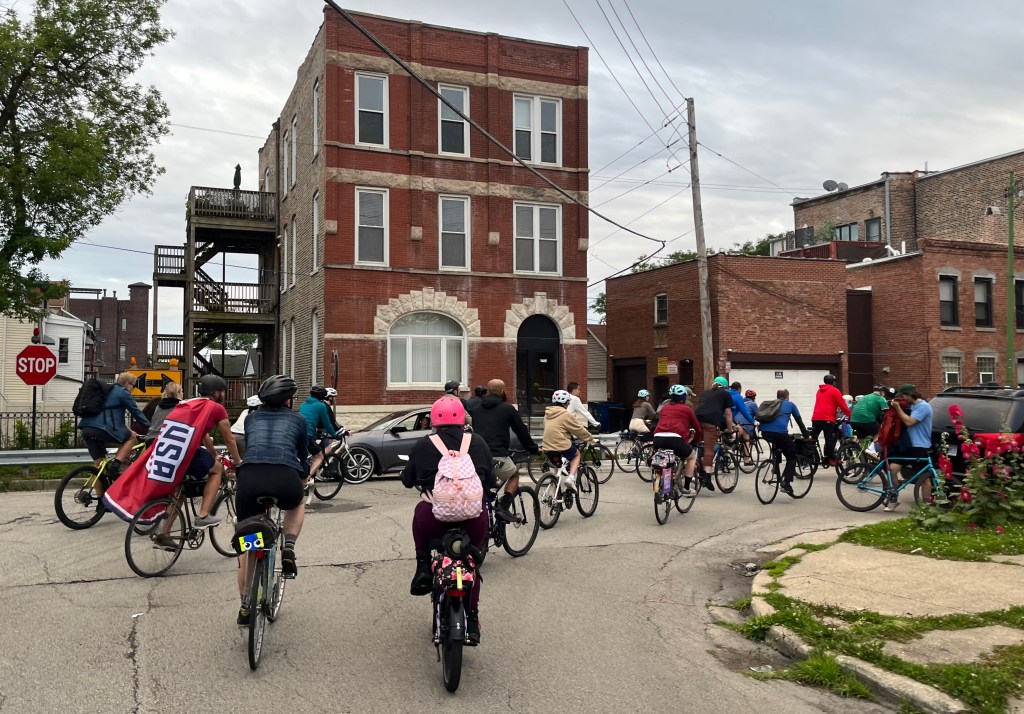
I didn’t get any word on what percentage of these thousands of cities the nonprofit’s researchers actually rode bikes in before finalizing their critiques. While I exchanged several emails with People for Bikes’ PR person recently, I never succeeded in scheduling an interview.
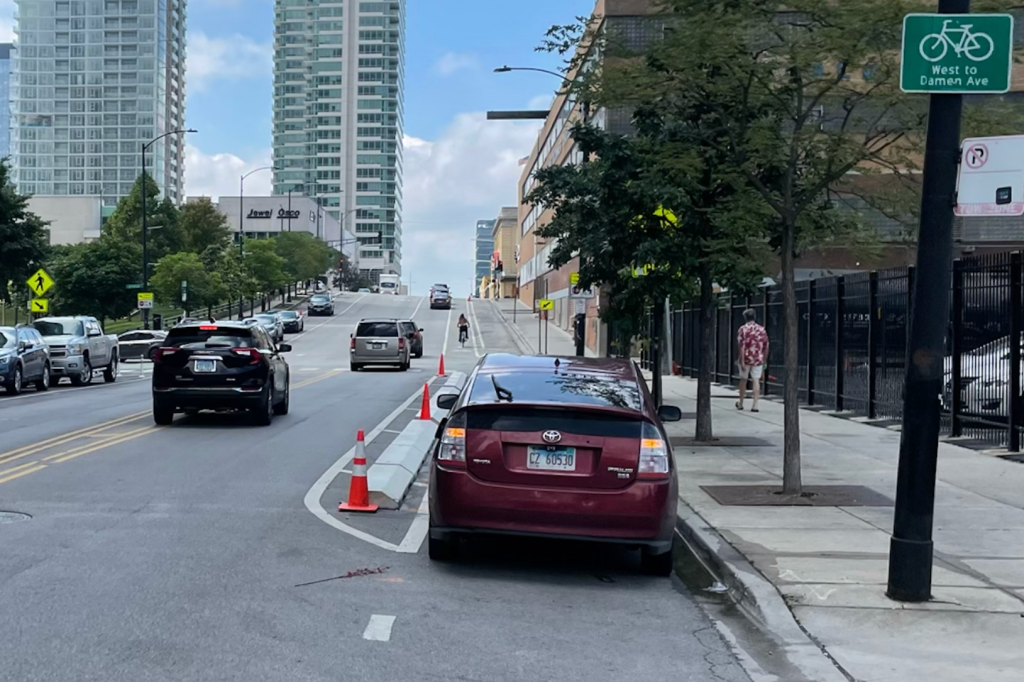
To address the elephant in the room, yes, Chicago needs to make major improvements in order to become a truly bikeable city. Tragically, that fact was laid bare last month when a driver fatally “doored” Chicago Department of Transportation Complete Streets Planner Riley O’Neil, 35, as he was riding home from work in a paint-only bike lane. Among other issues with cycling here, we need more protected bike lanes, which would have prevented that deadly crash.
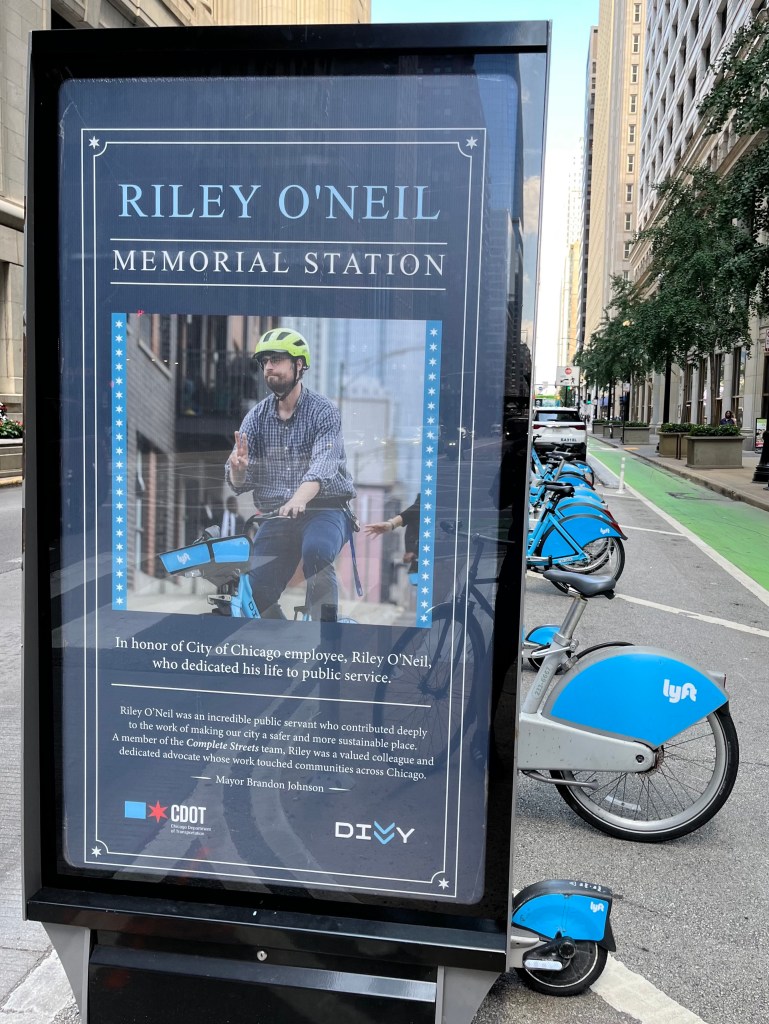
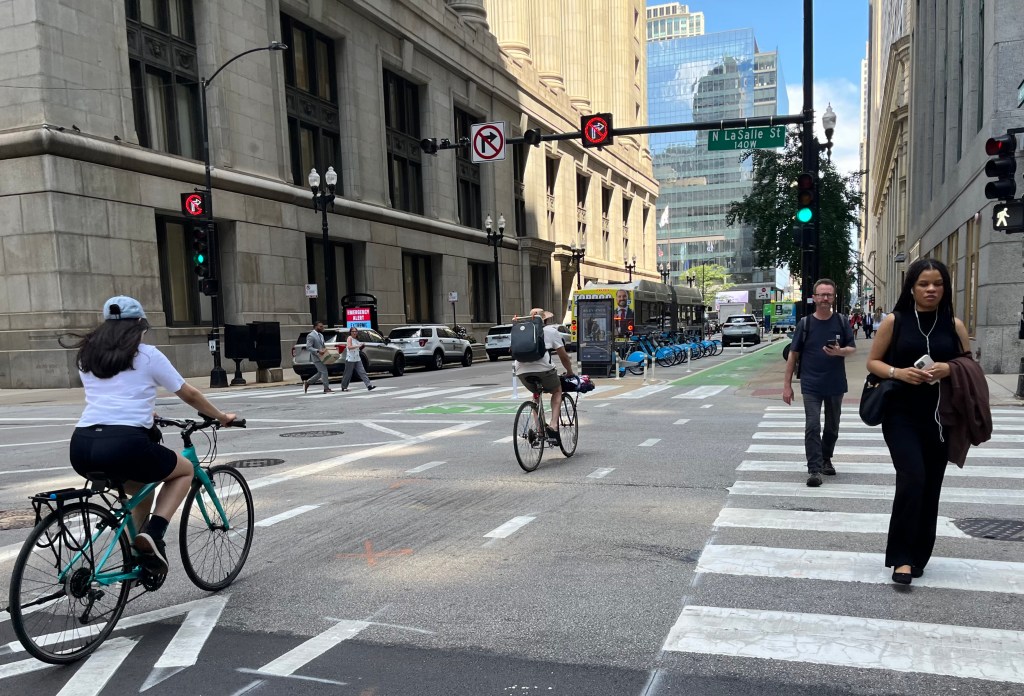
It’s no secret that Chicago has many distracted, reckless, and intoxicated motorists, and the O’Neil case was just one of the five bike and e-scooter fatalities that have happened on our city’s street this year, along with at least 13 pedestrian deaths. That’s in part because we still have too many wide, multi-lane roads, plagued by speeding and crashes. While CDOT continues to build protected lanes – often facing backlash from residents, merchants, and politicians – we’re still far from having a citywide grid of low-stress cycling routes.
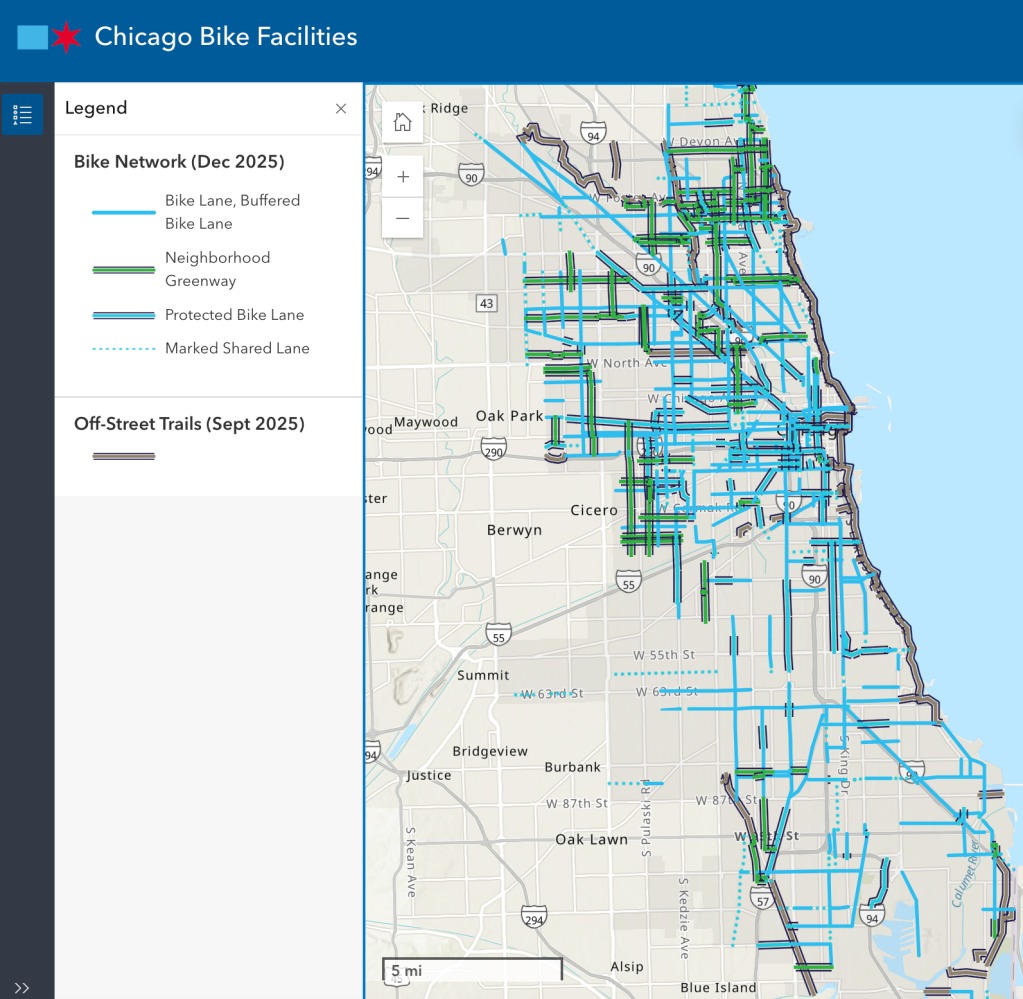
People for Bikes justifiably docks points from Chicago for having a bike network that’s not completely cohesive. That’s especially true when it comes to protected lanes and Neighborhood Greenways, bike- and pedestrian-priority side street routes, which are concentrated on the North and West sides, but sparse on the South Side.
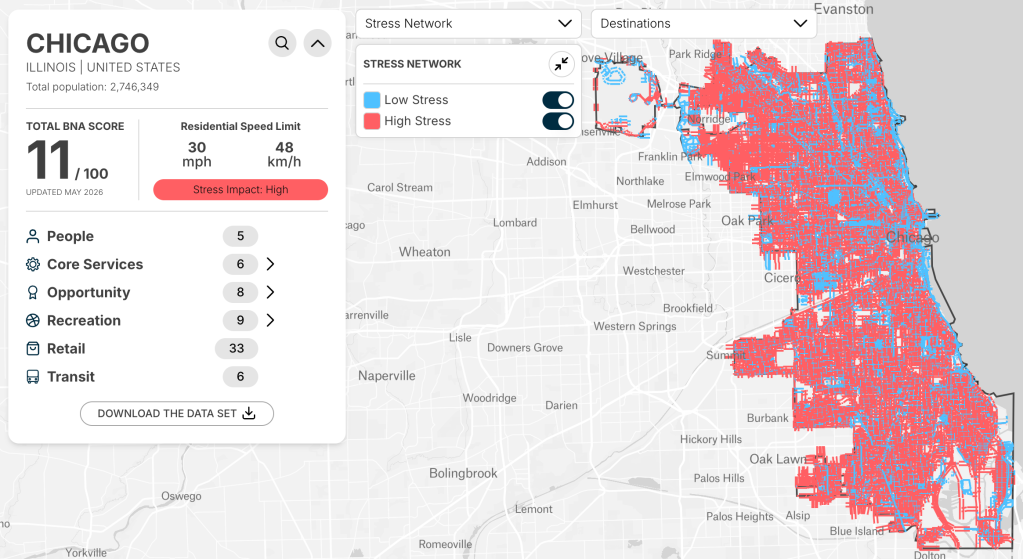
But the main reason our PFB City Rating is so low is that the nonprofit gives disproportionate weigh to posted speed limits, and Chicago gets heavily punished for our default 30 mph signs. Don’t get me wrong, Streetsblog loudly advocated for an ordinance to lower our speed limit to 25, which has been proven to save lifes in peer cities like New York. Frustratingly, the City Council voted down that initiative in February 2025, and we haven’t heard much about that effort since then.
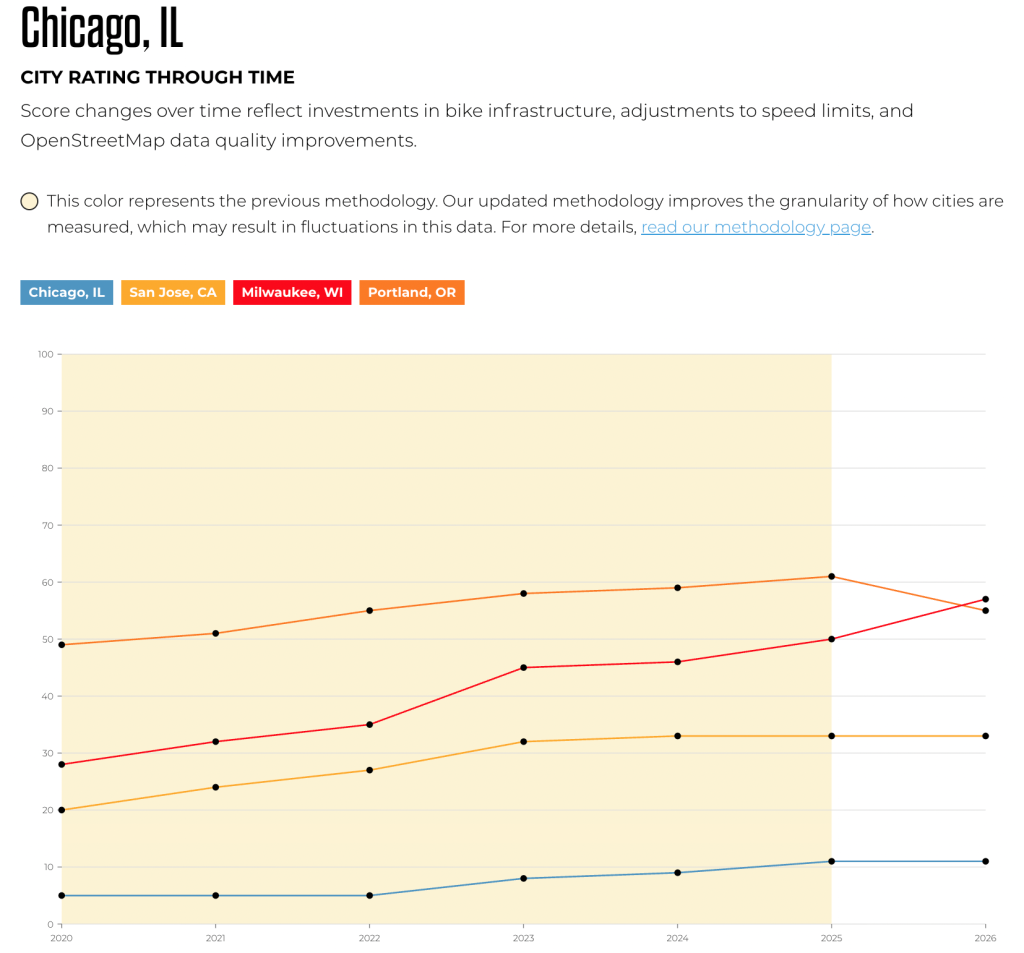
Years ago, a People for Bikes staffer told me Chicago’s rating would be near the top of the rankings if we lowered our posted limit by 5 mph. This PFB chart from last year makes that clear: While in 2018 our city was tied with Portland, OR, our score plummeted in 2020, when the nonprofit increased it’s emphasis on speed limits.
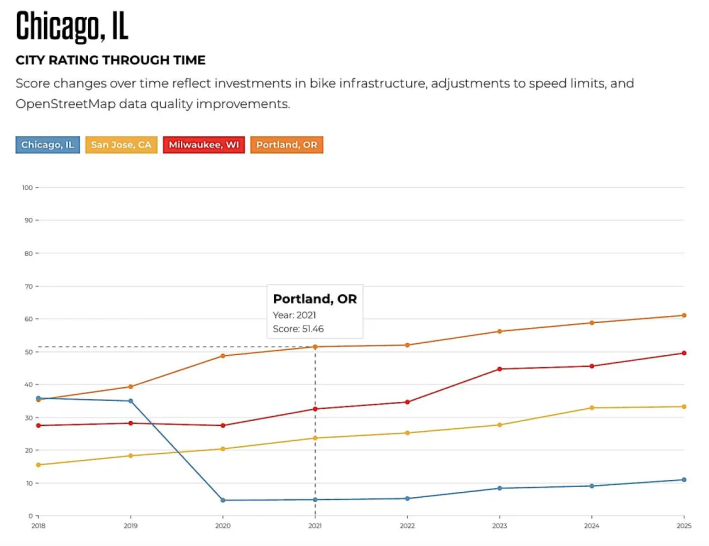
It that seems that after Streetsblog pointed out this discrepancy year after year, this time People for Bikes may have felt a little sheepish about that. This year’s graph starts in 2020, so someone who hasn’t been following the saga might assume PFB has always rated Chicago as a terrible place to bike.
Similarly, because of our 30 mph speed limit, PFB’s Bike Network Analysis tool colors just about every street in our city red to classifying them as “High Stress” Here’s a screenshot of their map, which gives us a BNA rating of 11 out of 100.
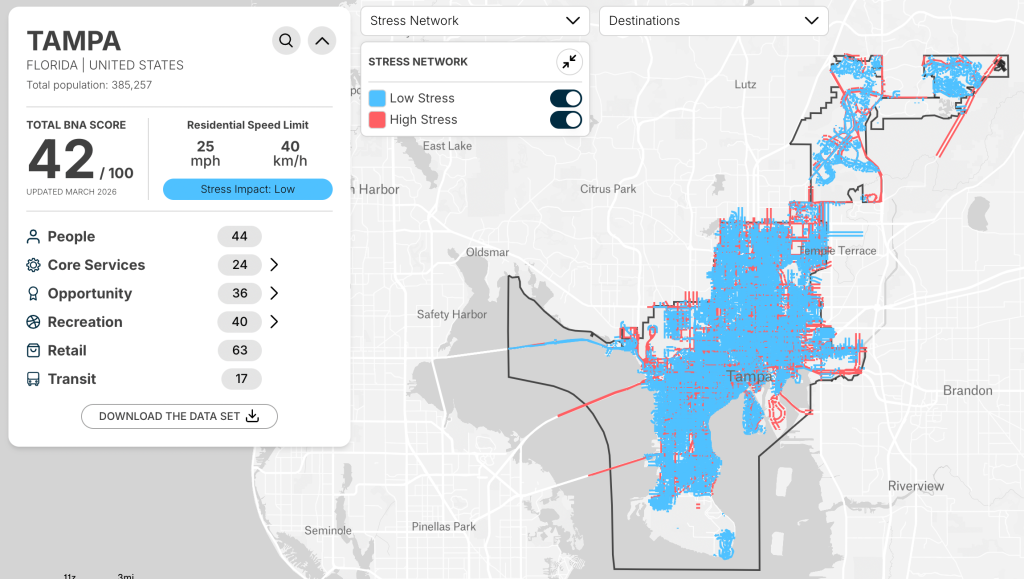
Meanwhile, Tampa, FL, which few people consider to be a cycling paradise, gets a BNA of 42, and almost all of it’s streets are colored blue as “Low Stress,” simply because that car-centric city happens to have a 25 mph residential speed limit. People for Bikes’s skewed ratings of Chicago and Tampa, and other more car-centric cities that are ranked far above ours, are all about the speed limit sign numbers.
CDOT’s perspective
After the 2026 People for Bikes report came out, I asked for CDOT’s response to the claim that Chicago is tied for the worst large U.S. city for biking.
“Here are a few data points and examples that show Chicago is a great biking city and continues to become an even better one, with more people riding and continued investments in safer, more comfortable infrastructure,” responded spokesperson Erica Schroeder. Here’s a list of bullet points she sent (CDOT’s words.)
- Last year, Chicago’s bikeway network surpassed 500 miles
- Since 2021, nearly two-thirds of all new bikeways installed have been low-stress (protected bike lanes and Neighborhood Greenways)
- 136 miles of low-stress bikeways since 2021, a 249 percent increase.
- More details on the breakdown of PBLs, greenways, etc. are available here (note this doesn’t include projects that are currently under construction)
- Chicago’s Divvy bike-share system is the largest by area in the United States and continues to set ridership records. Chicagoans took a record 6.8 million Divvy trips in 2025 and are on pace to surpass that total again in 2026.
- This post from Divvy’s general manager has some cool stats about record ridership days this year.
- Divvy is continuing to be more convenient, reliable, and affordable (as outlined here.)
- Chicagoans also took 6.1 million Lime scooter trips in 2025, demonstrating continued growth in micromobility as an everyday transportation option.
- Replica mobility data shows Chicago has the fastest-growing bicycle mode share among the nation’s 10 largest cities.
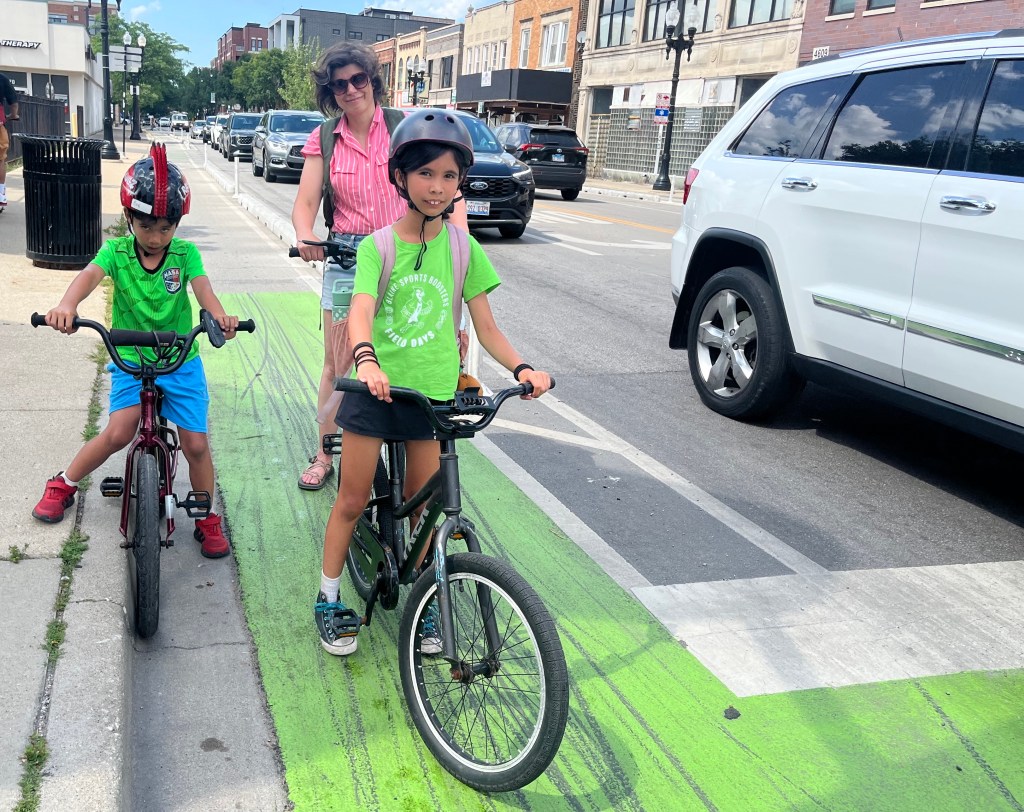
“In addition to this, Chicago also supports programs that make bicycling more accessible, affordable, and welcoming for residents of all ages and experience levels,” Schroeder added. She provided a couple more bullet points (CDOT’s words.)
- Our “Bike Chicago” distribution program provides free bicycles, helmets, and locks to income-eligible residents, with the program nearing its goal of distributing 5,000 bikes.
- Our popular Learn to Ride program offers free classes for riders of all experience levels, helping hundreds of Chicagoans each year build skills and confidence.
So that’s CDOT’s side of the story. Next week I’ll share some thoughts from Chicago civilians about the People for Bikes rankings, and the state of cycling in our city.
Check out People For Bikes’ 2026 City Ratings report here.
Check out their 2026 ratings for Chicago here.

If you appreciate Streetsblog Chicago’s livable streets reporting and advocacy, please consider making a tax-deductible donation to support our work. Thank you!

Read More:
Streetsblog has migrated to a new comment system. New commenters can register directly in the comments section of any article. Returning commenters: your previous comments and display name have been preserved, but you'll need to reclaim your account by clicking "Forgot your password?" on the sign-in form, entering your email, and following the verification link to set a new password — this is required because passwords could not be carried over during the migration. For questions, contact tips@streetsblog.org.