Don’t let the motorheads remove Complete Streets infrastructure. Consider chipping in to help SBC fight for better walk/bike/transit.


Hi there, Streetsblog Chicago readers! I hope you had a joyful Thanksgiving.
ICYMI, here are a few of our recent stories:
• Key findings from CDOT’s annual Chicago Traffic Crashes report: Recent Complete Streets projects correlate with reduced crash fatalities
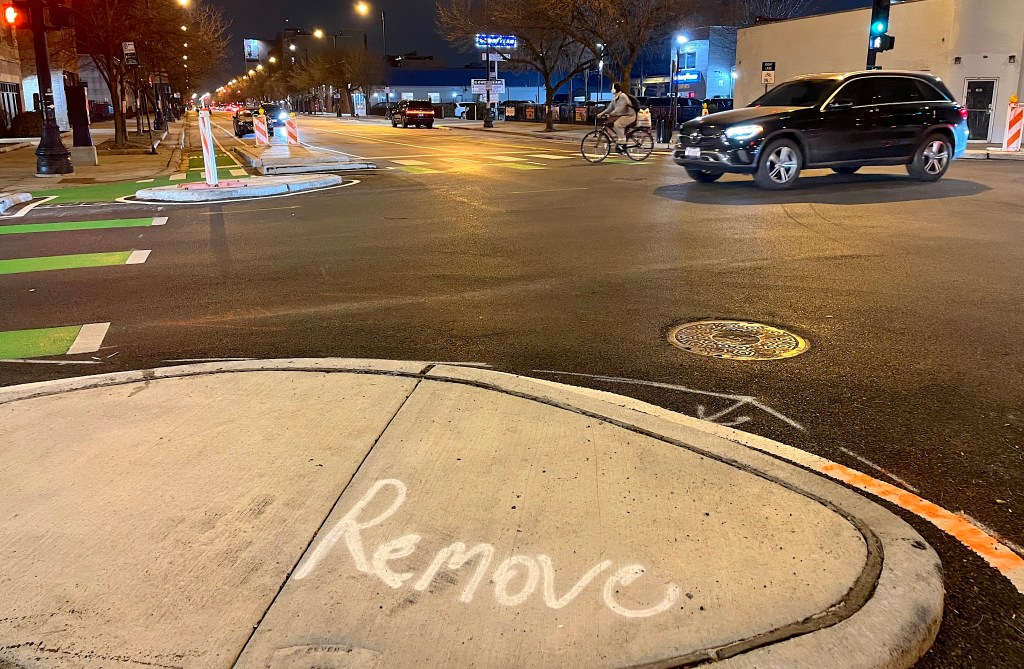
• Ald. Dowell forcing CDOT to tear out portions of already-installed bike lane protection on 18th shows what’s wrong with aldermanic prerogative
• Naysayers made noise about Kedzie and Archer Complete Street projects. Ald. Ramirez and CDOT discussed why the safety upgrades are needed.
If you’ve already made a recent donation to SBC, please feel to skip ahead to “The assault on Complete Streets” section of this post. Thanks!
One thing I’m very thankful for right now is that this sustainable transportation news and advocacy website has a future. As I discussed last month, recently things were looking dicey. Our annual major grant ended, and in the wake of federal funding cuts, there’s stiff competition for money from charitable foundations. Nothing had materialized, and our bank account would have been pretty much would zeroed-out by the time the giant pierogi drops in Whiting, IN for New Year’s.
Fortunately, one of our very loyal supporters came through with incredible generosity and committed to donating roughly half of our budget per year. Obviously, we’re extremely grateful for that!
On top of that, longtime advertisers Freeman Kevenides Law Firm and Keating Law Offices helpfully offered to re-up their sponsorships early. We appreciate the bump!
Still, we have to raise another $50,000, ideally by the end of February, to be funded for all of next year. Since we announced our 2026 fund drive last month, we’ve gotten thousands of dollars in reader donations plus an ad sales, and we’ve got a little more than $47K to go.
We’ll be reaching out to other generous major donors and sponsors soon. But it would also be a huge help if more SBC readers would like to step up on #GivingTuesday to make a tax-deductible contribution to help keep the site afloat.
If a donation of $100-plus works for you, consider that a subscription. It will help us keep this news outlet paywall-free for those with tighter budgets, as well as local officials who might be positively influenced by our reporting.
The assault on Complete Streets
As the three recent articles I linked to above demonstrate, it’s more important that ever for Chicago to have a Streetsblog site.
The new Chicago Department of Transportation crash report found that from 2021 to 2024 there was an 18.5 percent citywide decrease in serious and fatal crashes in our city. And during this period, there was a 39 percent reduction of such collisions in Austin, West Garfield Park, East Garfield Park, and North Lawndale. Pedestrian and bike fatalities fell by a whopping 69 percent in these neighborhoods.
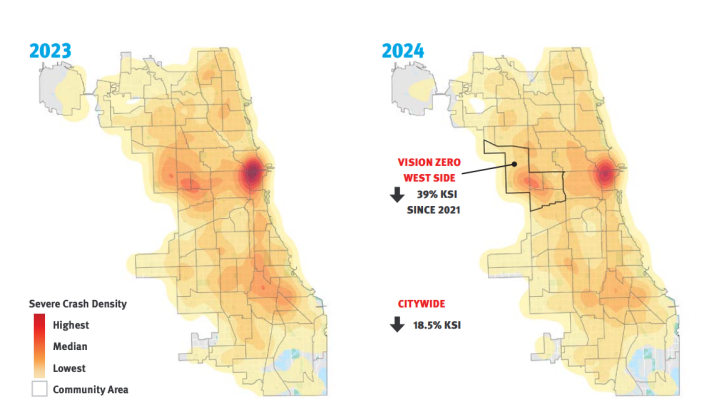
Sure, these safety improvements in the post-COVID era were partly due to a spike in crashes during the pandemic, when there were fewer cars on the road, and it was easier to speed. But it’s likely that projects on West Side arterials like Laramie Avenue, Central Park Avenue, and Jackson Boulevard – including things like curb extensions, raised crosswalks, and protected bike lanes – also played a role.
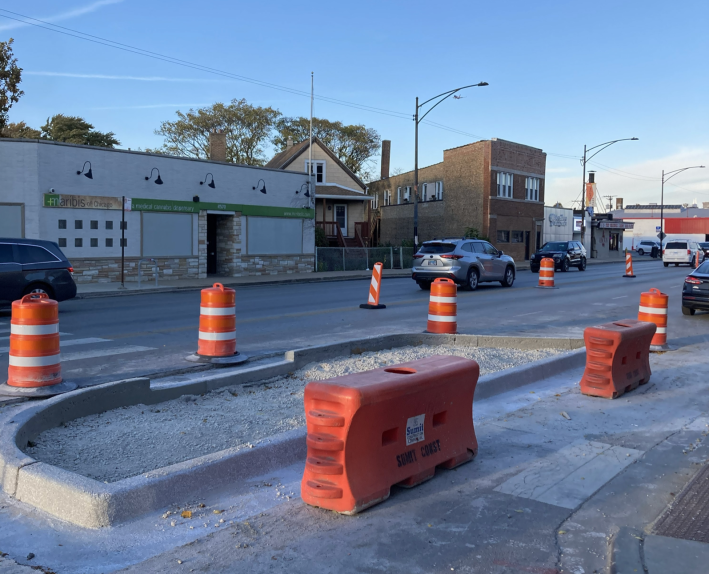
So it’s a major problem that Ald. Pat Dowell (3rd) recently indicated that she’s using aldermanic prerogative to order CDOT to remove safety infrastructure on 18th Street in the South Loop. It’s also troubling that some motorists are pressuring the City to do the same thing with in-progress Complete Street upgrades on crash-prone Kedzie and Archer avenues in Brighton Park.
That brings up one of SBC’s most important roles: Keeping tabs on windshield POV, Not In My Back Yard opposition to good projects, and fighting back with data and other evidence. That helps pave the way for completing these initiatives.
That’s not to say we’re lapdogs to CDOT, as some have claimed. While the department’s Complete Streets program is generally doing good work nowadays, we’re not shy about calling out design mistakes. In fairness, it seems these poor choices are sometimes due to the car-centric negative influence of higher-ups, City Council members, and local NIMBYs.
How do you solve a problem like clogged bike lanes?
While we’re on the subject, let’s address the elephant (polar bear?) in the room after the snowiest November day in Chicago history. Yes, curbside protected bike lanes are often unrideable soon after a major blizzard, forcing cyclists to share an (almost always swiftly cleared) mixed-traffic lane with motorists. That can actually be a sketchier scenario than what existed before the PBLs were installed.
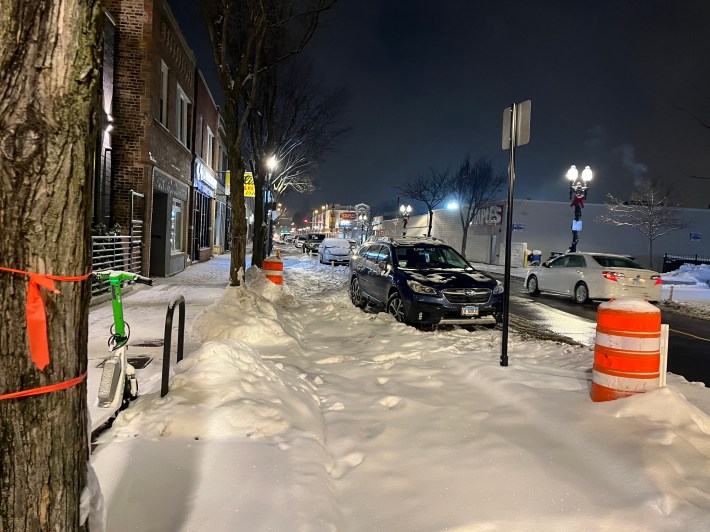
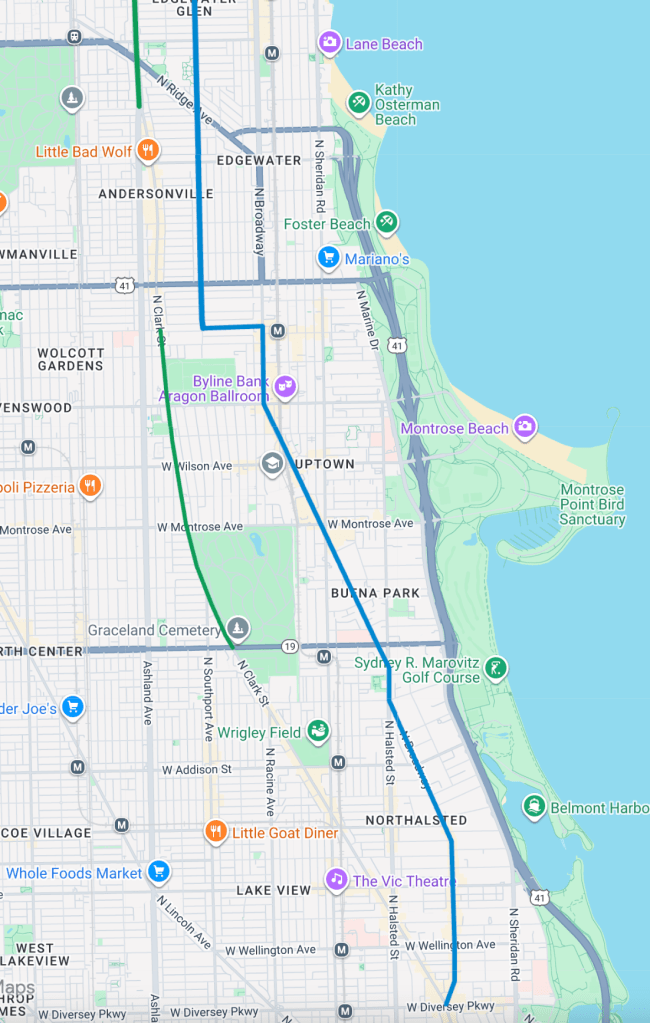
It’s a maddening situation for people on bikes. But I assume that most folks who are cycling during or just after a major snowfall are fairly seasoned riders, who probably know alternative routes. For example, while the Clark protected lanes in Edgewater and Uptown were a mess last night, I’m told the paint-only Glenwood Avenue Greenway side street route, a couple blocks east, wasn’t too awful. (And, in fairness, relatively few people were biking on Clark between Rogers Park and Andersonville before the physical protection went in anyway, because it was a scary five-lane street.)
Still, recent PBL conditions give ammunition to those who argue that it’s silly to build the lanes, making the (inaccurate) argument that “nobody rides in them during the winter,” blizzards excepted. So if CDOT is going to install protected lanes, they have to promptly clear snow, as is done in other northern cities with exponentially more all-season bike use, such as Stockholm, Sweden.
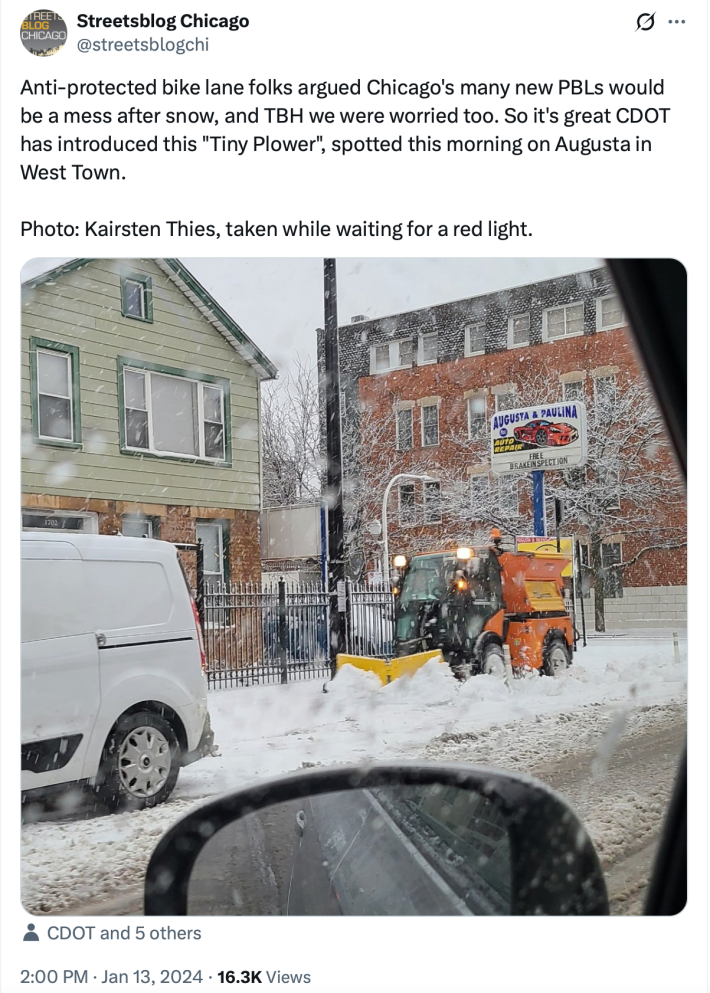
The good news is that CDOT does have some compact snowplows that are well-suited to PBL clearance. The bad news is that they don’t seem to use them particularly promptly, even on popular cycling routes like Clark. After thinking about the issue a bit this morning, I concluded there’s a vicious cycle going on:
• Because of the Byzantine ward system and prioritizing parking, PBLs tend to get installed in short segments, in parts of town where the alder is bike-friendly, there’s no need for parking conversions, and/or there’s low parking demand.
• These short snippets of protected lanes, installed one year at a time (eg. Clark: Devon Avenue to Andersonville, Clark: Montrose Avenue to Irving Park Road, Clark: Montrose to Winnemac) aren’t that useful on their own.
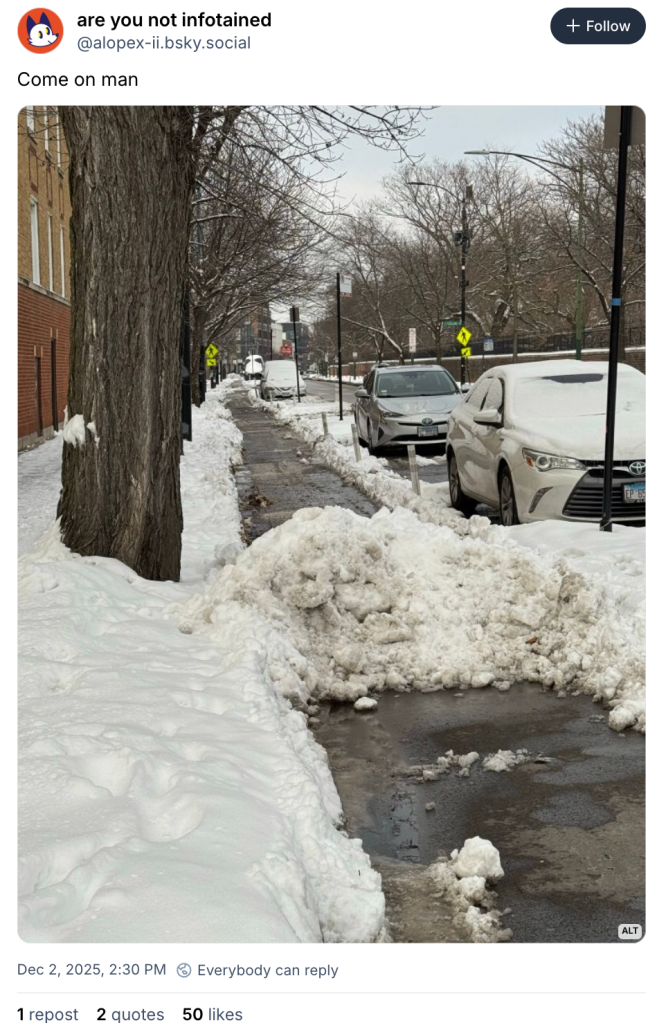
• As such, adding a few blocks of PBLs in a piecemeal fashion probably doesn’t increase bike traffic on a street by that much, especially by people who aren’t comfortable sharing the road with drivers, until the segments start adding up.
• With relatively low winter ridership, there’s not that much pressure on CDOT to plow protected lanes anywhere near as soon as “car” lanes get cleared.
• But if PBLs aren’t plowed promptly, people don’t bike in them, so there’s a chicken-and-egg situation going on.
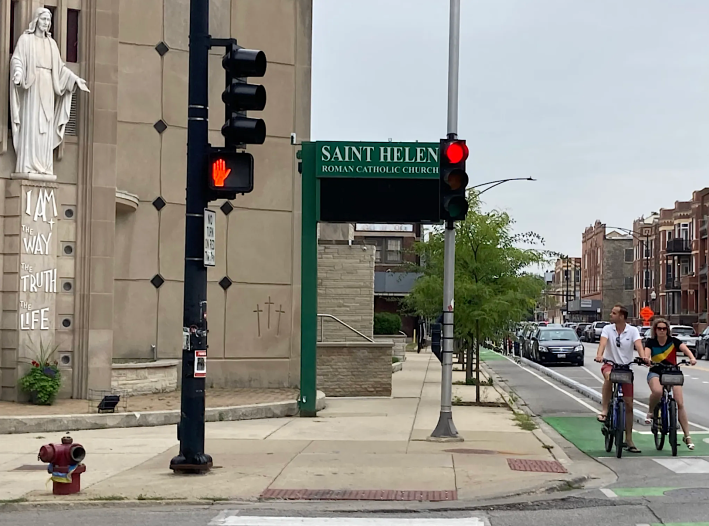
On the bright side, CDOT has been doing more outreach on the South and West sides through its Neighborhood Bike Network project, focusing on underserved neighborhoods, with more opportunities for community input. And lately we’ve been seeing more examples of longer protected lane routes (Augusta Boulevard in West Town springs to mind) and Neighborhood Greenways (check out CDOT’s Mid Northeast Project Area map for examples).
But CDOT speeding up the process of creating a citywide network of connected protected bikeways, is going to require nagging, cheerleading, and NIMBY blocking by advocates. Like our colleagues such as the Active Transportation Alliance and Chicago Bike Grid Now!, that’s a big reason why Streetsblog Chicago exists.
So please consider making a tax-deductible end-of-year donation so we can keep, uh, plowing ahead with this mission. Thanks for your support!

Read More:
Streetsblog has migrated to a new comment system. New commenters can register directly in the comments section of any article. Returning commenters: your previous comments and display name have been preserved, but you'll need to reclaim your account by clicking "Forgot your password?" on the sign-in form, entering your email, and following the verification link to set a new password — this is required because passwords could not be carried over during the migration. For questions, contact tips@streetsblog.org.