As the CTA approaches a major governance change, many alders “ghosted” it’s quarterly City Council hearing once again


The main article is by Ellen Steinke, and the update is by John Greenfield.
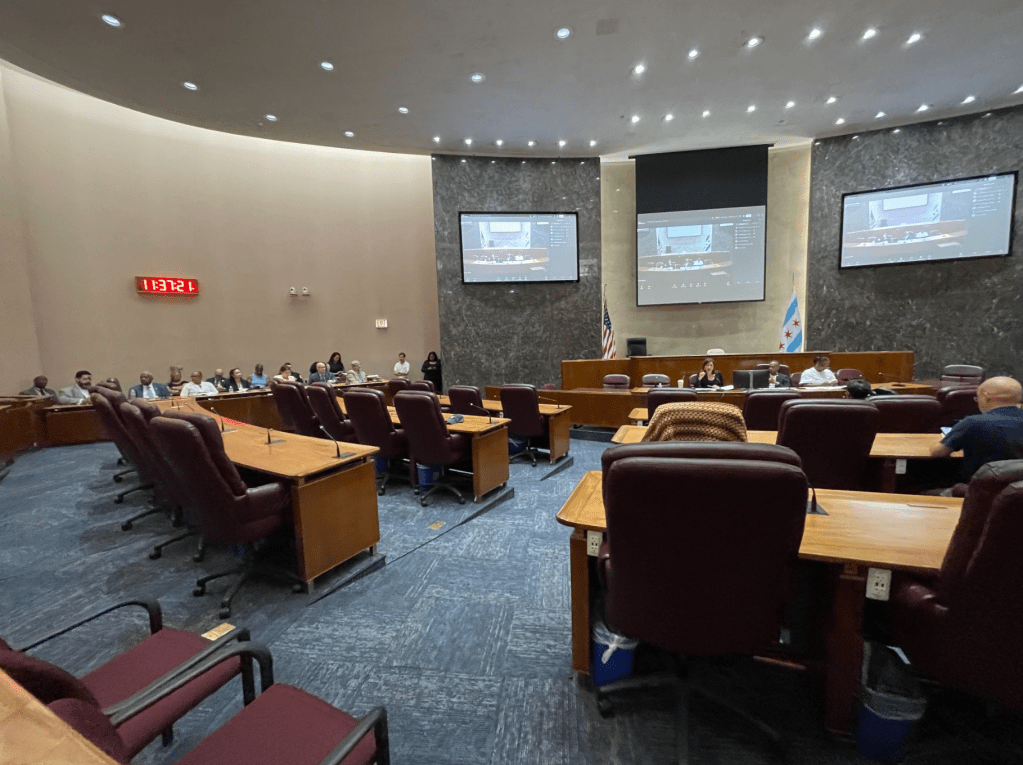
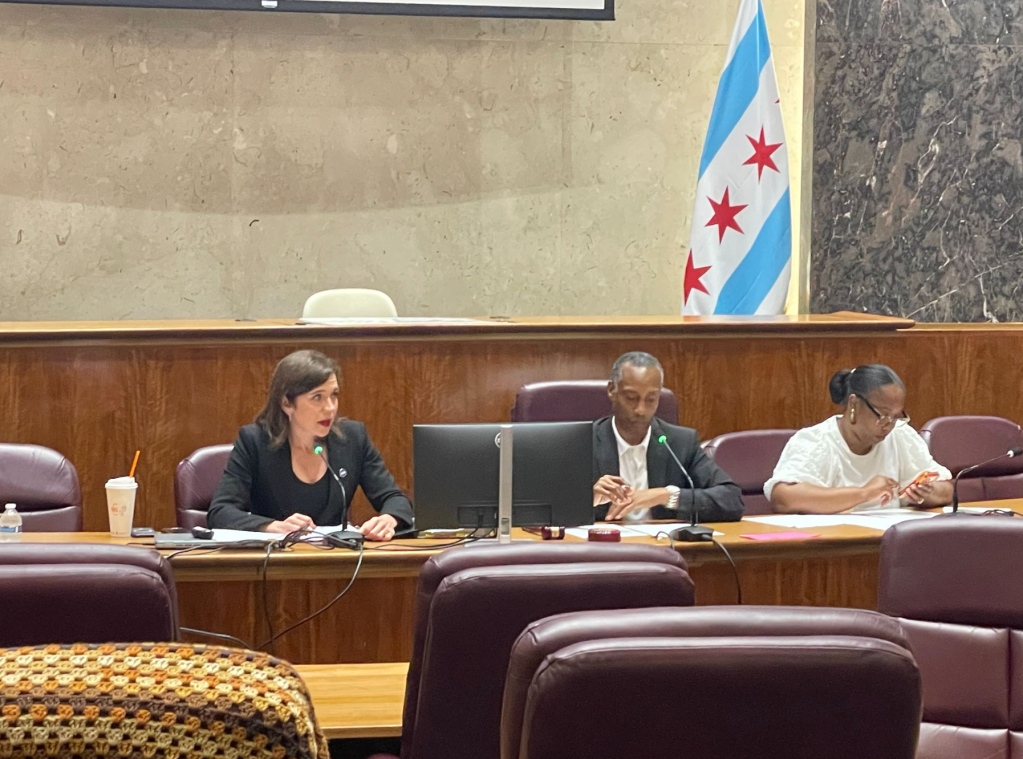
On Wednesday, for the second time this year, the City Council’s Committee on Transportation and Public Way failed to reach the necessary quorum, at least half of its 14 members attending in person, for a legally mandated quarterly hearing on the CTA. That cut short what was supposed to be a public update on service, safety, ridership, and the agency’s transition into a new regional transit era.
The committee yesterday for its quarterly CTA oversight hearing, required by a City ordinance. But, frustratingly, after public comment and a presentation from the agency’s acting president Nora Leerhsen, committee chair Ald. Greg Mitchell (7th) announced that the committee had not established quorum and adjourned the meeting before alders could ask questions.
Leerhsen arrived with what she described as “good news to report on several fronts.” However, the failure to reach a quorum meant Council members could not publicly question CTA leadership about her statements, the agency’s remaining challenges, or the fast-approaching transition to the new Northern Illinois Transit Authority governance structure.
During her presentation, the acting president reported that CTA ridership is at its highest level in six years, with bus ridership at 90 percent of pre-pandemic levels, and weekend ridership exceeding 2019 levels. The agency, she said, now regularly sees more than 1.1 million rides on an average weekday.
Moreover, she said, staffing is at its highest point in more than six years. The CTA now has more than 11,500 employees, its highest total in more than six years, including nearly 400 more full-time bus operators than in 2019 and 96 percent of the rail operators the agency had at that time.
Those staffing gains, Leerhsen said, are translating into better service. According to the CTA, the agency has delivered 99.6 percent of scheduled bus service so far this year. Meanwhile its Frequent Bus Network or 20 routes where buses are supposed to arrive every 10 minutes or fewer all day, every day is reportedly meeting that promise about 90 percent of the time. Large gaps between buses are now occurring just 3.6 percent of the time, the lowest level in five years, the acting president said.
“Gone are the days of widespread ghost bus complaints,” Leerhsen told the committee, adding that customer complaints about bus delays have dropped 80 percent since the depths of the pandemic.
On the rail side, Leerhsen said major delays of more than 10 minutes are at their lowest point in seven years and nearly 30 percent lower than last year. Rail delay complaints, she said, have dropped nearly 90 percent from pandemic-era levels.
Safety was also a major focus of the presentation. the acting president said CTA crime is down for the fifth straight month. Comparing May 2026 with May 2025, she said serious crime dropped 40 percent systemwide, violent crime fell 33 percent systemwide, and property crime was cut in half. She said that on the Red Line all crime fell 50 percent and violent crime dropped 77 percent.
She credited increased collaboration with the Chicago Police Department, including more than 500 Transit Rider Interaction Program missions since the start of the year. Those missions involve teams of officers boarding trains and inspecting cars at high-incident stations. She also cited concentrated overnight Red Line coverage, Cook County sheriff deployments, bus-focused police missions, and a new partnership with the Cook County State’s Attorney’s Office.
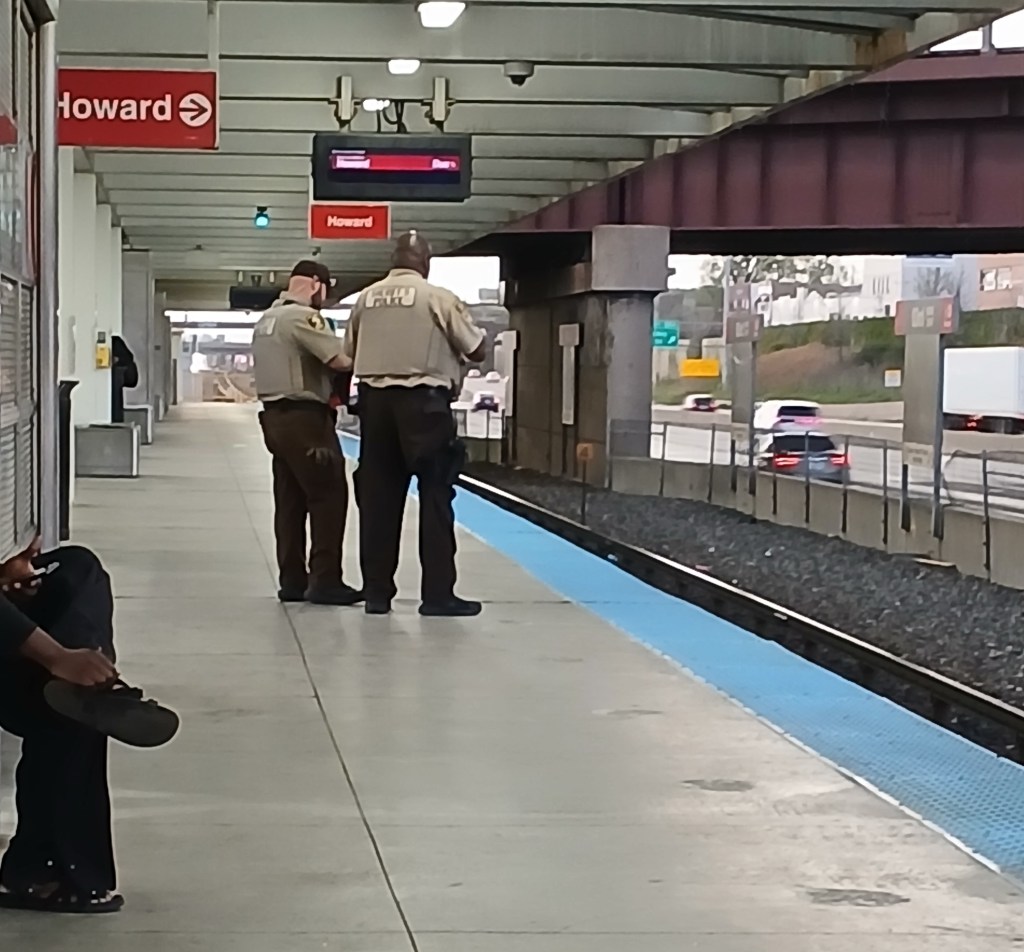
Leerhsen also addressed smoking, one of the most common rider complaints in recent years. She said police have issued more than 6,000 smoking tickets since the beginning of last year, and smoking complaints are down 40 percent from their 2024 peak.
But because the committee lacked a quorum, alders were unable to publicly ask follow-up questions about those figures or about issues riders continue to raise. These include slow zones, bus speeds, ADA accessibility, worker safety, and rider confidence.
The low aldermanic turnout also comes at a consequential moment for regional transit. The Northern Illinois Transit Authority Act, passed in Springfield last year, provides $1.5 billion in funding for Chicagoland and downstate transit annually, while reshaping the region’s transit governance structure. Leerhsen said the bill means the CTA, as well as Metra and Pace, are now on a path “not only to survive but to thrive and grow.”
“It’s unfortunate that we’ve got colleagues that are ghosting CTA,” Ald. Andre Vasquez, the most outspoken alder on transit issue, said after the meeting. “We’re talking about how much we care about trains and improving it, and this is the second time for us not to have quorum. We need to do better for Chicago.”
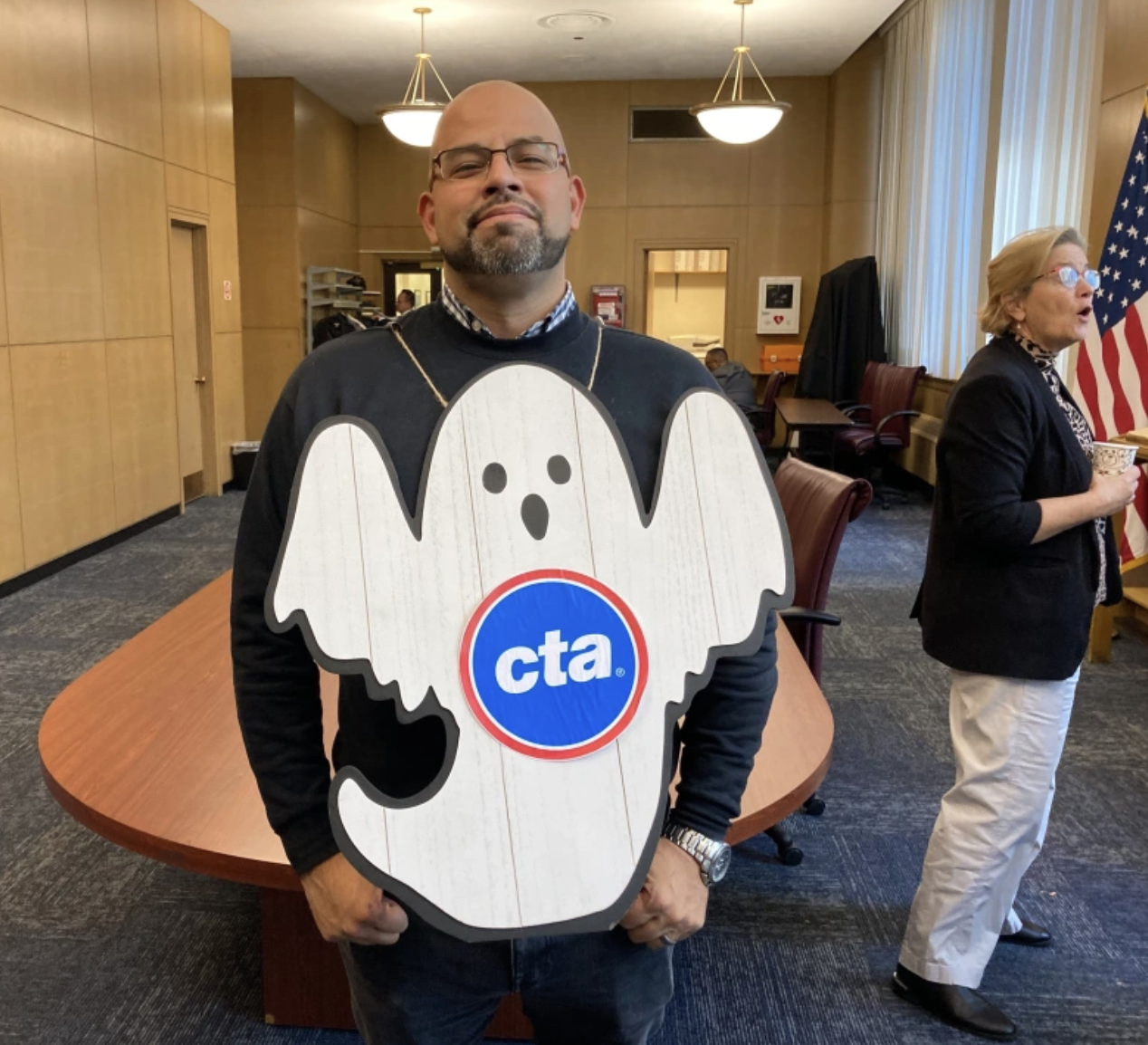
Around Halloween 2022, Ald. Vasquez wore a ghost outfit to a Council meeting to protest then-CTA chief Dorval Carter’s absences from City Hall hearings on transit. Photo: John Greenfield
Transit advocates said the lack of proper hearing was especially frustrating because City Council is entering a critical window for the transition to replacing the Regional Transportation Authority umbrella agency with the new NITA. Board appointments are approaching – the Tribune reported today that Cook County Board President Toni Preckwinkle has already proposed some directors. As such, the advocates said, alderpersons should be pressing CTA leaders on what the agency needs from the new regional structure.
“It is insulting and utterly unacceptable that Transportation Committee members for a second quarter in a row failed to reach quorum for quarterly hearings that City Council itself mandated into law,” Better Streets Chicago Executive Director Kyle Lucas said after the meeting.
Lucas noted that alderpersons will soon be involved in appointments to the new NITA board, since those directors must be approved by September 1. Tuesday’s hearing, he said, should have been an opportunity for City Council members to ask CTA leaders what the agency needs during the transition. “Instead of a CTA train or bus ghosting riders, City Council ghosted taxpayers,” he said.
That may be the lasting takeaway from the hearing. CTA came prepared to argue that the agency is no longer in pandemic free fall. Service is improving, ridership is growing, staffing is up, and crime is moving in the right direction, according to Leerhsenb.
But oversight only works when elected officials are present to do it. And at a moment when Chicagoland transit is entering one of its biggest governance transitions in decades, the committee charged with transportation oversight failed to show up in sufficient numbers to ask a single public question.
Update 7/3/26, 10:30 AM: Here’s a list of the alders who showed up for the July meeting, and the ones who hit the snooze button, so to speak, per NBC Chicago.
Attended in person: Greg Mitchell (7th), Michelle Harris (8th), Michael Rodriguez (22nd), Scott Waguespack (32nd), Samantha Nugent (39th), and Andre Vasquez (40th).
Attended remotely, so not counted for a quorum: David Moore (17th), Bill Conway (34th)
Didn’t attend: Brian Hopkins (2nd), Jeylu Gutierrez (14th), Ronnie Mosley (21st), Jessie Fuentes (26th), Jason Ervin (28th) and Desmon Yancy (5th).
Here’s the list from March, compiled by Tribune reporter Jake Sheridan.
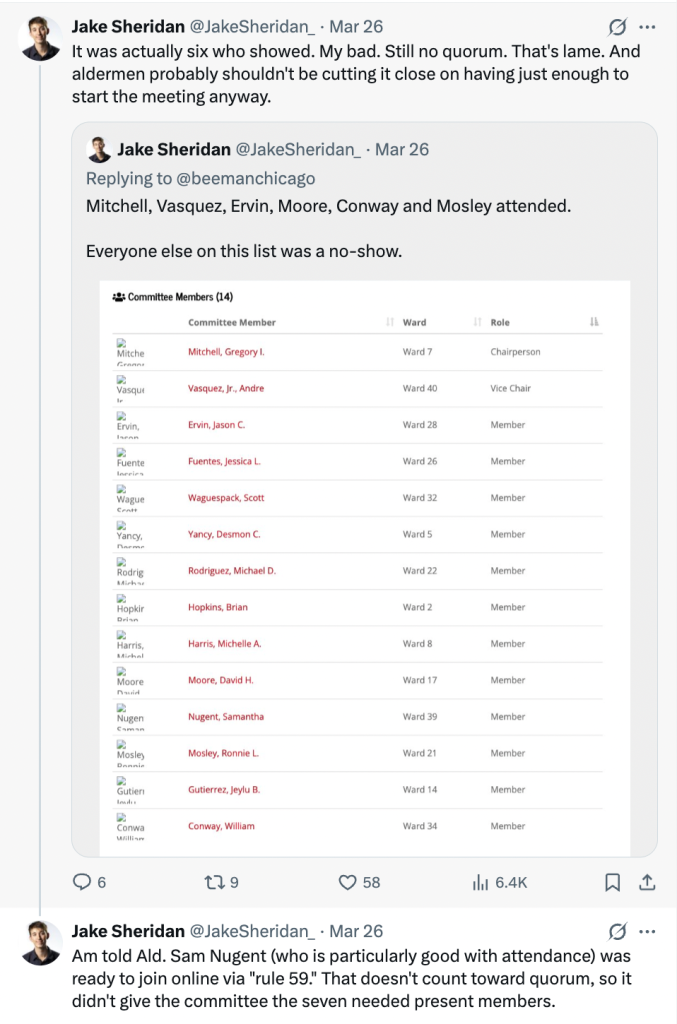
Screenshot of Sheridan’s tweet.
The alders who didn’t show up live or online (like 39th Ward rep Samantha Nugent did) in March were Brian Hopkins (2nd), Desmon Yancy (5th), Michelle Harris (8th), Jeylu Gutierrez (14), Michael Rodriguez (22nd), Jessica Fuentes (26th), and Scott Waguespack (32nd).
So to summarize, here’s the attendance record for the March and July meetings. Again, remote attendance doesn’t help form a quorum. Repeat absentees are in bold. Repeat in-person attendedees (Mitchell and Vasquez) have three asterisks.
• Ald. Brian Hopkins (2nd): Didn’t attend either meeting
• Ald. Desmon Yancy (5th): Didn’t attend either
• Ald. Greg Mitchell (7th, committee chair): Attended both meetings in person***
• Ald. Michelle Harris (8th): didn’t attend March, attended July in person
• Ald. Jeylu Gutierrez (14th): Didn’t attend either
• Ald. David Moore (17th): Attended March in person, July remotely
• Ald. Ronnie Mosley (21st): Attended March in person, didn’t attend July
• Ald. Michael Rodriguez (22nd): Didn’t attend March, attended July in person
• Ald. Jessica Fuentes (26th): Didn’t attend either
• Ald. Scott Waguespack (32nd): Didn’t attend March, attended July in person
• Ald. Bill Conway (34th): Attended March in person, July remotely
• Ald. Samantha Nugent (39th): Attended March meeting remotely, July in person
• Ald. Andre Vasquez (40th): Attended both in person***
There are legitimate reasons to miss a meeting. Hopkins, who said he generally has good City Council attendance, told NBC this week, “On those few occasions when I am absent, it’s typically due to illness or family commitments that were scheduled prior to notice of the date for the missed meeting.”
Still, if you live in a district where the alder has recently been a no-show to these meetings, you can contact their ward office (find your alder and their contact info here) to tell them reliable, efficient, safe, and pleasant CTA service is a priority for you. Let them know that attendance of these quarterly hearings will be a factor in how you vote in next February’s aldermanic election.
Update 7/9/26, 12:00 AM: After publication of this article, Ald. Jeylu Gutierrez (14th) provided screenshots of emails to Chair Greg Mitchell that show that she attended both meetings remotely. That still did not help form a quorum.
Update 7/10/26, 12:00 AM: Records show that, contrary to what NBC reported, Ald. David Moore (17th), Ald. Ronnie Mosely (21st), and Ald. Jason Ervin (28th) also attended the July 1 meeting remotely. Again, that did not contribute to forming a quorum.

If you appreciate Streetsblog Chicago’s livable streets reporting and advocacy, please consider making a tax-deductible donation to support our work. Thank you!

Read More:
Streetsblog has migrated to a new comment system. New commenters can register directly in the comments section of any article. Returning commenters: your previous comments and display name have been preserved, but you'll need to reclaim your account by clicking "Forgot your password?" on the sign-in form, entering your email, and following the verification link to set a new password — this is required because passwords could not be carried over during the migration. For questions, contact tips@streetsblog.org.