An express headed west: Pace considers I-290/I-88 service at open house

By Austin Busch
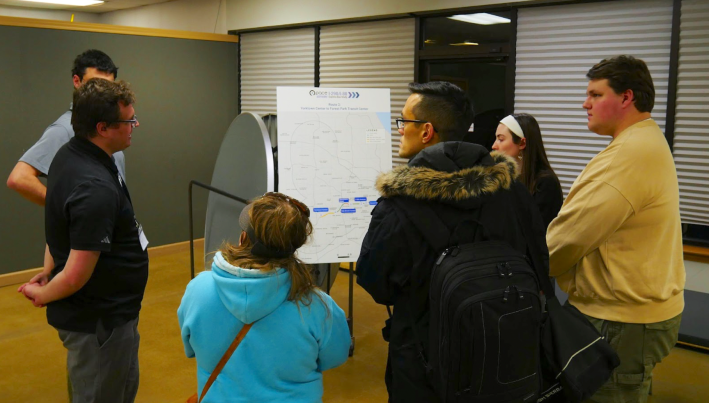
On Tuesday, Pace held an open house at the Howard Mohr Community Center in Forest Park to collect public feedback about feasibility studies underway for I-290 and I-88 express bus service.
Streetsblog has previously covered the study’s beginning in March of this year. Since that time, a Transit Supportive Infrastructure Plan was published over the summer, and a Service Design Plan was released in September, both of which were covered in this open house.
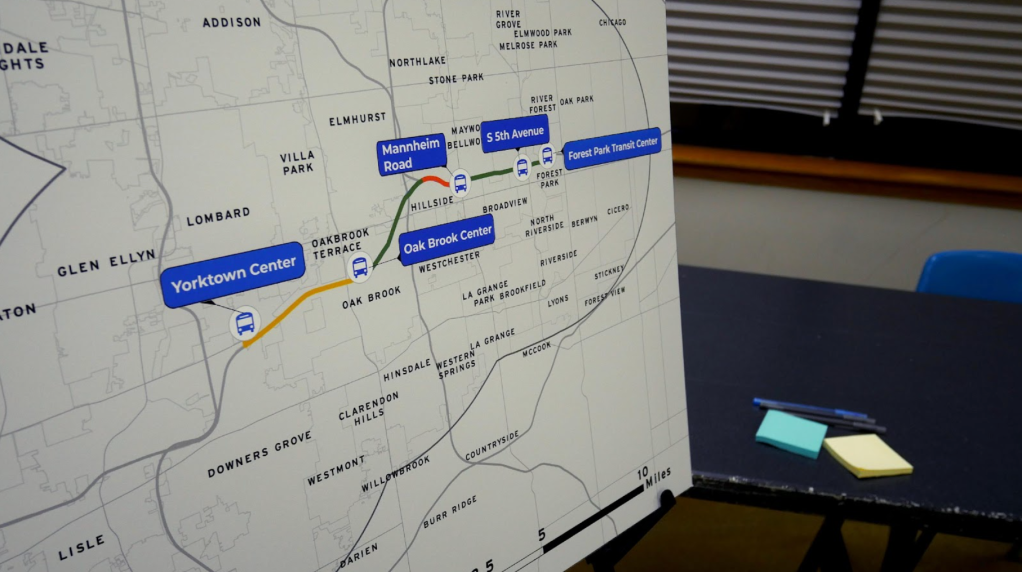
The study proposes two routes, running over a combined corridor west of the Forest Park Blue Line to Mannheim Road. The two routes proposed routes then diverge west at the ‘Hillside Strangler‘, with one traveling west on I-88 to Yorktown Center, and the other traveling north on I-290 to the Northwest Transportation Center in Schaumburg.
The service design plan suggests weekday headways of every 15 minutes during rush hour, with half hour frequencies the rest of the day from 5 a.m. to 11 p.m. Weekends are recommended to run an hourly schedule from 6 a.m. to 8 p.m.
Getting into alignment
The western alignment would run parallel to the Pace Pulse corridor underway for Cermak Road. The Pulse Cermak route will have more local stops (about every mile) and connect the CTA’s Pink Line to the Yorktown Mall. The team emphasized they are committed to seeing both projects through to serve different needs, which attendees were pleased to hear.
“You’re going to have local, you’re going to have enhanced bus service, and then you’ll have a true express service,” said Lenny Zaleski of Oak Brook. “I think it’s great that they’re planning on overlaying those services together and making sure they don’t conflict. I think that’s how you do transit-oriented development: giving people a lot of good options and having things built up around them.”
While there would be potential for suburb-to-suburb travel by transferring between the two routes, most meeting attendees expressed a primary interest in reaching the City of Chicago from the suburbs.
Noah Sullivan of Oak Park saw the benefit in making a faster alternative to existing routes, but specifically wanted the service to extend east of Forest Park to go to downtown Chicago. “What I wanted to see was more express service in competition with the CTA,” he said. ‘CTA, outside of peak commuting hours, has become too dangerous. If I had an alternative, if I had an express bus from this area to downtown Chicago, I would use it. And I think, if it was offered, they could not provide enough buses for the demand, because who is going to use [the CTA Blue Line’s Forest Park Branch] in off-hours?”
“Ninety-three of the 158 people who died on the CTA between 2018-2022 died on the Blue Line, or just under 59 percent,” Katie Prout wrote in the Chicago Reader in October 2023. “Why the Blue Line? There are a few possibilities… The [Forest Park Branch] travels through neighborhoods that see higher overdose-related deaths than many other parts of the city: Austin, West Garfield Park, and East Garfield Park.”
Some attendees also pointed out the ability to reach non-central locations in Chicago faster, unlike with nearby Metra service. Robert Wagner of Villa Park recounted challenges with doing a bike + train commute to Wicker Park by cycling on the Prarie Path to the Blue Line. “If you didn’t get there in time [to avoid rush hour periods], you couldn’t bring your bike on the train,” said Wagner. “Having a bus line that would take me to Forest Park would be really nice.”
One attendee asked the project team about why the routes ended at the Forest Park Blue Line, instead of continuing a short distance further to the Oak Park Metra and Green Line station to allow more connections. The project team explained that the Pace 318 already covered that route (with stops) every 15 minutes, which they expected to be adequate.
Ramping up the infrastructure
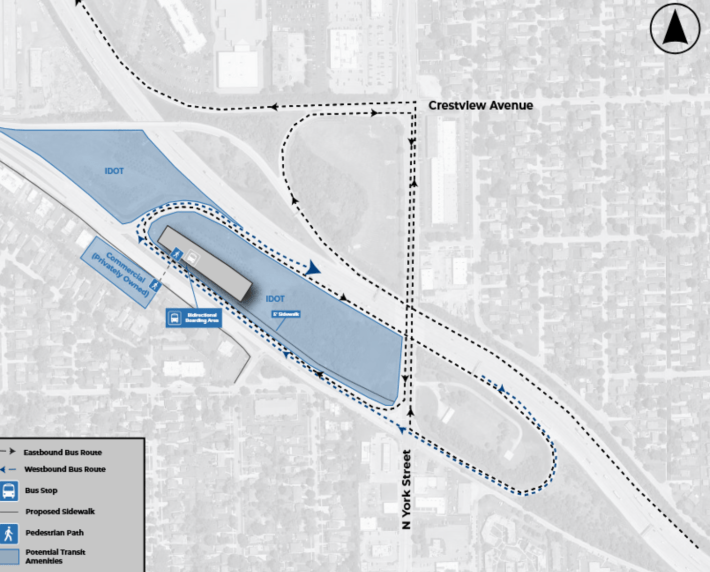
The proposed new stations were selected to prioritize the ability to transfer onto other local Pace services, nearby Metra train, or multi-use trails. In some cases, the project team has proposed new sidewalks to facilitate access to the stations and nearby connections, which were outlined in a detailed section of the Infrastructure Plan.
Stations in the expressway medians are proposed at points where on- and off-ramps do not exist. These would include Irving Park Road and Addison Road, as well as a side platform station at Elmhurst/Berkeley connecting to the Berkeley Metra UP-W station.
“I am impressed by the ingenuity and thoughtfulness of how to incorporate these stations, but I definitely would not want to be waiting for a while on the open 290 lanes,” said Zaleski. “I would be interested to see how the stations can safely accommodate people and make them feel comfortable on something as hostile as a giant four-lane highway.”
When the rubber hits the road
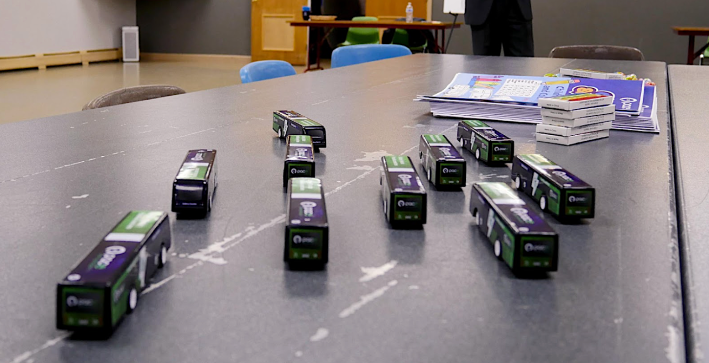
Service is being targeted to begin around 2028 to existing Pace facilities, with construction on newer infill stations expected later around 2033. Since the infill stations are planned to be built on off ramps or between active expressway lanes, the initial service could continue while they are constructed.
Eric Mueller, a consultant on the project with the firm Epstein, described the rollout of the service as “not route-by-route implementation, but station-by-station implementation.”
The I-88 route has the most infrastructure ready, with Yorktown Center and Oakbrook Center already in use by Pace. Most of the infill stations on the I-88 route proposed to be located away from the expressway near access ramps, simplifying their construction. The I-290 route to the Northwest Transportation Center, however, would not have any intermediate stops until construction takes place, and the expressway-adjacent stations will be more complex to build.
IDOT still needs to approve the service plan and stations, and will need to widen some inside shoulder lanes to accommodate the proposed shoulder-running sections.
A Pace survey is currently live for responses here.

On November 12, SBC launched our 2026 fund drive to raise $50K through ad sales and donations. That will complete next year’s budget, at a time when it’s tough to find grant money. Big thanks to all the readers who have chipped in so far to help keep this site rolling all next year! Currently, we’re at $7,260, with $42,740 to go, ideally by the end of February.
If you value our livable streets reporting and advocacy, please consider making a tax-exempt end-of-year gift here. If you can afford a contribution of $100 or more, think of it as a subscription. That will help keep the site paywall-free for people on tighter budgets, as well as decision-makers. Thanks for your support!
– John Greenfield, editor
Streetsblog has migrated to a new comment system. New commenters can register directly in the comments section of any article. Returning commenters: your previous comments and display name have been preserved, but you'll need to reclaim your account by clicking "Forgot your password?" on the sign-in form, entering your email, and following the verification link to set a new password — this is required because passwords could not be carried over during the migration. For questions, contact tips@streetsblog.org.