Bike lanes should always use protection. But officials say they usually shouldn’t go both ways.

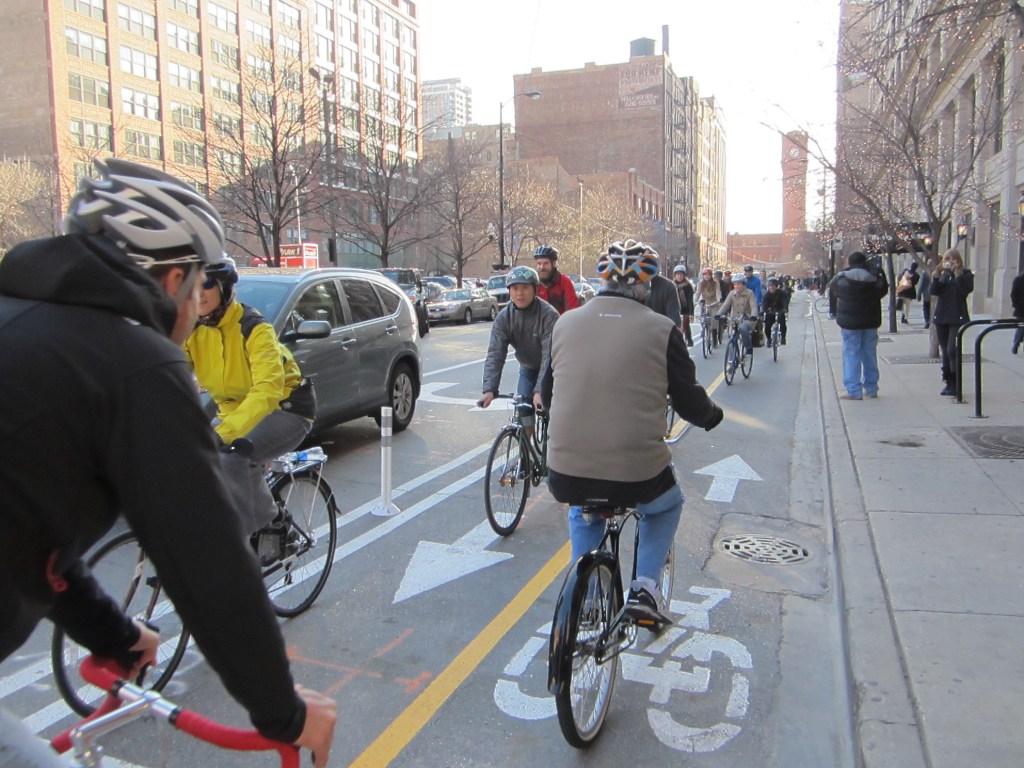

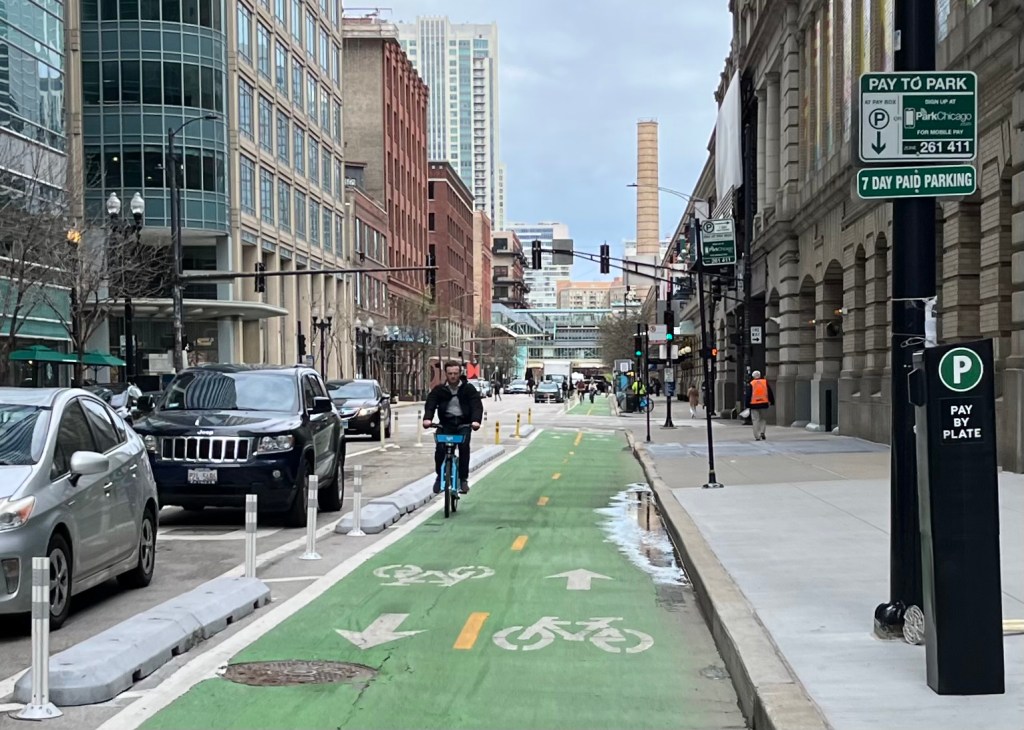
Chicago’s bidirectional protected bike lane on Dearborn Street downtown has stood the test of time. It debuted almost 14 years ago as one of our city’s first PBLs, running between Polk Street in the Loop, over the Chicago River, to Kinzie Street on the Near North Side.
While the Dearborn facility started out with just paint and flexible plastic posts, since then it’s been upgraded with concrete. As Streetsblog readers know, protected bike lanes help prevent bike riders from being seriously injured or killed by distracted, reckless, or intoxicated drivers. As such, bike lanes should always have physical protection in the form of parked cars, curbs, and/or other concrete barriers.
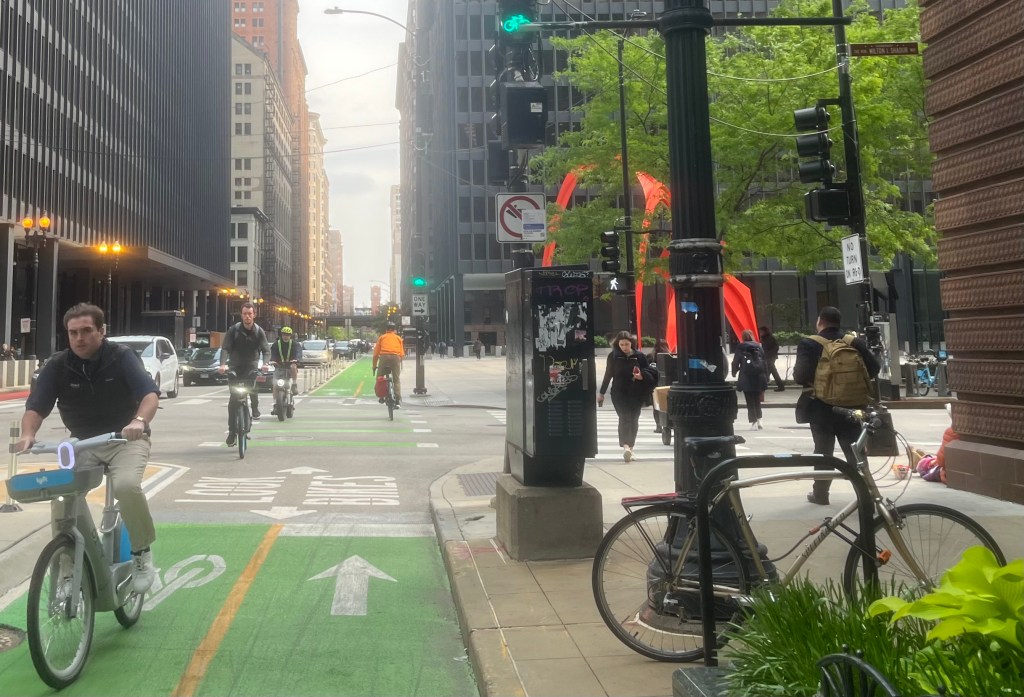
Predictably, drivers often complain loudly about new protected lanes. That’s especially true when their installation involves the conversion of mixed-traffic lanes or car parking spots.
But even bike riders sometimes have grievances with the design of protected lanes. However, that’s not much of an issue anymore on the Dearborn two-way. Also seemingly fairly popular nowadays is the similar bidirectional protected bike lane about half a mile west on Clinton Avenue between Fulton Market and Harrison Street on in the West Loop. Both Dearborn and Clinton are one-way for drivers.
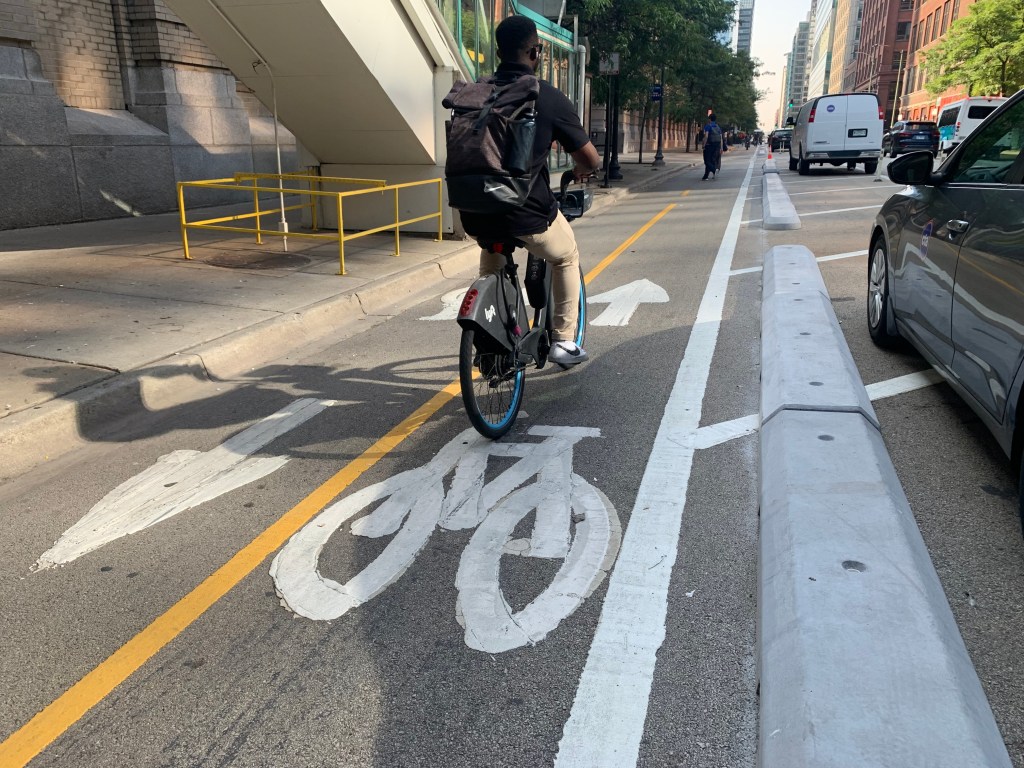
The Clinton two-way protected lane. Photo: CDOT
Recently, I wondered why two-way protected lanes aren’t more common in the Windy City, since they seem to avoid some of the drawbacks associated with some PBLs that run on both sides of a street. I floated that question to a Chicago Department of Transportation spokesperson.
“One common complaint about Chicago’s protected bike lanes is that they’re too narrow to comfortably pass other users,” I wrote. “That’s not really an issue on the popular Dearborn two-way protected lane.”
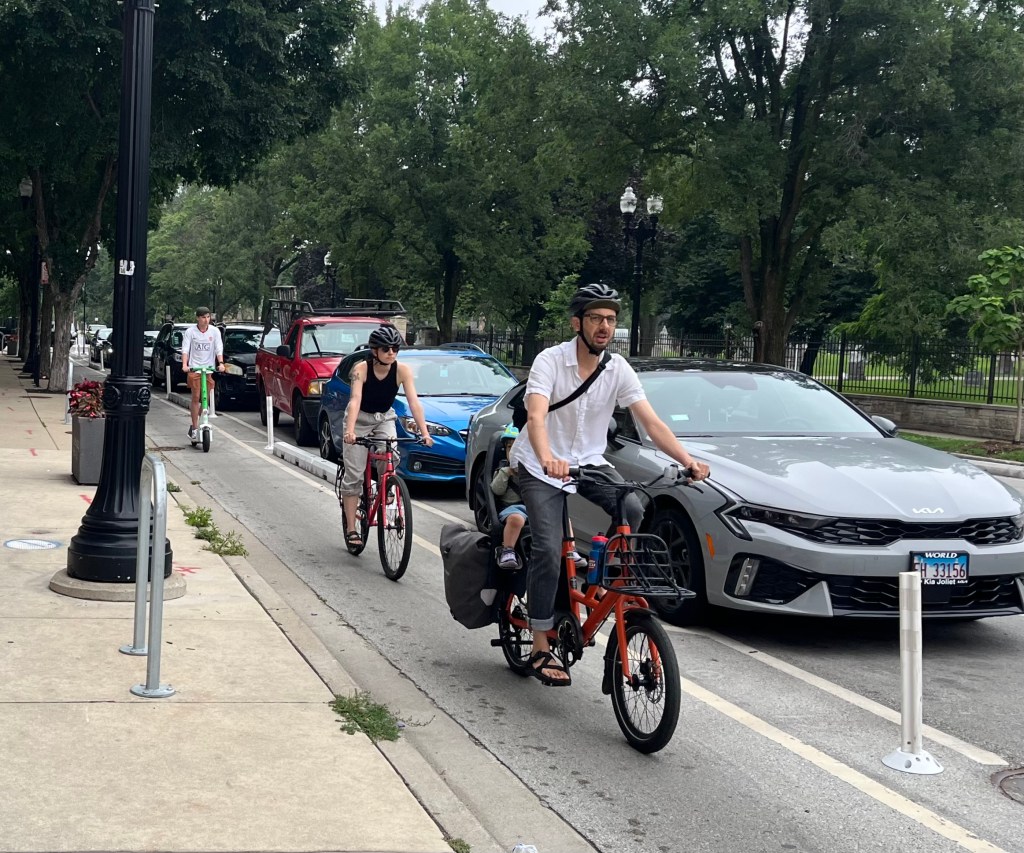
“A few other potential perks that spring to mind [about two-way bikeways] are easier sweeping and plowing of the PBLs and less right-of-way needed, which would could provide more space for wider sidewalks and/or reduce the need for car parking space conversions,” I said. “Has CDOT considered this approach on other streets? Is there any reason [the department] feels two-way PBLs wouldn’t work on two-way streets for drivers?”
“CDOT evaluates each corridor individually when determining the appropriate bikeway design,” replied the spokesperson. “Factors such as roadway width, traffic operations, transit needs, access to businesses and residences, and connectivity to the broader bike network all inform the design.”
“CDOT also follows the National Association of City Transportation Officials’ Urban Bikeway Design Guide, which identifies one-way protected bike lanes as the preferred treatment in most circumstances,” the spokesperson added. “Unidirectional bike lanes generally have fewer conflict points at intersections and driveways, require fewer modifications to traffic signal operations, are more intuitive for all road users, and better connect to the existing bike network.”
“Bidirectional bike lanes can be helpful in some situations,” concedes the NACTO guide. “Where there are significantly fewer intersections and driveways on one side of the street, a bidirectional bike lane may be safer and more comfortable. They can provide an important contraflow connection on a one-way street with motor vehicle volumes and speeds that preclude a bike boulevard [called a Neighborhood Greenway in Chicago] or advisory bike lanes. They may also be applied in highly constrained rights-of-way where minimums for all other street elements are already achieved, including the total number and width of general travel lanes.”
So what’s your take, Streetsblog readers? Is it fair to say CDOT’s and NACTO’s attitude towards “bi” bike lanes is straightforward, but not narrow?

If you appreciate Streetsblog Chicago’s livable streets reporting and advocacy, please consider making a tax-deductible donation to support our work. Thank you!

Read More:
Streetsblog has migrated to a new comment system. New commenters can register directly in the comments section of any article. Returning commenters: your previous comments and display name have been preserved, but you'll need to reclaim your account by clicking "Forgot your password?" on the sign-in form, entering your email, and following the verification link to set a new password — this is required because passwords could not be carried over during the migration. For questions, contact tips@streetsblog.org.