Extreme Makeover: Bus Station Edition. As the City greases the wheels to buy the terminal, Chaddick Institute proposes an affordable facelift


In September 2024, Greyhound owner FlixBus narrowly escaped eviction from its station, 630 W. Harrison St. in the West Loop.
But in November 2025, there was some great news from Mayor Brandon Johnson’s team: The City planned to buy and upgrade the terminal. Their strategy was to use about $50M in Tax Increment Financing money for the project, including $35M to purchase the facility, and $15M for a makeover.
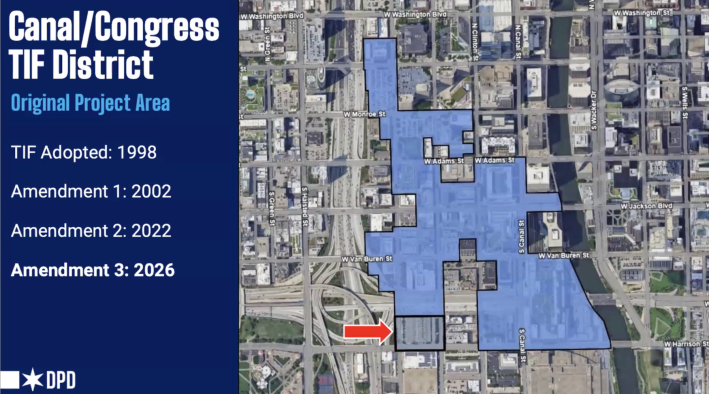
As reported today by the Sun-Times’ David Struett, the (bus) wheels are in motion to make this idea a reality. Last week, the Chicago Department of Planning and Development held a public hearing about enlarging the Canal/Congress TIF District to encompass the station. The proposal will be considered at the April Community Development Commission meeting. And after that, the plan to supersize the district may be voted on by City Hall’s Finance Committee, and then the full Council, the latter hopefully on May 20. If a majority of alderpersons sign off on the plan, the City might purchase the terminal later this year.
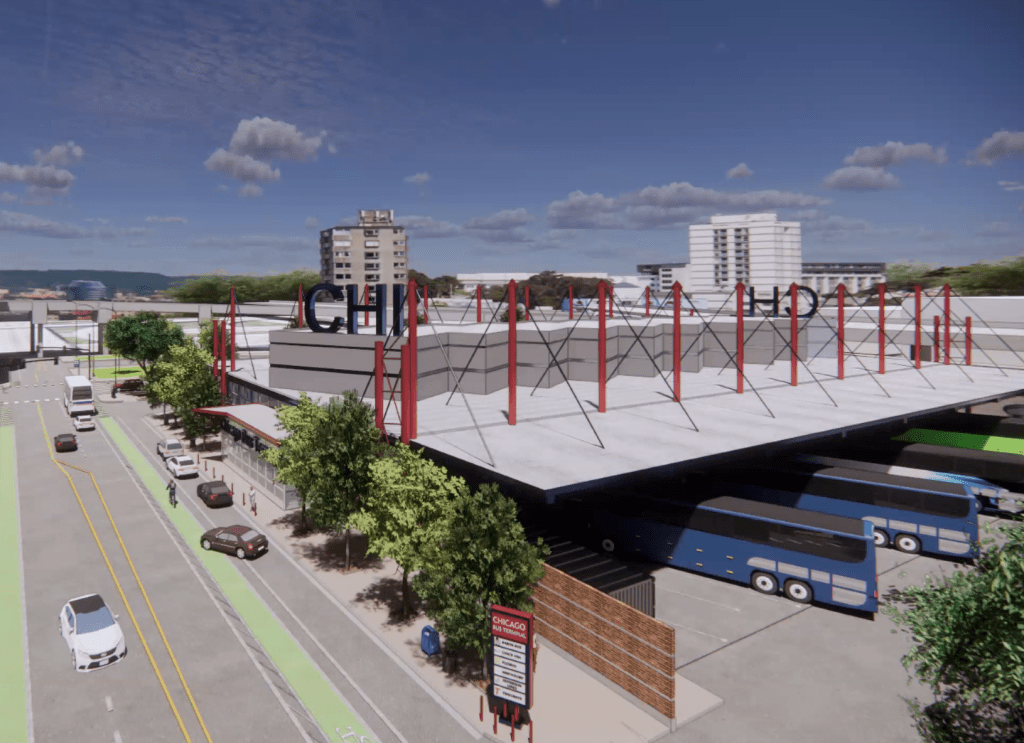
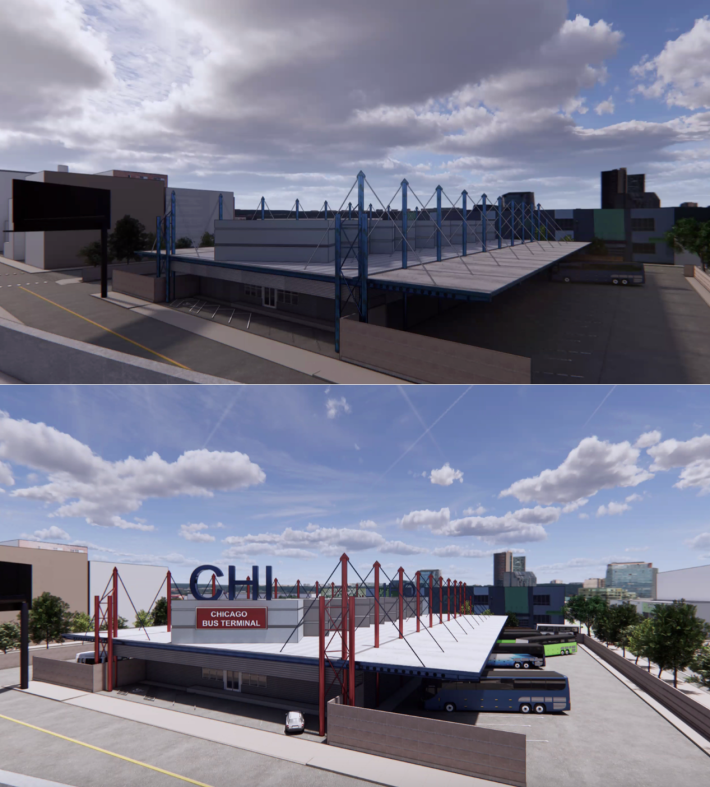
And the bus station situation shifted into a higher gear this afternoon when DePaul University’s Chaddick Institute for Metropolitan Development unveiled renderings of what an upgraded Greyhound station might look like. The think tank’s director Joe Schwieterman and urban planning assistant Nathale Nicoletti released their report, “Reimagining the Chicago Intercity Bus Terminal: A Proposal to Enhance a Critical Asset Under City Ownership.”
The Environmental Law and Policy Center hosted a lunchtime update on bus business, featuring the two report authors, as well as ELPC’s Deputy Director Kevin Brubaker and Better Streets Chicago Executive Director Kyle Lucas. The latter urged sustainable transportation advocates to lobby their alders and attend the public meetings to support the TIF zone expansion. He noted that bus travel, the most affordable mode of intercity transportation, is crucial for people from marginalized communities.
Schwieterman and Nicoletti went over slides of their redesign proposal. “We tried to use the placemaking principles, that people would be curious about taking a bus: ‘This looks interesting… let’s explore this. I’m sick of flying,’ and so forth, and provide views [of the renovated station] from the expressway.” He added, “We use the street wall across Harrison to do a little bit of branding. And borrowed some principles from airports with that ‘CHI’ theme we’re gonna use.”
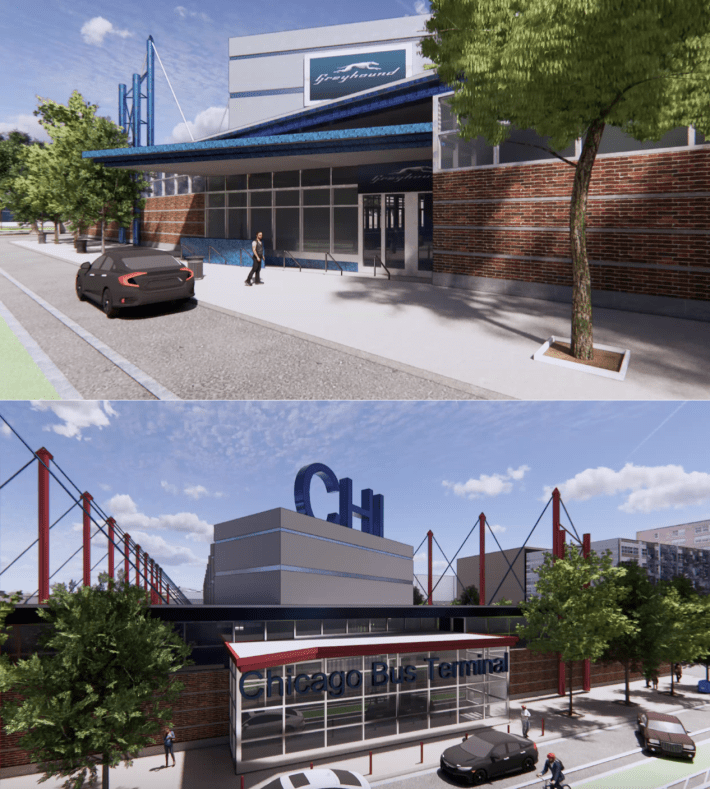
“For the new profiles, we can just set a new coat of paint and probably change the color scheme as well, more vibrant colors, Chicago flag colors,” Nicoletti said. “And we can see also a new glass entrance right in the middle. To create a possible partnership with the storage unit across the street, we can paint a mural. Art always bring identity to our place. So having a ‘Welcome to Chicago’ [mural], people can get a sense of belonging and arrival.”
“Structurally, this is not a big lift, but we’ll see with this clever branding, I think we can give [the station] a new look first,” Schwieterman said.
“The entrance is [currently] really hard to see,” Nicoletti said. “If you’re coming from the east or the west side, it’s not really visible. So the first thing to do was a glass entrance that is sticking out, and it stands out more from the side.”
“That’s a really exciting thing,” Schwieterman said. “This is not a billion-dollar wish list. This is just a super-modest change to an existing building. But the change is to the user experience, where the current situation is, you have to go down steps into a dark space. Down into dark is by its very nature, a threatening thing. And now instead, you’re going in at surface level into a well-lit space.”
Brubaker noted that the new entrance design eliminates eliminates an existing “blind corner” where “you don’t know who’s waiting around the corner. If you’re arriving at night, it can be threatening… [This is a] bright-lit thing where you can actually see your surroundings.”
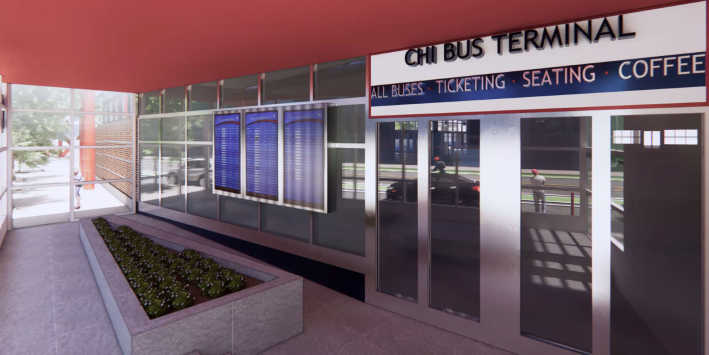
Schwieterman added that the glass enclosure gives passengers a high-visibility, weather-protected place to wait for a ride or ride-hail. “[People] taking the bus for the first time, they’re apprehensive, so it gets you kind of a comfort zone,” He said.
Next Nicoletti showed renderings of the north side of the station, as seen from Ida B. Wells Drive. “Right now we have a place that we don’t even know is a station,” she said. “So to bring in more a sense of belonging to the place, we added the same signage from the facade, which is the ‘CHI’ that can be perceived from far away, and by people coming from the interstate… You’ve got millions of people seeing this, so it becomes one of the most visible locations in the city.”
Watch a video of the webinar here:
Download the “Reimagining the Chicago Intercity Bus Terminal” report here.
Read the Sun-Times article here.

On November 12, SBC launched our 2026 fund drive to raise $50K through ad sales and donations. That will complete next year’s budget, at a time when it’s tough to find grant money. Big thanks to all the readers who have chipped in so far to help keep this site rolling all next year! Currently, we’re at $20,542 with $29,458 to go, ideally by the end of February.
If you value our livable streets reporting and advocacy, please consider making a tax-exempt gift here. If you can afford a contribution of $100 or more, think of it as a subscription. That will help keep the site paywall-free for people on tighter budgets, as well as decision-makers. Thanks for your support!
– John Greenfield, editor

Read More:
Streetsblog has migrated to a new comment system. New commenters can register directly in the comments section of any article. Returning commenters: your previous comments and display name have been preserved, but you'll need to reclaim your account by clicking "Forgot your password?" on the sign-in form, entering your email, and following the verification link to set a new password — this is required because passwords could not be carried over during the migration. For questions, contact tips@streetsblog.org.