O’Hare Area Bike Network Study takes off with first virtual meeting

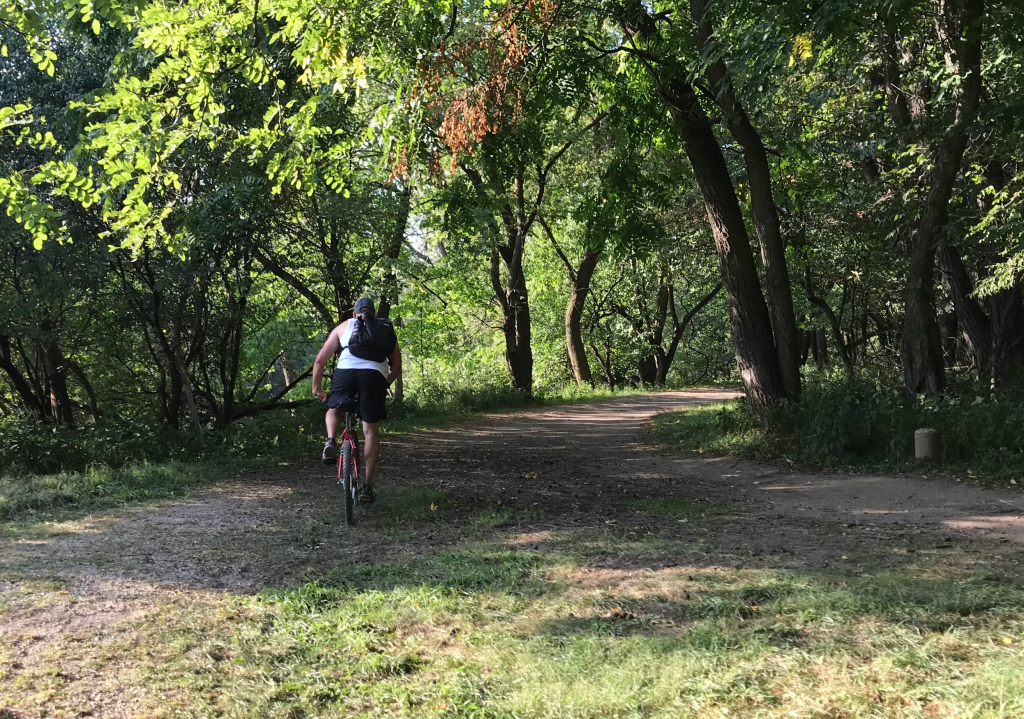
Last winter, the Cook County Department of Transportation and Highways create the O’Hare Area Bike Network Study to examine ways to create a more connected bikeway network in the communities surrounding the airport. The people working on the project include a steering committee and advocacy groups. Read Streetsblog’s previous coverage of the project here.
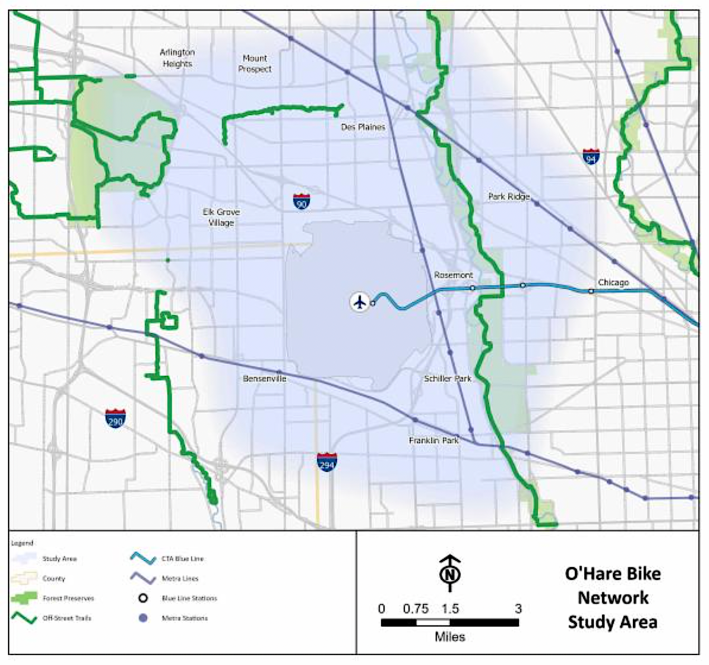
On Thursday, the first virtual meeting on the project took place. “The point of this was not, how do you get to O’Hare via bike,” said Ride Illinois Excutive Director Dave Simmons, who also serves as Friends of Cycling in Elk Grove Village, and has led a casual ride through a study area. “It was just in this area that lends itself to traveling by bike,” he said. “What’s the experience, what’s connected, what’s not connected? Where are the connection points between communities, and how can we improve some of the existing connections.”
The participants discussed the demographics of the study area. There are 178,000 residents, with a median age of 43. The median household income is $100,967, which is much higher than the Chicago region’s average of $87,766. Approximately 67 percent of total households include families, which is lower than the suburban Cook County figure of 77 percent. 6.5 percent of the workers who live around O’Hare do not own a car, the same percentage as in Suburban Cook County overall.
“Another important part of the attributes of residents of this county that we wanted to make sure we look at is the travel behaviors from the US Census,” said Jesse Thomas, a planner at the firm CDM Smith. “So these two pie charts show the difference between our study areas surrounding O’Hare and then suburban Cook County, which is Cook County minus the city of Chicago.”
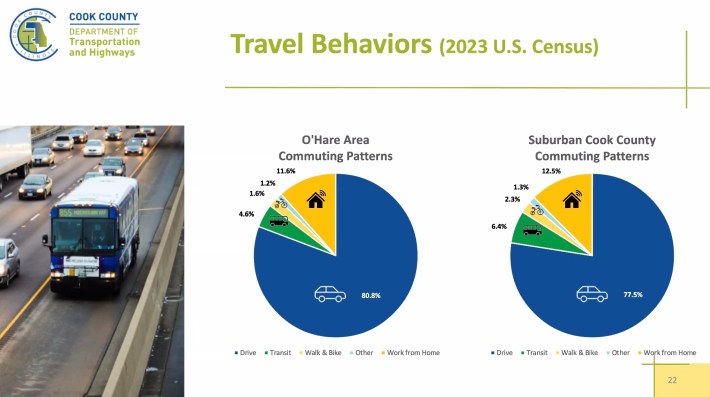
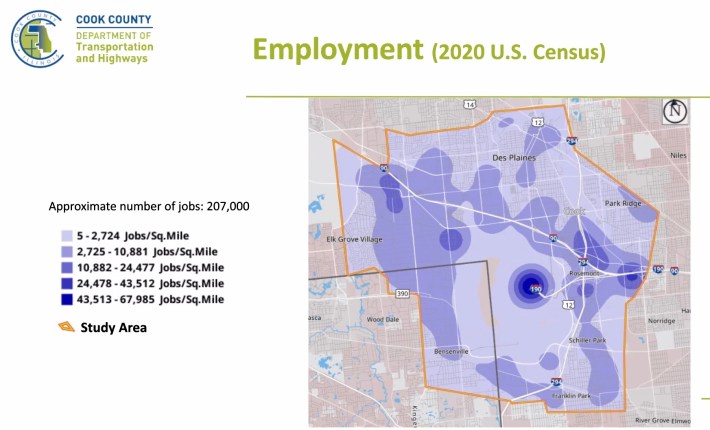
“You can see that suburban Cook County, elsewhere, actually has a bit higher transit use to get to work and a higher rate of biking to commute than our study area,” Thomas added. “So employment and getting to work are a big part of our study, because our study area has such a high level of employment. Again, according to US Census numbers, there are more jobs here than residents in the area, with about 207,000 jobs. A lot of these are, of course, from O’Hare International Airport itself.”
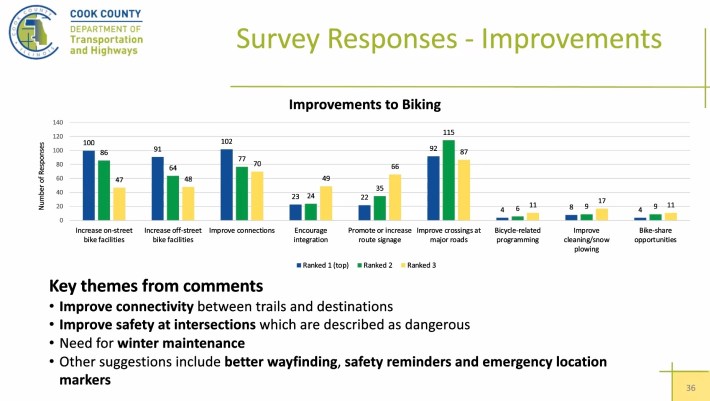
During the meeting, several surveys were available for people to fill out, adding to the data DoTH is collecting for the project. Once they’ve collected all feedback from the public outreach efforts, DoTh will use it to prioritize corridors for improvement and implementation based on transportation connectivity, proximity to trip generators, existing/anticipated demand, safety, and equity. The Steering Committee will review the study recommendations, and the finalized proposed corridors will be decided upon next year before subsequently being given to the public.
At the end of the meeting, there was an extended Q&A section where people on the Zoom call could ask questions. One of the questions related to something said earlier in the evening, that within the project area there are 425 miles of LTS 1 (lowest level of traffic stress) roads and 137 miles of LTS 4 (highest level of traffic stress) roads. An audience member asked how they were defining a low-stress bike route.
“Level of traffic stress is, or it’s from, specifically from our bike plan, but some metric that’s common in bicycle route planning, it’s where we look at bicycle facilities, where users feel comfortable because they have little risk of being hit by a [driver],” said Joseph Seymour, a planner at DoTH. “These are low-stress facilities you feel comfortable riding, whether you’re eight years old or 80 years old. So these low-stress facilities are often lower speed. They may have a bicycle facility. They often [have] street parking. And often the lowest stress facility is going to be a paved shared-use facility next to a roadway.”
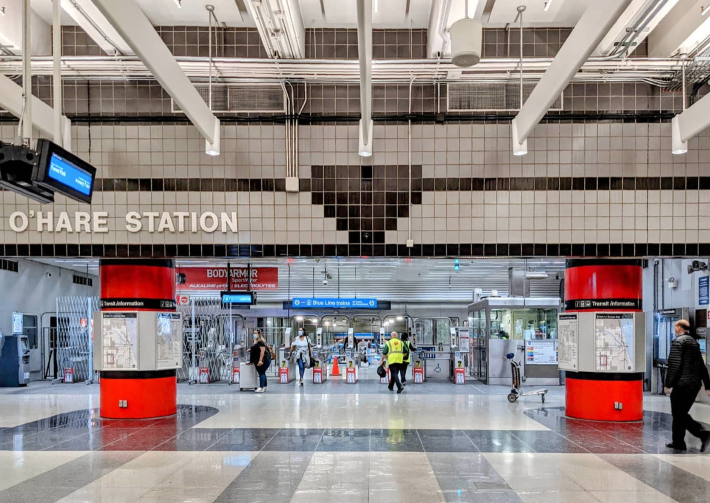
Another person asked whether this project will include bike storage at the airport, or if that already exists. “We’re aware of bike parking at the CTA station at O’Hare, and we’re not aware of any other parking at O’Hare itself,” Seymour replied. [Fun fact: Back in the mid-2000s when I worked as the Chicago Department of Transportation’s bike parking coordinator, I rode the Blue Line to O’Hare with the crew that installed the first parking racks inside the station. – John Greenfield, editor]
“Of course, we want to consider that many people are going to O’Hare not to travel but to work there, as I showed the data on employment at the airport,” Seymour added. “So, having bicycle parking as a benefit for potential travelers and employees, we are definitely putting it under consideration for our project. Still, ultimately it’s likely to be the Chicago Department of Aviation, CDA, or other land use owners that are connected to the airport that can do that, but that’s something we definitely want to consider and encourage where feasible.”

On November 12, SBC launched our 2026 fund drive to raise $50K through ad sales and donations. That will complete next year’s budget, at a time when it’s tough to find grant money. Big thanks to all the readers who have chipped in so far to help keep this site rolling all next year! Currently, we’re at $6,773, with $43,227 to go, ideally by the end of February.
If you value our livable streets reporting and advocacy, please consider making a tax-exempt end-of-year gift here. If you can afford a contribution of $100 or more, think of it as a subscription. That will help keep the site paywall-free for people on tighter budgets, as well as decision-makers. Thanks for your support!
– John Greenfield, editor

Streetsblog has migrated to a new comment system. New commenters can register directly in the comments section of any article. Returning commenters: your previous comments and display name have been preserved, but you'll need to reclaim your account by clicking "Forgot your password?" on the sign-in form, entering your email, and following the verification link to set a new password — this is required because passwords could not be carried over during the migration. For questions, contact tips@streetsblog.org.