As NYC eases fire department control over street redesign projects, Chicago’s fire chief calls for “more conversations… with CDOT”


According to our colleagues at Streetsblog NYC, last Election Day, local residents gave robust support for ballot initiatives to speed up the process of installing bus and bike lanes. One of the five proposals from Mayor Zohran Mamdani’s Commission on Government Efficiency, which called for repealing bureaucratic speed bumps to safer street redesigns, passed with two-thirds of the vote.
“Most recently, lawmakers last year passed legislation from Council Member Joanne Ariola (R-Queens) that required [the NYC Department of Transportation] to not only get the sign-off from the Fire Department headquarters, but also written confirmation that FDNY officials got feedback from all affected firehouses in the area of any three-plus-block project or open street,” explained SBNYC reporter Kevin Duggan.
“Prop. 3 eliminates that requirement by giving agency heads discretion over who must be consulted during the street redesign process,” Duggan added. “It also explicitly gives DOT the power to redesign a street regardless of whether those consultations have occurred. COGE officials say the changes will speed up live-saving street redesigns by ‘at least’ 33 percent.”
That’s great news for the Big Apple. Meanwhile here in the Windy City, Chicago Fire Department Commissioner Annette Nance-Holt recently called for more CFD influence on Chicago Department of Transportation Complete Streets projects. The commissioner is slated to retire from the department next May.
As previously reported by WBBM’s Geoff Buchholz, during a Chicago City Council budget hearing last Thursday, Nance-Holt attributed slower first responder response times to new traffic safety infrastructure. There was apparently no discussion of whether another possible factor in firetruck and ambulance delays is increased car traffic from ride-hail trips and retail deliveries.
The subject of CFD response times was raised by Committee on the Budget and Government Operations Vice Chair Ald. Nicole Lee (11th). It’s a very timely topic for her. On June 5, CDOT Complete Streets Planner Riley O’Neil, 35, was cycling on Halsted Street in Bridgeport in Ald. Lee’s ward, when a motorist failed to check for oncoming traffic and opened a car door on O’Neil, causing a deadly collision.
In the wake of that tragedy, sustainable transportation advocates have noted that the fatal crash wouldn’t have happened if O’Neil had been riding in a curbside protected bike lane. Some of them are calling for PBLs to be installed on Halsted in Lee’s district. When I asked the alder about that before a memorial ride for the CDOT worker, she seemed open to the idea. “It’s going to take all of us working together to get physical infrastructure that protects people better,” she said.
Here’s video of Thursday’s exchange.
And here’s a transcript of the discussion, edited slightly for clarity and brevity.
Ald. Nicole Lee: Does CDOT talk to you all in coordinating? [The fire commissioner turned her head.] I can see the eye roll. My question is, we’re adding infrastructure on our streets, whether that is a cul-de-sac, a speed hump, bike lanes. And I think that’s a very active conversation that’s going on right now. We try to make sure that we’ve had the conversation with the fire department locally. I wonder citywide how involved or not involved CFD is in those conversations about just how wide a street is, changes to the infrastructure. I recently met somebody who was a CTA bus driver who commented on the bike lanes. And she said, a bus is so wide and the street is really built for… and your rigs are just about as big as a bus.
Commissioner Annette Nance-Holt: Sometimes we learn about them after the fact. A lot of times… an example is Mount Greenwood, Engine 92, Truck 45, where they built a bump-out and it caused [a situation] where our fire companies couldn’t get in or out. They couldn’t make the turns. So I think, even at a fire, we’re challenged because… and we agree with pedestrian [safety infrastructure] and bike lanes. It’s not that we don’t agree with it, but when we add these things, it changes our tactics. It changes how we respond. Response times are going up, number one, because we have restricted lane usage. You might have one lane, or if we’re trying to get to a hydrant, we can’t access a hydrant because it’s restricted.
So there are a lot of things and a lot more conversations that need to go on with CDOT as far as that. It sounds really good, but we’re not thinking about the whole picture. And we have to think about how long is it going to take the fire department to respond. So now we’ve created more traffic in these areas as well. There is no way for us to get around for the paramedics or for the fire engines or trucks. And these are big pieces of equipment. They’re sitting there waiting just to get around because there is no clearance to get around. So those are serious concerns that need to be talked about with the aldermen, with the fire department, with the police department. They really do need to be talked about.
[End of transcript.]
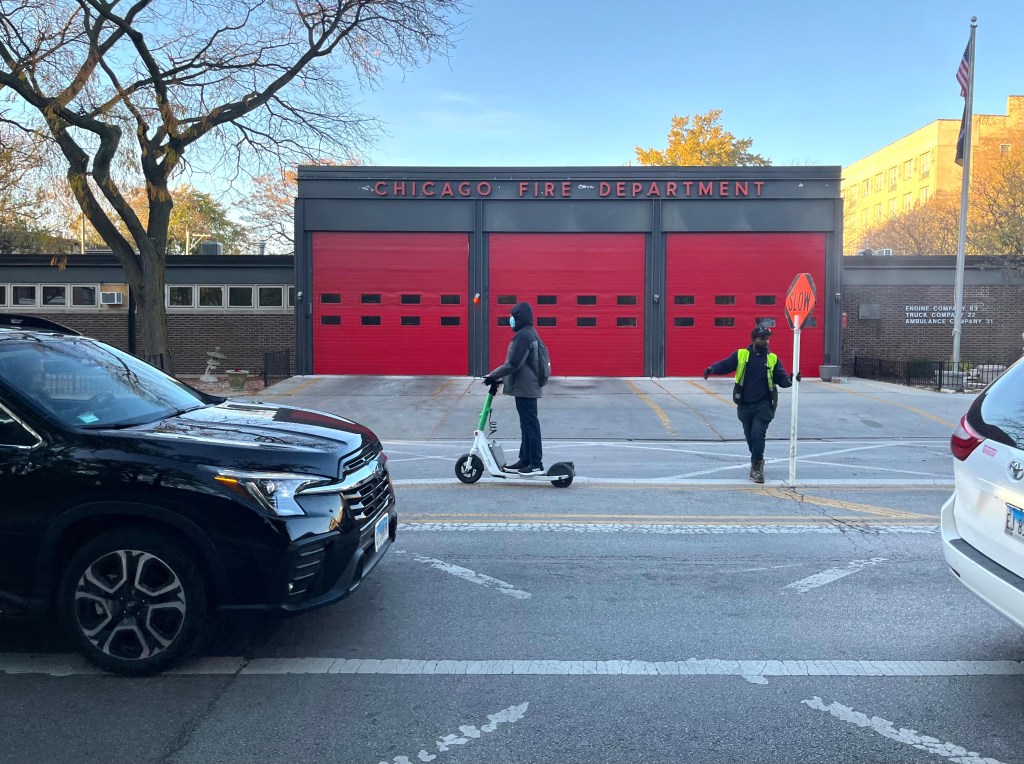
Here it’s worth noting that this seems to be the first time in recent years the the fire department has mentioned any problems caused by Complete Streets initiatives. On at least two previous occasions, CFD spokespersons indicated there weren’t any major issues with such projects.
In November 2023, neighbors told WGN’s Jenna Barnes that first responders were getting stuck in traffic because of new pedestrian infrastructure and protected lanes on Augusta Boulevard in West Town. “WGN News took their concerns to the Chicago Fire Department, whose spokesmen had not heard of any issues for firefighters,” Barnes reported.
And in March 2024, a resident contacted Streetsblog concerned that a mixed-traffic lane conversion on Dearborn Street on the Near North Side was delaying emergency vehicle drivers. However, CFD spokesperson Larry Merritt told me at the time, “To the best of our knowledge, no problems have been brought to our attention.”

Riding on reconfigured Dearborn near Chestnut Street in October 2024. Photo: John Greenfield
I also asked CDOT spokesperson Erica Schroeder about the Dearborn complaint. “CDOT always considers how changes in street design might affect traffic, including access for emergency vehicles and other essential services like garbage collection, snow removal, and street sweeping,” she responded. “In recent years, Chicago has significantly increased the number of curb-protected bike lanes that maintain on-street parking, including on Augusta Boulevard, Belmont Avenue, Kedzie Avenue, and others.”
“CDOT is not aware of any problems regarding emergency vehicle access along these routes as a result of the changes in street design,” Scheroeder said. “In fact, observations show that the addition of protected bike lanes have resulted in fewer people driving at dangerous speeds, making these corridors safer whether you are walking, biking, or driving.”
That is, reducing the need for ambulances in the first place.
As for Commissioner Annette Nance-Holt’s comment about “a lot more conversations that need to go on with CDOT,” such conversations have happened in the past. For example, at an October 2024 community meeting for the Granville Avenue traffic safety project, transportation department staff said they had already talked with the CFD about their proposal.

Image from CDOT’s presentation at the October 2024 Granville meeting.
Finally, it has to be noted that U.S. firetrucks are much larger than their counterparts in Europe and Asia. Our huge vehicles make American fire departments prefer wide travel lanes and turning radii – conditions that make serious and fatal traffic crashes more likely. But as retired fire chief Robert Avsec posted a decade ago, we need to make U.S. firetrucks fit our city streets, not the other way around.

That’s something to consider if we’re serious about making it easier for fire fighters to navigate Chicago’s increasingly car-choked roadways. We should move away from such “big pieces of equipment,” as Commissioner Nance-Holt said,

If you appreciate Streetsblog Chicago’s livable streets reporting and advocacy, please consider making a tax-deductible donation to support our work. Thank you!