View from the wheel: Dedicated bus lanes on DuSable Lake Shore Drive matter more than you think

This piece also runs on the website A City That Works, a newsletter about public policy in the Chicago region. It’s written by an anonymous CTA bus operator, whose opinions reflected in this article are solely theirs and do not reflect the opinions of their employer.
Last June, we ran another article by this transit worker, “CTA needs a better approach to Bus Control.”
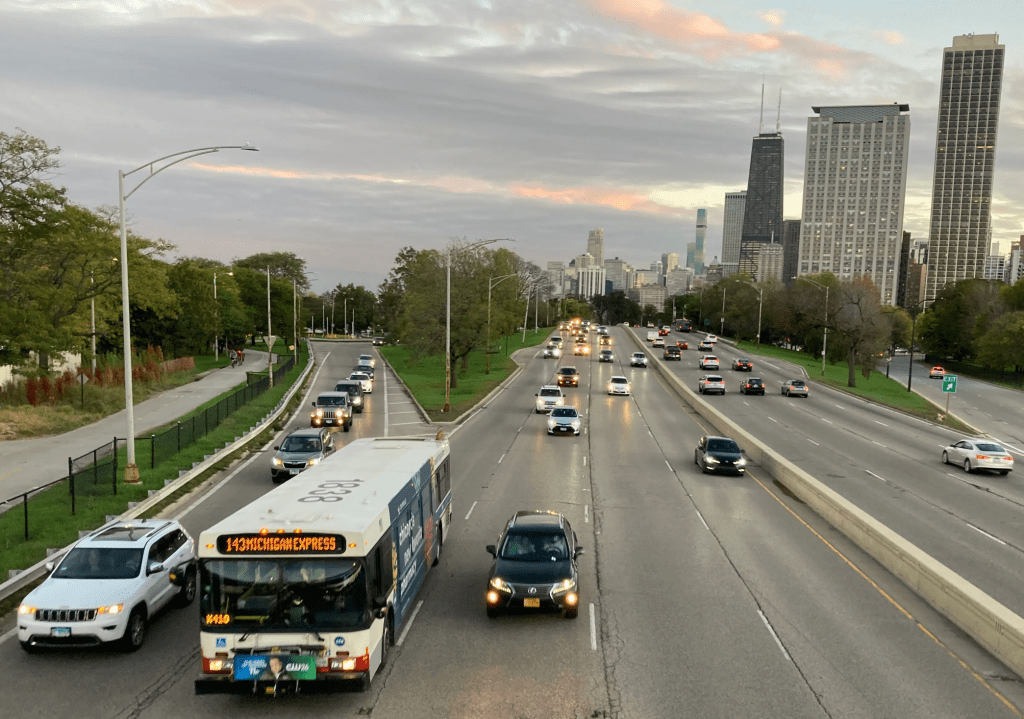
If you’ve spent any time around North Side transit advocates recently, you’ve probably gotten an earful about DuSable Lake Shore Drive. Key parts of our highway-on-a-lake are crumbling, and a number of agencies, led by the Illinois Department of Transportation, have a proposal on the table to mostly rebuild the drive as-is, with added space coming from lake infill. Transit advocates would like to see a more transit- and pedestrian-friendly alternative that doesn’t continue to cut communities off from one of our city’s greatest assets.
I’m definitely supportive of re-imaging the Drive, but I think even activists are underestimating how transformative prioritizing buses on DLSD would be. It would not only directly benefit express bus riders through reduced travel times, but enhance reliability and drastically reduce the costs of providing service across the entire CTA network.
The North Side’s DuSable Lake Shore Drive express routes are a very important component of CTA service. Weekday boardings across them are comparable with all Red Line stations in the State street subway (~28K bus boardings versus ~31K subway boardings). Planners and advocates alike correctly point out that several buses carrying 50-100 people stuck in traffic alongside cars usually carrying only one person is a waste of space and discourages people from using efficient transportation modes that get the most out of our urban space.
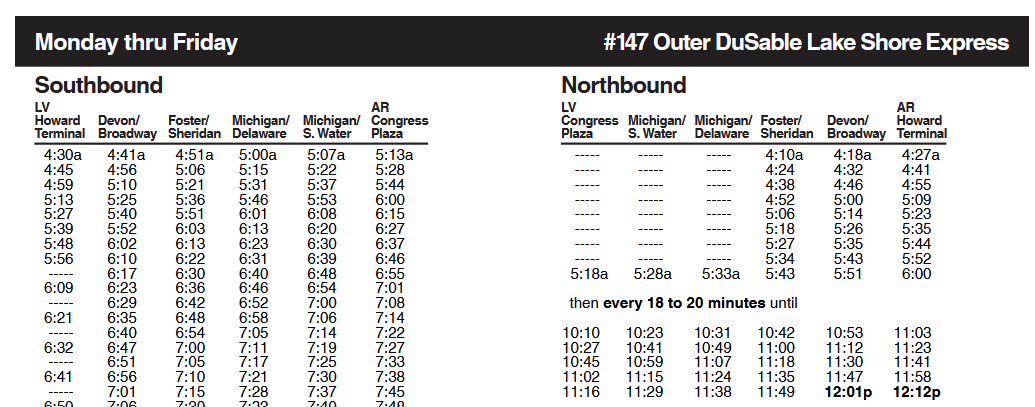
Obviously, buses carrying passengers are very important. But a functional network does not survive on in-service routes alone. In order for CTA to deliver rush hour service, it needs to be able to run more buses in the peak direction than the reverse-peak direction. For example, the 147 Outer DuSable Lake shore Drive Express runs to the Loop approximately every five minutes during morning rush, but only every 20 minutes out of the Loop. (See schedule below.) There are two primary ways the CTA manages this challenge. Operators either pull buses out from the garage and go directly to the beginning of the rush-direction runs, or operators will run out-of-service from another in-service run – sometimes on different routes – and position themselves at the beginning of the peak-direction run.
For example, the Kedzie Garage runs shortlined 151 Sheridan morning rush buses that enter service at Belmont Avenue, rather than their usual terminal way up at Arthur Avenue and Clark Street in Rogers Park. In order to arrive at Belmont, these buses either come up from Kedzie Garage via Interstate 290, Lower Wacker Drive, and DuSable Lake Shore Drive, or come back up from the Loop after finishing another bus route ending downtown. In both cases, these positioning moves are also subject to DuSable Lake Shore Drive traffic. The reverse is true in the afternoon – after completing their outbound run, these buses will deadhead down DuSable Lake Shore Drive back to the Loop, through Lower Wacker, then to Union Station to begin northbound 151 runs.
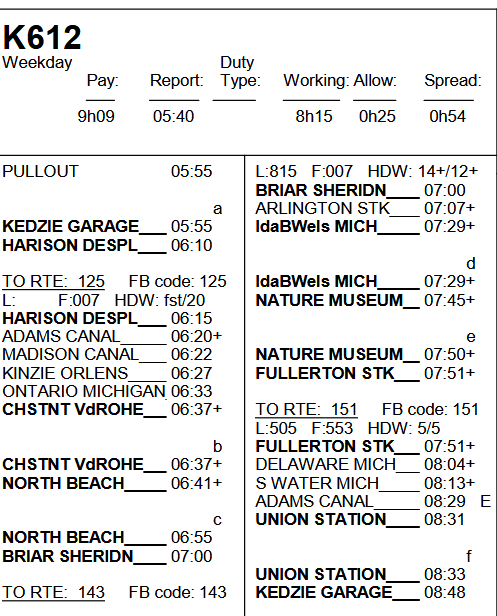
Run K612 does pulls out at 5:55AM, does a 125 Water Tower Express run, goes north via DLSD to do a 143 Stockton/Michigan Express run heading south, then goes back north on Lake Shore to start a 151 southbound run before pulling into the garage. See: How to read a Run Paddle
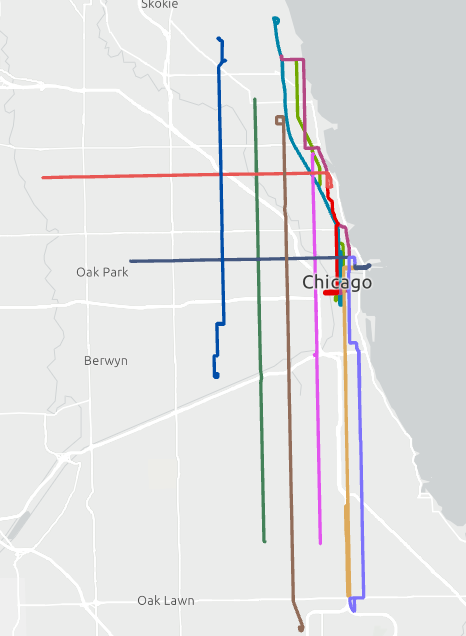
Even routes you wouldn’t expect to see on DuSable Lake Shore Drive make appearances. As highlighted in my previous article “Why are all the buses stacked together,” Route 66 Chicago does a few trips using North DuSable Lake Shore Drive briefly to reach Navy Pier. At least 13 other routes do similarly, mostly long north-south routes like the 9 Ashland or 22 Clark.¹ Of course, the Lake Shore Express routes also run deadheads in the reverse peak direction as well. That means that if DLSD is excessively backed up it can gut service on routes that do not actually run on the Drive, especially in the evening rush where buses are using it to head to the Loop for in-service trips out of the Loop, rather than mostly returning to the garage out of service.
Not Just Speed – Reliability
A final benefit of dedicated bus lanes is for restoration of service. When buses get knocked off schedule, many routes will be sent down DuSable Lake Shore Drive as an unscheduled detour to put them back on schedule. Faster, stable travel times make it easier to do so. For example, a 151 bus that’s far behind schedule arriving downtown might only need to deadhead down DLSD to North Avenue rather than Belmont to get back on schedule. This keeps buses in revenue service for more time and reduces the impact on the buses behind the delayed bus by better serving upstream waiting passengers.
The direct benefits of bus lanes for in-service travel are well known. But bus lanes would also improve speeds and reliability for deadhead bus moves that use DuSable Lake Shore Drive by avoiding delayed departures from terminals and minimizing big-gap situations. It would reduce time, and therefore costs, for buses heading back to the garage, allowing the CTA to either add more service or reduce operating costs. Ensuring all buses, in service and not in service alike, have a reliably smooth and fast trip on DuSable Lake Shore Drive has massive ripple benefits for the entire network, unlocking faster, more efficient, and more reliable operations for buses throughout the city.
1 Based on reading current run paddles the list is at least Routes 9 and X9 – Ashland and Ashland Express, 49 and X49 – Western and Western Express, 8 – Halstead, 3 – King Drive, 29 – State, 77 – Belmont, 82 – Kimball/Holman, 151 – Sheridan, 22 – Clark, 36 – Broadway, and 156 – LaSalle. I may have missed some.

If you value Streetsblog Chicago’s livable streets reporting and advocacy, please consider making a tax-deductible donation here to help us continue publishing. Thank you for your support!
Streetsblog has migrated to a new comment system. New commenters can register directly in the comments section of any article. Returning commenters: your previous comments and display name have been preserved, but you'll need to reclaim your account by clicking "Forgot your password?" on the sign-in form, entering your email, and following the verification link to set a new password — this is required because passwords could not be carried over during the migration. For questions, contact tips@streetsblog.org.