View from the wheel: CTA needs a better approach to Bus Control

This piece also runs on the website A City That Works, a newsletter about public policy in the Chicago region.
Note from ACTW:
“We strongly believe that if Chicago is to get better at delivering public services, we’re going to need to get better at listening to front-line public servants. So we’re very happy to run today’s guest piece, written by an anonymous CTA bus operator.
If you’re a bus or train operator, teacher, police officer, firefighter, or any other frontline employee, we’d love to publish your thoughts on how to improve your organization. Our bar for content is pretty high: We try to run things that will be helpful for the smartest member of the City Council.1 But we’re happy to work with you to turn a great idea into a great article.”
On June 6th, CTA exploded. Well, not literally, but between a sold out soccer match at Soldier Field, a Pokemon GO event so popular it may have crashed cell service downtown , Blues Fest, a Cubs game, an EDM Festival, a “return to” shorter weekend trains, and the Red Line running up top [see SBC post below], things were not great. As for me? I happened to be driving a bus that wound up 45 minutes late on a 90 minute trip.
My first trip of the day was a trip to the Loop. I did half of the trip pretty much on time – about five minutes late. Then I began to hit the events, and capacity quickly hit standing room only. Every stop became an exercise in reminding riders to let people off, then move back to take up the space so folks could board. My follower (the bus behind me) passed me briefly, then immediately also hit the same problem. As did their follower. Delays piled up, and then I hit Michigan (which basically cries out for bus lanes) and only got further behind. By the time I hit my terminal, I was 45 minutes late on a 90 minute trip. When I turned around I quickly wound up in a five bus bunch, with several of us running mostly empty the whole trip out of the Loop.
I arrived at my relief point (where drivers swap buses) 45 minutes late – and 15 minutes late to take over my second bus after my scheduled 30 minute lunch. The operator of my second bus had discharged their passengers and pulled into the garage just minutes before I pulled up my first bus. This left me to make a trip back to the garage, pull a new bus out, skipping my trip to the loop, and a good chunk of the trip back. I was told to go to a point partway into my trip out of the Loop, and enter service there. I arrived 10 minutes early, waited, and entered service… immediately next to my leader (the bus ahead of me), who was running late. I carried almost no passengers that trip.
So, at the end of what was scheduled as effectively two round trips, I had done a single productive trip to the Loop, a bus with passengers actively on it got taken out of service because I was so late, I missed a literal hour of being in service, and I spent a good chunk of time basically empty while bunched with other buses. That’s not ideal.
How does CTA respond to these problems?
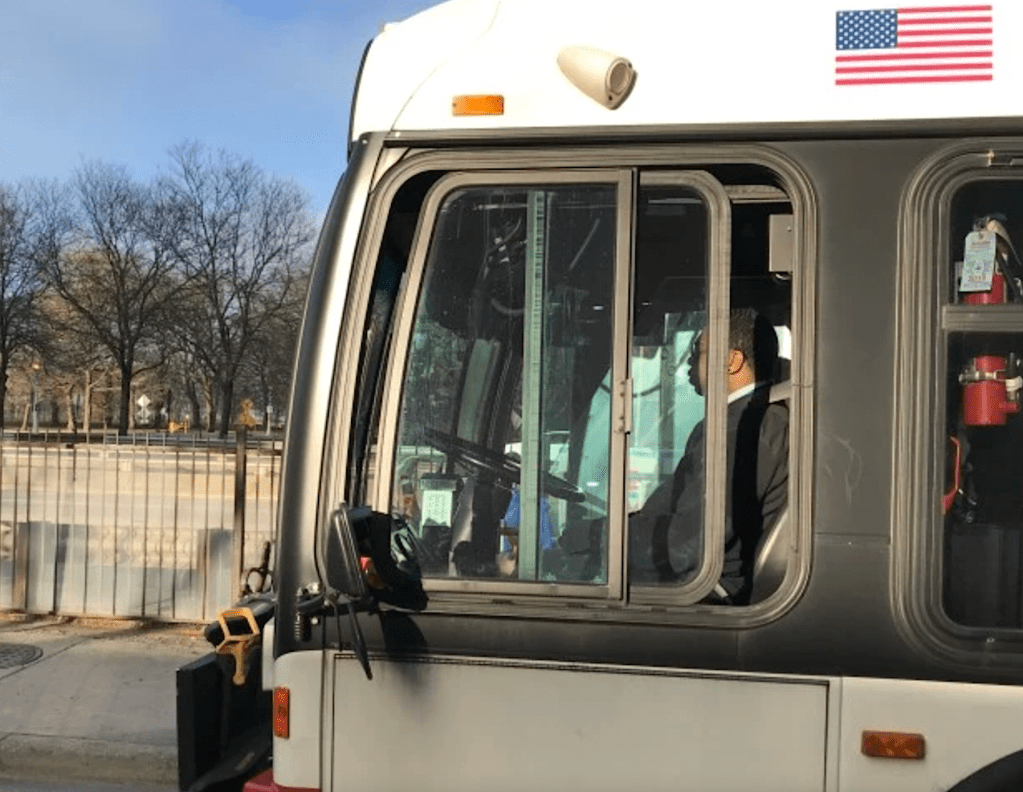
There is a CTA department tasked with responding to incidents and maintaining continuity of service for buses. It’s called Bus Control. If you’ve seen a CTA bus operator stopped at a random place, looking upset while talking on their phone, they’re probably calling Control. CTA buses also have devices that the drivers can use to send updates to and receive information from Control.
Control consists of a team of former bus operators tasked with coordinating with fire, police, supervision, and maintenance to address issues that come up with vehicles on the road. They worked several years as bus operators, then switched into supervision or another promoted role, and were then were promoted into Control.
This is great for a lot of situations. Control has seen it all: Bus engine is on fire? Here’s what to do. Customer is drunk and trying to start fights with everybody on board? They’re familiar.
What Control does not seem to be trained to do 2 is maintain consistent bus spacing and service. Anyone who has ever taken a “frequent route” (buses every 10 minutes or less, all day, every day – allegedly) can tell you bunching and gaps in service are extremely common, even at night when traffic issues should not be very impactful. In my experience, nighttime bunching is often just daytime bunching that has not been addressed.
Unfortunately there does not seem to be much emphasis on maintaining continuity of service. This makes sense. Control seems to be understaffed. With limited resources, putting out (sometimes literal) fires first is logical. But from both an operator and a rider perspective, this lack of effective resource management is very frustrating.
I had hoped that Control would take some action to help alleviate these issues and help me stay in useful service for more time, but despite me pushing the “Delayed” button repeatedly, no action was taken by Control to alter my trip.
Of course, around the same time, two articulated buses crashed into each other [after a car driver ran a red light], so I imagine Control had other things on its hands.
CTA should take bus spacing seriously
Bus spacing management is fundamentally a different skill than incident management, and there seems to be little emphasis on it or technology to support it. From Control and Supervision’s perspective, managing police, fire, supervisor, and mechanic response to incidents is their core function. Managing bus spacing seems to mostly be done in service to maintaining bus handoffs and post-incident schedule adjustments, and barely managed past that.
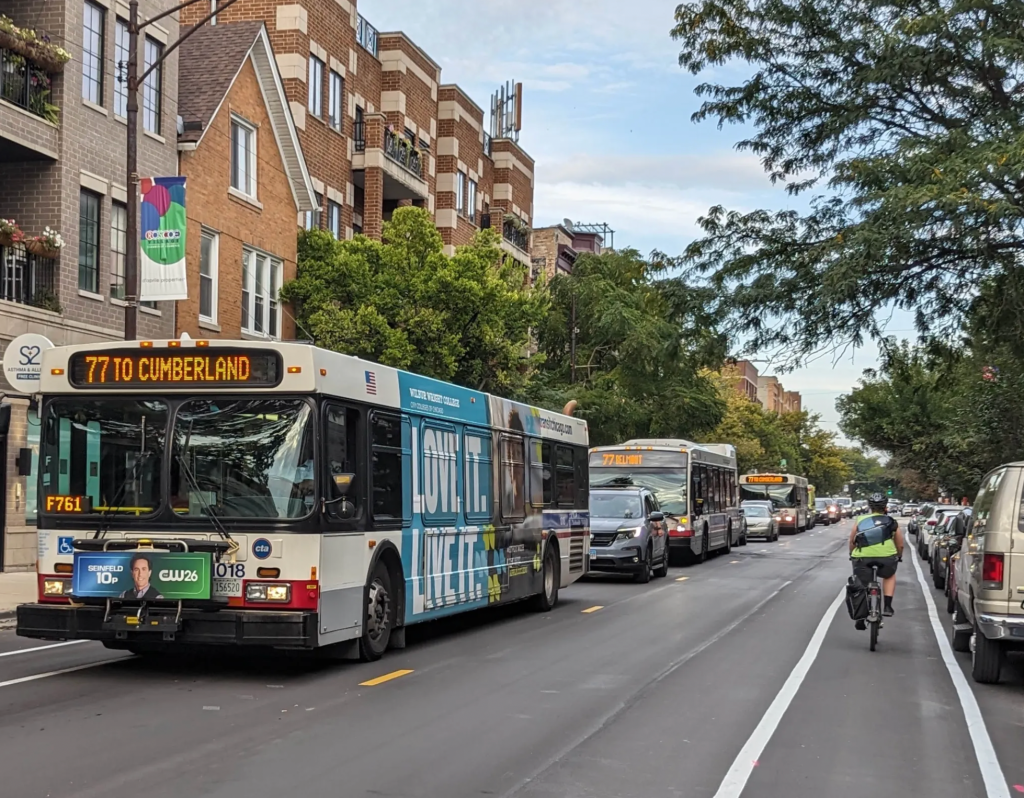
But from the perspective of operators and riders, this is the task that most impacts the average trip we take. If a bus is 15 or 20 minutes late to a stop, riders don’t really care what the cause is – they’re just frustrated and likely late for wherever they need to be.
The technology to do so also seems to be lacking. Supervisors rely on Bus Management Software that simply displays each of the runs, their schedules, and their current location in a text format (no map). This makes seeing the total state of the network very difficult. Sometimes, even this isn’t used. When my supervisor put me in place after pulling a bus out, they merely looked at my paper copy of my schedule, and said “go to this major street and leave it at your scheduled time.”
We need a new branch of Control
Rather than asking an incident response team to manage network and routing, CTA should create a second branch of Bus Control dedicated to managing bus spacing, establish new tools and practices to support it, and hire people with logistics management response for it – rather than strictly hiring former drivers. This would add a second team to Control, splitting the operation into Incident Response Control and Bus Spacing Control. Incident Response Control would consist of the current Control team, and focus solely on incident response.
What would this new Control team do, and how would it do it?
The new Control team would:
- Monitor the state of the bus network using map based tools, operator inputs, and information from the incident response Control team.
- Determine how best to redeploy buses and operators once incidents are resolved to maintain consistent service, and manage issues with reliefs.
To do this, the following changes in procedure and technology would be necessary:
- Passenger tracking: Buses have onboard passenger trackers that are supposed to send live reports to Control about passenger counts. If those aren’t working, CTA needs to fix the technology. And in the short term, drivers should have to make regular reports about the load status our buses.
- Bus tracking: CTA needs to add portable tracking modules to buses, to ensure that when the existing onboard tracking fails CTA can still provide accurate information to riders and Bus Spacing control.
- Mapping: Based on the inputs above, CTA needs to develop a standard mapping tool that displays the current location and direction of all buses on the route, how late they are, what kind of bus they are (articulated or standard), how many buses are in active service versus scheduled, and display the next action for the bus (eg, relief, turn around, deadhead to a different route, etc), and how late the bus will be to that next action
- Service restoration techniques: When things go sideways, CTA needs to move faster to use existing techniques of shortlining, deadheading and/or expressing buses to normalize service for riders.
- Rider-centric metrics: To improve service management, CTA needs to focus on metrics that matter to riders, including average time between buses, standard deviation in bus load along a route, worst gap in service, and percent of buses taken out of service with passengers on them by Control
- Digital schedule updates: When routes are modified, CTA needs to update digital schedules, rather than just providing verbal instructions to operators. Buses should not be sitting on the road waiting for police and supervisor response to incidents still showing as live runs. Buses should not be shortlined as “Out of Service” with no tracking (999 run code), but instead have their run paddle updated over the air (this is possible, but almost never done) to include the Out of Service travel as part of their run, so that folks who will be down the line of the bus entering service can know a bus is coming.
Let’s return to my trip, and see how this new Control might have addressed each issue, if it had occurred individually:
- Several standing room only buses bunched together headed to downtown: Shortline trips in response to events (and maybe schedule extra!) – The bus I was operating only ran a limited portion of its run though the event areas. By shortlining and turning around some buses once they passed through the event area and mostly emptied out, they could’ve alleviated some level of bus crowding, helping to speed all buses through the area and improve wait times for customers.
- Multiple buses leaving the terminal at the same time: Run buses “not in service” for a slight portion at the beginning of their trips – just half a mile or a mile, using highways if possible – to help prevent gaps in service. When three buses pull up to the terminal together, it makes very little sense to send them all out from the terminal together.
- More proactive relief management: Reliefs are a critical point for CTA buses – if a bus is taken out of service unexpectedly in the middle of the line, riders are left to wait an indeterminate amount of time to eventually cram onto the next bus, slowing that bus down as well. Bus Spacing Management should keep a close eye on reliefs, and swap schedules and operators around as available to keep buses on track
The new Bus Spacing Control team should also develop new techniques, through experimentation and based on best practices from other systems. The Bus Spacing Control team could be built gradually, starting with a few Controllers focusing on just a few sample routes.3 This would allow the operation to develop the skills and techniques to aid service and prove itself before spinning up a full operation.
We’ve built a system to manage the worst-case scenarios. That system performs relatively well at managing disasters. But in the process, we’ve neglected the needs of everyday users, and built an inflexible process that struggles to make regular, meaningful improvements.
CTA bus operations are far from the only place where this is true in government. Fortunately, this case presents a relatively straightforward fix. By investing a comparably small amount of resources into better management of its existing service, CTA could improve service by far more than spending large amounts of money dumping more buses and operators onto the road would. There’s no reason we have to ignore on-route bus spacing challenges, and a dedicated team at Control could make a world of difference.
Edit: This is also not a foreign concept to CTA. As a reader points out below, CTA developed a prototype transit headway control tool in 2022-2023, that appeared to deliver improvements. Unfortunately, it appears to have been abandoned since. CTA should take this approach the learnings from the pilot to help support the new Bus Spacing Control Team.
The author is a CTA bus operator. The opinions reflected in this article are solely theirs and do not reflect the opinions of their employer
1 Yes, we’re referring to you Alderman.
2 Note that this is my perspective as an operator, and validated by some inquiries to others with knowledge of CTA operations by A City That Works. But if you work in Control or supervision and think I’m missing something here, please reach out to the A City That Works team. I’d love to talk to you off the record, or even write a follow-up article with you.
3 To cover a range of different situations, I’d suggest two long routes, one high frequency with an X counterpart, one low frequency, two short routes, one high frequency, one low frequency, an AM/PM highway express route, and an all-day highway express route.

On November 12, SBC launched our 2026 fund drive to raise $50K through ad sales and donations. That will complete this year’s budget, at a time when it’s tough to find grant money. Big thanks to all the readers who have chipped in so far to help keep this site rolling to the end of 2026! Currently, we’re at $34,046 with $15,954 to go, ideally by the end of June.
If you value our livable streets reporting and advocacy, please consider making a tax-deductible gift here. If you can afford a contribution of $100 or more, think of that as a subscription. That will help keep the site paywall-free.
Streetsblog has migrated to a new comment system. New commenters can register directly in the comments section of any article. Returning commenters: your previous comments and display name have been preserved, but you'll need to reclaim your account by clicking "Forgot your password?" on the sign-in form, entering your email, and following the verification link to set a new password — this is required because passwords could not be carried over during the migration. For questions, contact tips@streetsblog.org.