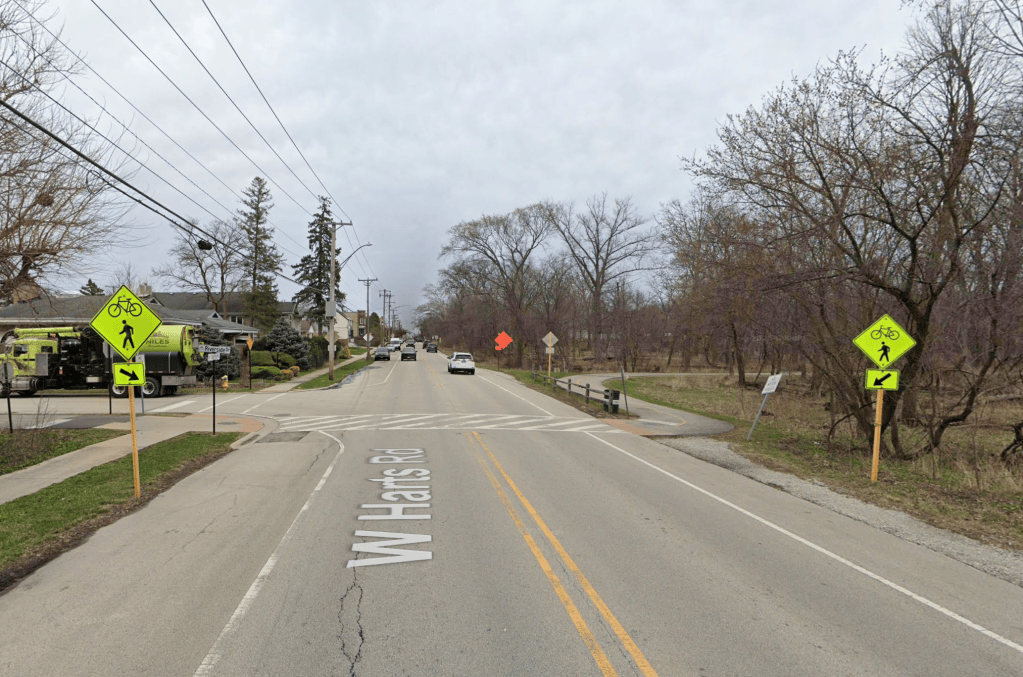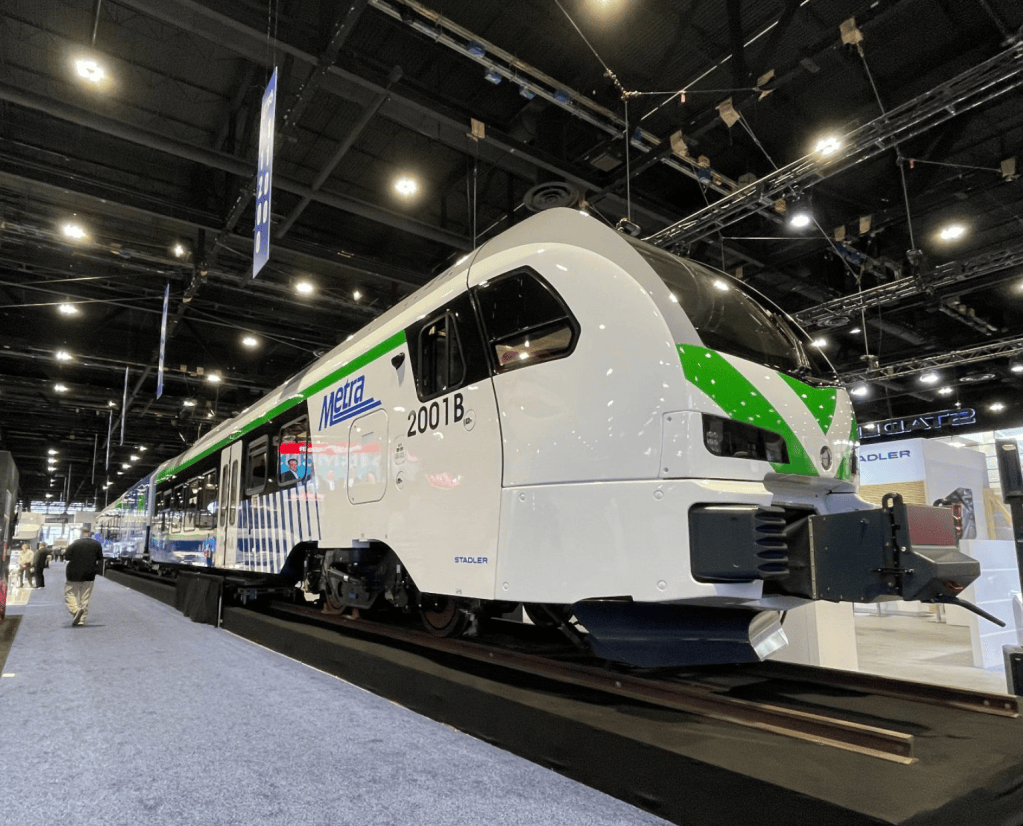
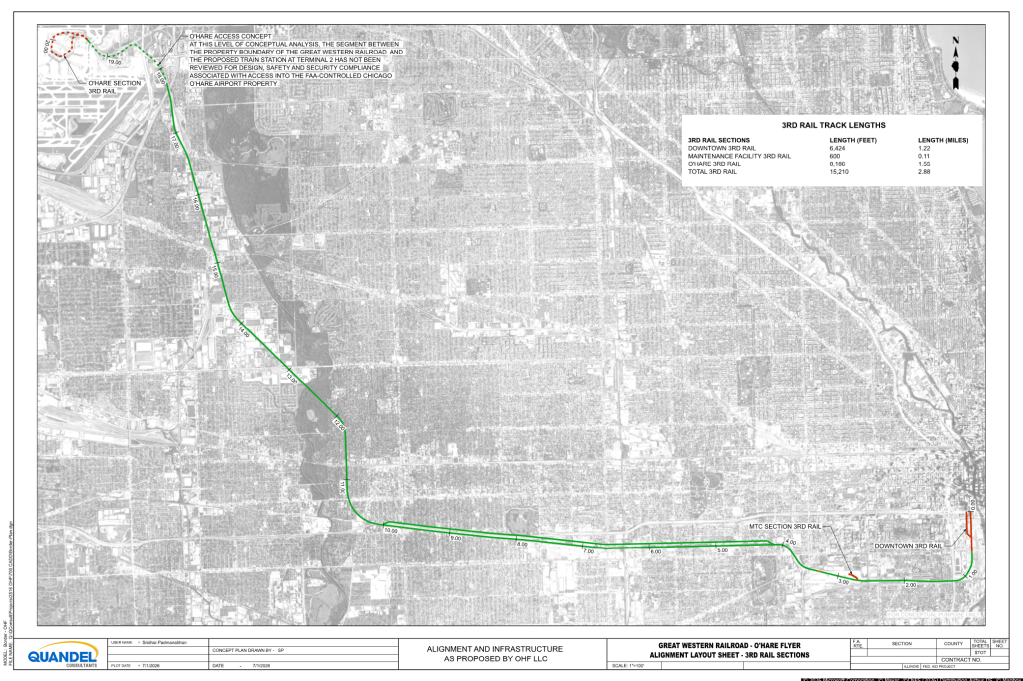
Wait, *how* exactly are the 14 miles of single track and 6 miles of double track for the O’Hare Flyer supposed to work?

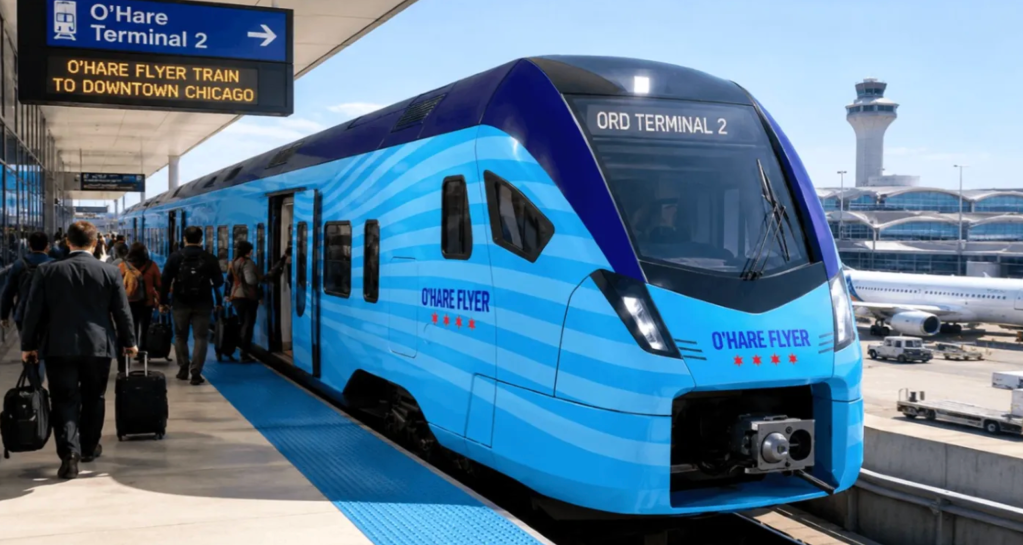

When it comes to the O’Hare Flyer (ORDF) proposal that was announced last week, promising 15-minute battery-powered train trips, four times an hour, between the West Loop and O’Hare Airport, I’m still agnostic.
On the one hand the team, made up of heavy-hitters in the railroad, urban planning, and financing fields, and key players in other relevant professions, have been working on this idea for years. Some people I regard as reliable authorities on train issues, including Chaddick Institute’s Joe Schwieterman and High Speed Rail Alliance’s Rick Harnish, gave me optimistic statements about the O’Hare Flyer pitch.
And, to be honest, I’m delighted by anything that tacitly throws shade on Elon Musk’s ridiculous late-2010’s O’Hare Express scheme. That podcast pipe dream allegedly would have involved digging a 17-mile tunnel to the airport for 100 mph “electric sled” service, with the fictional price tag of only $1 billion total.
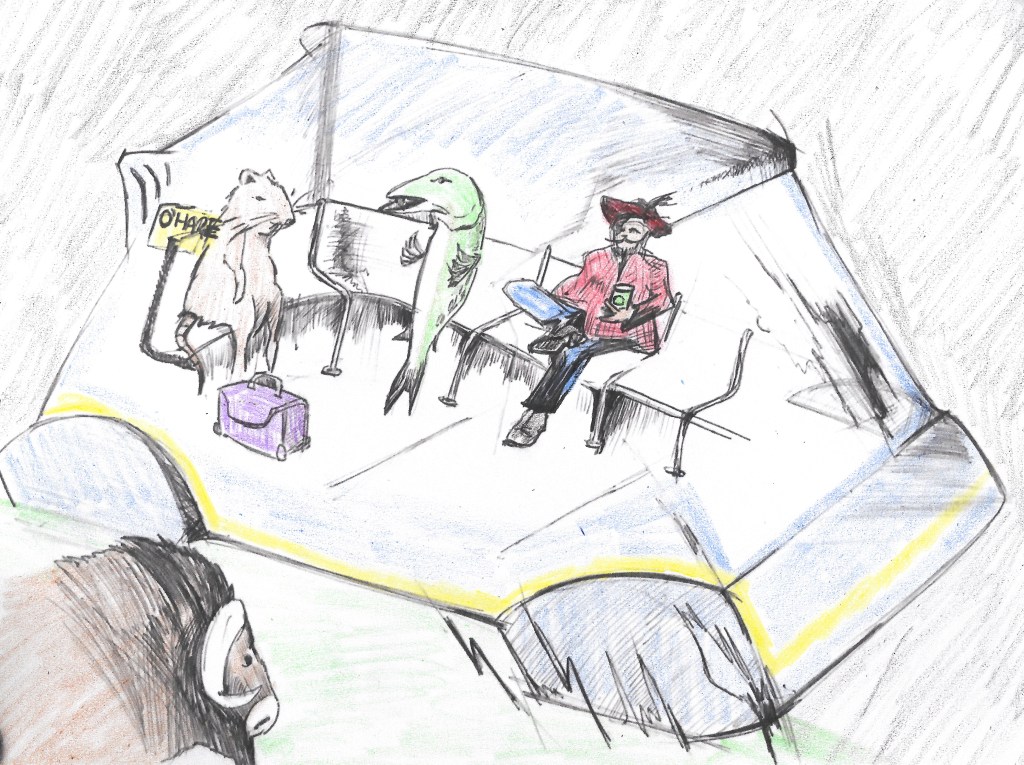
Artist’s rendering of one Elon Musk’s non-existent “electric sled” pods, featuring a musk ox, a muskrat, a muskie, and one of “The Three Musketeers.” Illustration: Jonathan Roth
On the other hand, offering “safe, reliable, world-class” transit service, according ORDF Founder and CEO Dave Lundy, to those who can afford it, as an alternative to the Blue Line, raises equity issues. While the CTA option is transit for the masses at $5 or less, I haven’t heard of any big plans to make it faster, more frequent, and more dependable.
And the proposal has already been getting a significant amount of opposition and skepticism based on other concerns. Crain’s recently reported on “Not In My Back Yard”-style pushback from residents west-suburban River Forest, which includes the new proposed high-speed rail corridor.
The Chicago Tribune, whose editorial board gave a full-throated endorsement of the O’Hare Flyer plan on the morning it was announced, has also published two letters voicing opposition so far this week.
“A much cheaper and more efficient way to accomplish [express service to O’Hare] is by utilizing existing CTA infrastructure,” claimed Chicagoan Paul Juettner, who appears to be a retired patent and trademark lawyer, in his LTTE. “Existing CTA trains could be configured to run express.” Of course, that would require converting a lane or two of the Kennedy Expressway. But given what’s been going on with the planning process for the North DuSable Lake Shore reconstruction recently, that’s actually not such a far-fetched idea.
Glenview resident Bruce Nathanson, who wrote that he has “dealt with numerous railroads during my professional career,” ridiculed the ORDF idea. “There is no way on earth that you can safely operate a train traveling at grade level, involving three railroads, with multiple interchanges that can get you from downtown to O’Hare. I assume that the private investors floating this project also believe in Santa Claus.” Ouch!
But, as I wrote last week, one O’Hare Flyer nonbeliever whom I’m inclined to give some credence is Jarrett Walker, a Portland, OR-based transit analyst who previously did consulting work for the CTA. (I realize I’ve been giving this guy a lot of airtime on Streetsblog Chicago lately, but he said some very astute stuff about yesterday’s Northern Illinois Transit Authority launch.) Here’s what he posted on the day of the ORDF reveal.
To recap, an O’Hare Flyer responded to SBC that day, “Jarrett Walker’s assertion is incorrect, because the design of the route and the project’s agreements will allow for redundancies to preserve the availability of 15-minute service.”
The next day, ORDF Chief Development Officer Mark Walbrun, a railroad industry vet, provided more explaination. “If you look at a Google Earth at the line that is there, you’ll see a single track,” he said. “That’s actually not the track we’re using. These railroad rights of way are about a hundred feet wide. We need twenty feet. We’ll be setting up our track on their right of way, but not their track. So they will still continue to use other track for their purposes.”
“And the arrangement that we have, it’s a little different with each railroad, but it’s that we will do some upgrades to their tracks, so that from time to time if we have to service our track, or if there’s an emergency, we can switch to their track,” he added. “So there’s a lot of redundancy built into the system.”
That day, the O’Hare Flyer contingent also provided a full statement about its Plan B strategy for maintaining reliable service in the event of mechanical snafus. I ran that last week, but if you haven’t seen it yet, I’ve re-posted it in italics at the bottom of this article.
I shared the ORDF gang’s statements on social media via the SBC accounts, and invited Jarrett Walker to respond to their statement that his “assertion is incorrect” He declined.
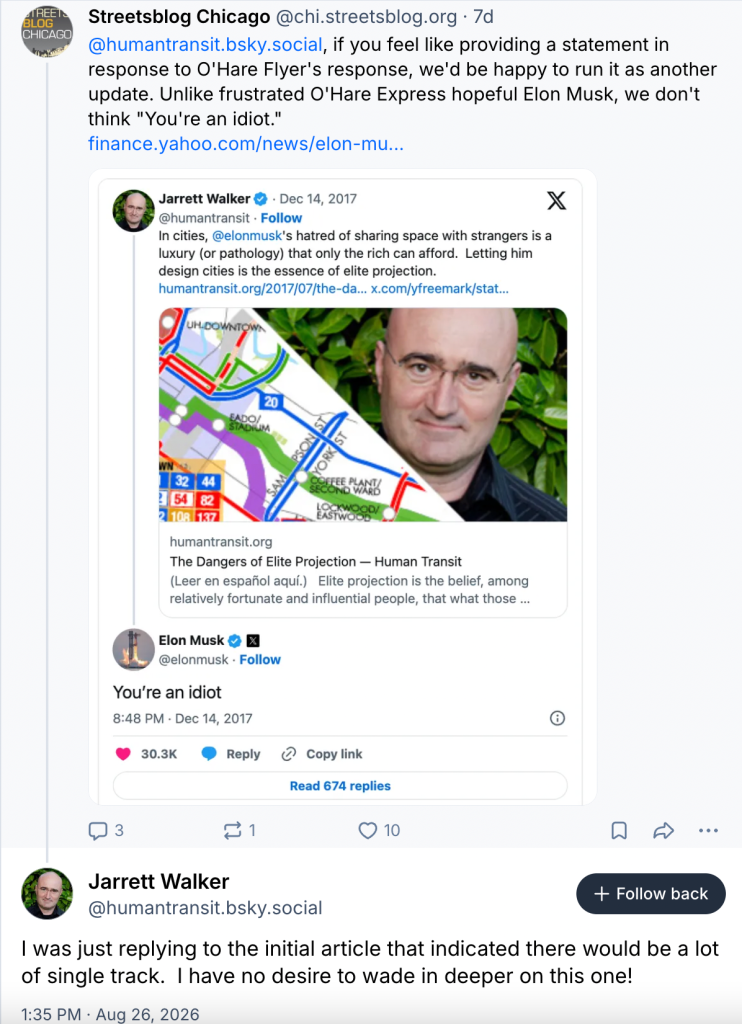
I asked which “initial article” about the O’Hare Flyer he was talking about. “Sun Times,” Walker replied. “Its article, at the least of the time that I read it, indicated that there would be long stretches of single track.”
Indeed, that article by David Struett who, like the Tribune, was given a sneak peek at the proposal and published at 5 a.m. on the day it went public, said, “Trains will run along a single track, except for six miles of double track midway along the route so trains can pass each other.” That info was attributed to ORDF CEO Dave Lundy, who presumably knew what he was talking about.
“I’m still a little confused here,” I wrote to my O’Hare Flyer contacts after reading that Sun-Times passage. “I don’t see how ‘the design of the route and the project’s agreements [allowing] for redundancies to preserve the availability of 15-minute service’ [as ORDF’s press release stated] would make much of a difference for maintaining consistent 15-minute trips.”
An O’Hare Flyer staffer replied that the Sun-Times statement was correct. He explained that the plan is to use six-miles of ORDF-exclusive double track as a zone for passing. But he added that the newspaper didn’t mention that the express trains will also have access to the parallel freight track.
Unlike a diesel locomotive, the battery-powered trains they plan to use have few moving parts, making them quite reliable, the staff member asserted. Her also said the team has a multifaceted strategy to address any service problems that may arise, and their operator has significant single track service, not unlike Utah’s FrontRunner train, which serves Ogden, Salt Lake City, and Provo.
To illustrate why the O’Hare Flyer team is confident that having a roughly 20-mile route with 14 miles of single track will still allow for reliable 15-minute service, the staffer described this scenario. An outbound train would leave the West Loop, from its station next to the Old Post Office, 433 W. Van Buren St., every quarter of an hour. Also every 15 minutes, an inbound train would leave the station in Terminal 2 of the airport. They’d depart simultaneously, say at 2 p.m. Around 7 minutes after that, the O’Hare-bound run would enter the northernmost of the double tracks, while the downtown-bund train wold enter the southernmost track. They’d pass each other two minutes later on separate tracks, like ships in the night.
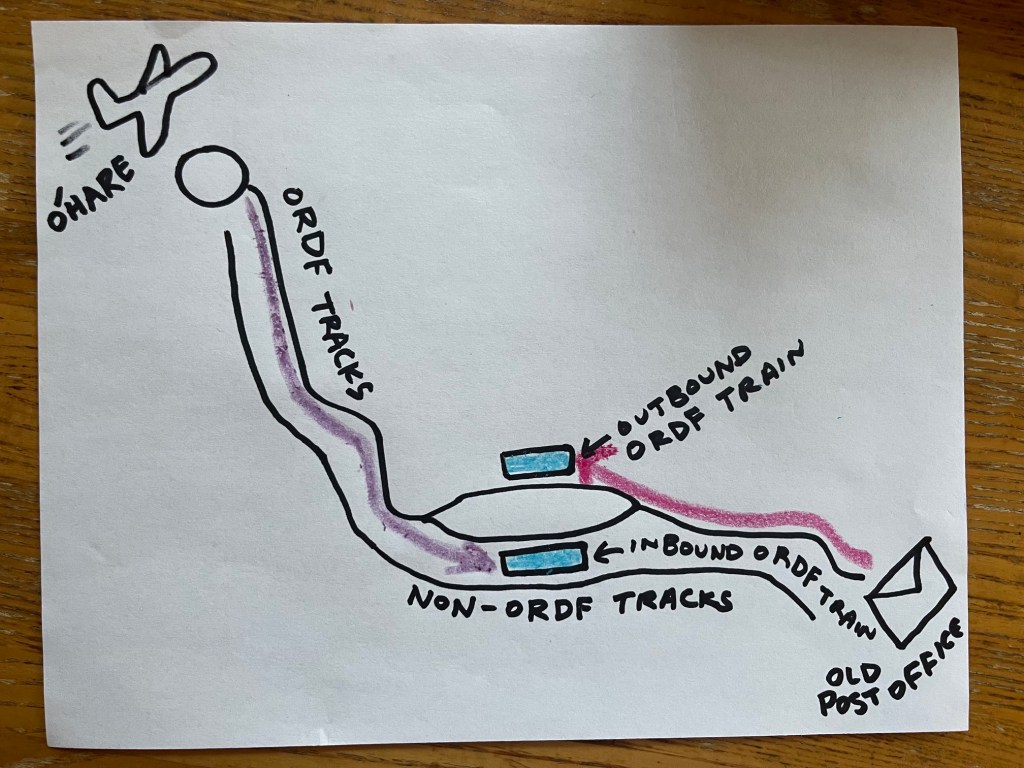
By 2:11 p.m., the O’Hare Flyer trains would both leave the double-tracked section for the single track again, trading places, the staff member said. Since there’d be no further obstruction, they would each arrive at their destinations by 2:15 p.m..
The staffer mentioned that the mechanics for this sort of operation for two trains passing at full speed were worked out in 1850’s rail manuals, and have since been used nationwide. And he confirmed that no other passenger or freight trains will use the O’Hare Flyer’s tracks, whether in the six miles of the ORDF’s double tracks, or the 14 miles of the express line’s single track.
Well, that all seems to make sense to me. I’m still curious exactly how it’s possible for the O’Hare Flyer to have its own private single track in the congested West Loop and O’Hare districts, but I didn’t want to team them too much for details this time. So I’ll try to report on that topic in the near future.
ICYMI, here’s the statement from the ORDF folks that I shared last week.
Managing potential service disruptions due to train mechanical issues
The proposed O’Hare Flyer trainsets are designed to be highly reliable. Unlike diesel locomotives, there are few moving parts. The trains run off battery cells driving traction motors. Following are unlikely failure modes and responses going from rare to almost impossible:
- If one of the multiple traction motors fails, the operator will get a warning, and the train system will isolate that motor automatically. Since the trainsets have eight motors, one failure would not have any impact on the operation.
- If one of the multiple battery systems fails, the operator will get a warning, and the train system will isolate the battery pack automatically. Since the trainsets have multiple battery packs, one failure would not have any impact on the operation.
- The trains are actually made up of two full trainsets each with four cars and “powerpack” which contains the batteries. Each set can operate independently. If an entire set fails (both batteries and traction motors) then the other set can either push or pull the remaining set at a somewhat reduced speed.
- If the failure is such that one the trainsets are fully disabled, then we can disconnect the two sets from each other (it is automatic and takes about 10 seconds) and then proceed to the nearest station with the functioning half after moving the passengers to that trainset. In that case our locomotive will be dispatched with a maintenance crew to retrieve the disabled trainset and return it to the yard. This can be completed in less than 30 minutes.
- In the case of a significant delay, we have track alternatives. The CSX section has a full 6 mile double track used for passing to and from the airport. In the event of a disruption on this segment, we would simply operate temporarily as a single track with trains taking turns. There is also a third track used for freight which can be used as an alternative. On CN there is parallel freight track which is being upgraded for passenger speeds and can be accessed in an emergency. On UP there is a two-mile double track with one of the tracks used to access the maintenance center but could also be used to bypass the main line.
- The downtown station has a two-track platform with a full train on “hot stand-by” to protect the operation to the airport. If any problem occurs on the planned train, we simply move to the other train.
- The airport platform can hold two full trains. If one of the trains is fully disabled, we can still berth the next one and reverse out on the loop back to downtown.
As you can see, there are multiple options to quickly restore service in the event of an extremely rare event of a two fully independent trainsets being disabled.

Did you appreciate this post? Streetsblog Chicago is currently fundraising to help cover our 2025-26 budget. If you appreciate our reporting and advocacy on local sustainable transportation issues, please consider making a tax-deductible donation here. Thank you!

Read More:
Streetsblog has migrated to a new comment system. New commenters can register directly in the comments section of any article. Returning commenters: your previous comments and display name have been preserved, but you'll need to reclaim your account by clicking "Forgot your password?" on the sign-in form, entering your email, and following the verification link to set a new password — this is required because passwords could not be carried over during the migration. For questions, contact tips@streetsblog.org.