DePaul’s Schwieterman and High Speed Rail Alliance’s Harnish hope the O’Hare Flyer will succeed where Elon Musk failed

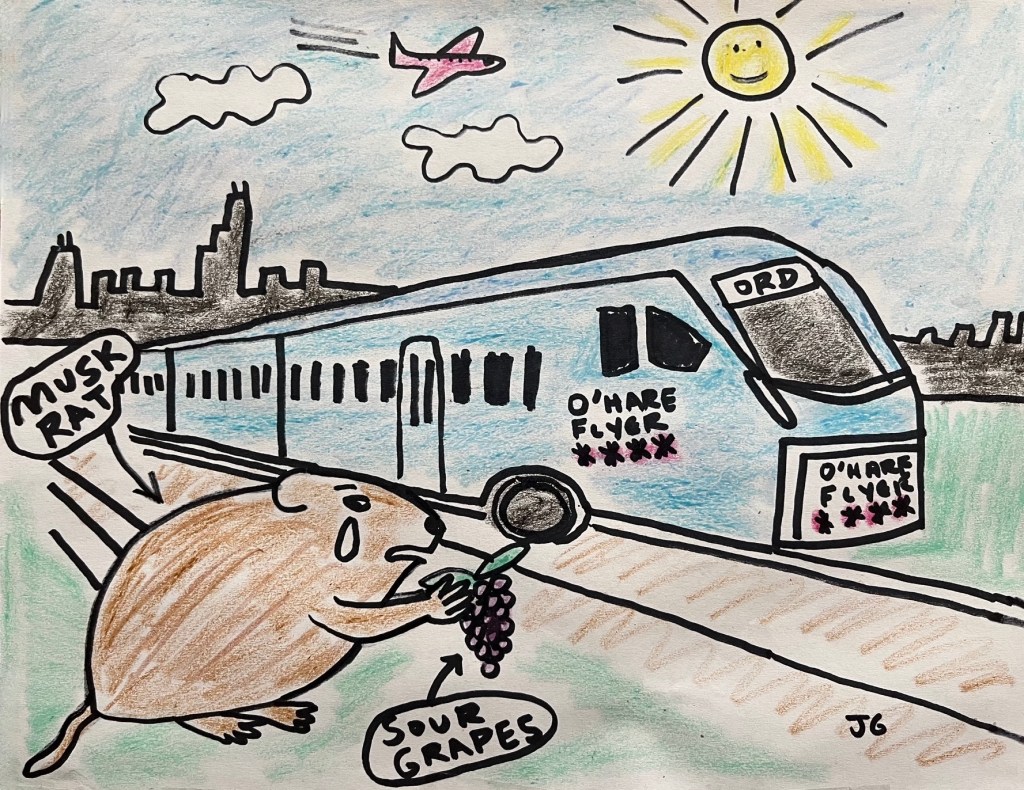

Chicagoland Tesla owners now displaying “I bought this before we knew Elon was crazy” bumper stickers may remember the good old days when Musk’s proposal for the O’Hare Express, a premium fast transit route to O’Hare, seemed silly rather than sinister.

In the late 2010s, then-mayor Rahm Emanuel was promoting the erratic tech guru’s idea for non-stop transit to the airport estimated at the time to cost $20-25 each way, as a strategy to make Chicago more appealing to business travelers and affluent visitors. Musk fantasized that he could dig a tunnel roughly 17 miles from the Loop to O’Hare and take people to O’Hare at 100 mph in “electric sled” pods, for a total of merely $1 billion in construction and vehicle costs. Emanuel and Musk claimed the project could be completed without using taxpayer money, which appeared to be a pipe dream. Thankfully, the next mayor Lori Lightfoot permanently shelved the plan soon after she took office in Spring 2019.
So I probably wasn’t the only local sustainable transportation advocate who raised an eyebrow this morning when they saw headlines about a new pitch for the O’Hare Flyer express train service, promising 15-minute rides between the airport and the West Loop. It brought up bad memories of local Musk-O-Mania, and once again sounded to good to be true. But I resolved to keep an open mind about the latest “railway to runway” scheme until I learned more about how its team hopes to pull it off.
Background on the O’Hare Flyer proposal
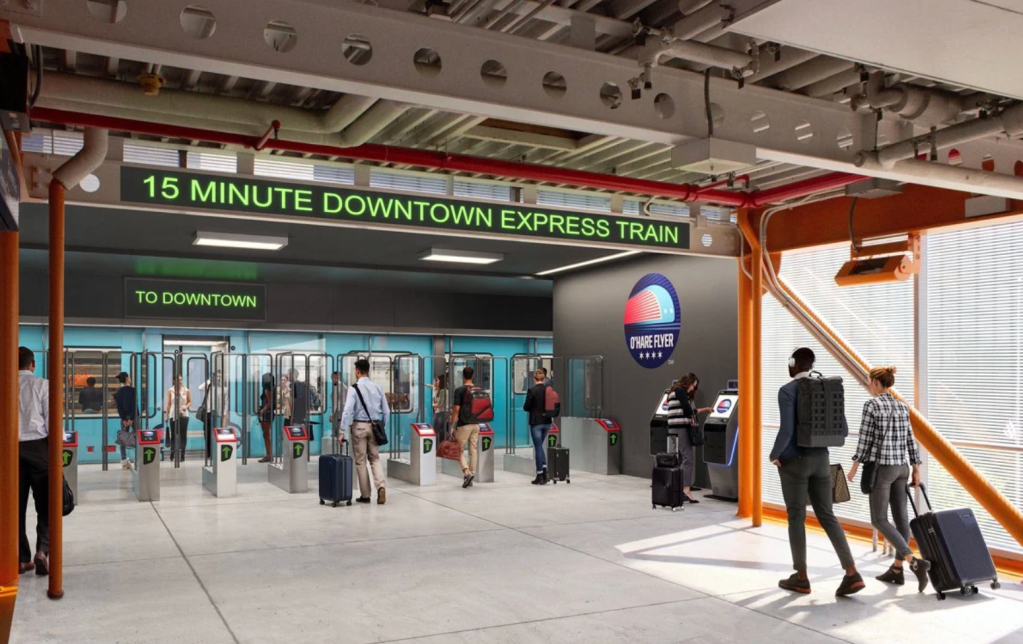
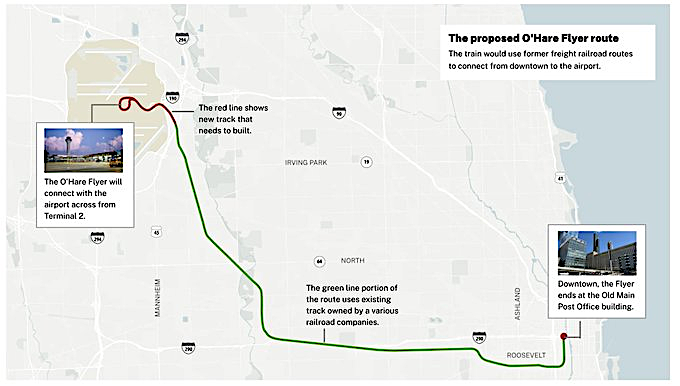
Here are the basics of the plan from the team’s press release. It’s being proposed by a coalition of Windy City business and civic leaders, who promise that rides will depart every 15 minutes between the airport’s Terminal 2 and a station near the Old Post Office, 433 W. Van Buren St. on a dedicated track. The boosters say the route will combine three exiting, underused freight rights-of-way into a dedicated express rail corridor. There will be luggage racks in each car.
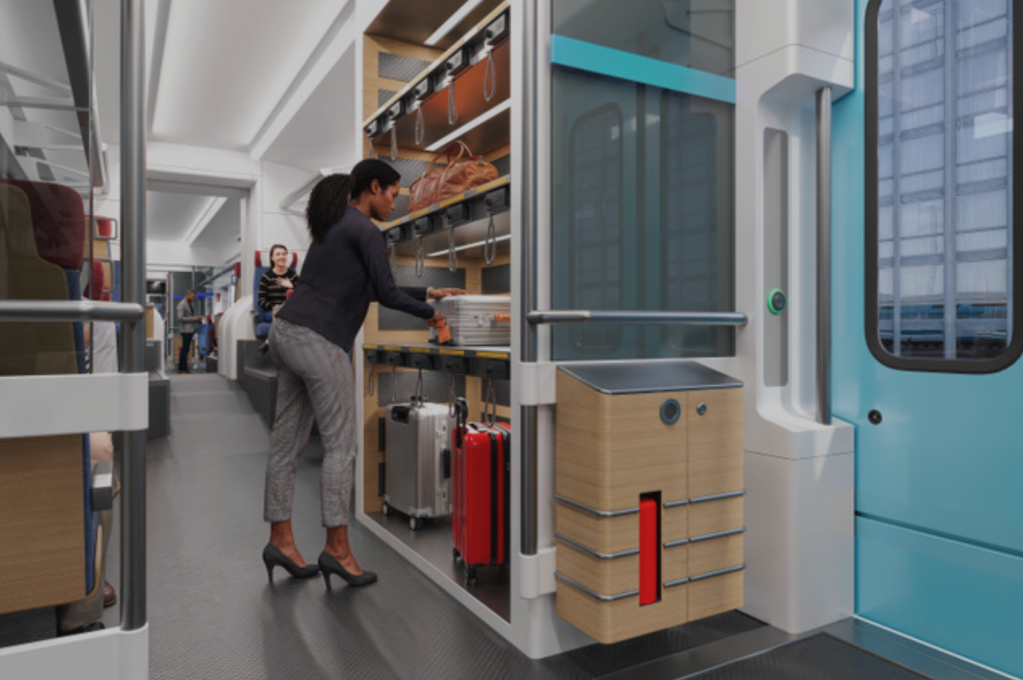
“O’Hare Flyer will connect our world class downtown with our world class airport in fifteen minutes,” asserted O’Hare Flyer Founder and Chief Executive Officer Dave Lundy in a statement. “This is a first-of-its-kind express train in the U.S. and will give Chicago a safe, reliable, world-class rider experience on a fast, whisper-quiet battery-electric train.”
The proponents say this concept has been in the works for the last three years, and their confederation includes cream-of-the crop urban planning, design, architecture, law, engineering, marketing, and PR firms. Two key accounting and consulting firms have joined forces with them.

The new service will operate on freight rail right-of-way owned by CSX, Canadian National, and Union Pacific railroads. “The O’Hare Flyer has reached agreement on terms, memorialized in a Letter of Intent with CSX and is moving forward with the other carriers as well,” the press release says.
Like Musk, the O’Hare Flyer alliance insists that it is not looking for money from the government or dollars that might otherwise go to public transportation like the CTA, Metra, and Pace systems. The backers hope to roll out service within five years. “The O’Hare Flyer team is now meeting with public officials, business, finance, government, and community groups and will be expanding outreach throughout the region in the months ahead,” they state.
Watch a video with their pitch here.
This morning I contacted just about every local transit agency, expert, and advocate I could think of to get their take on this game-changing news, and a few got back to me by press time. This post will likely be updated with other perspective in the near future. I’m guessing that some Chicagoans will question whether it’s equitable to offer “safe, reliable, world-class” transit service only to those who can afford to pay a premium for it, when no major upgrades are currently planned for the CTA Blue Line’s O’Hare Branch.
Metra
The commuter railroad is currently working on upgrading its own service to O’Hare. “We look forward to working with the new Northern Illinois Transit Authority [which launches on September 1] to learn more details about the O’Hare Flyer and determine how it would integrate with the regional public transit system and what impacts the project may have on the region’s capital funding decision-making,” said Metra spokesperson Michael Gillis.
DePaul University’s Joe Schwieterman
“A major global city like Chicago needs more than a relatively slow rail-transit line linking its largest airport to its downtown – the Chicago Flyer will fill that need,” said Schwieterman, director and professor at the university’s Chaddick Institute for Metropolitan Development. “A critical feature will be its 15-minute service, which greatly increases the value proposition, even for those who need to use public transit to reach its downtown station.”
“It will be crucial for City officials to embrace the proposal and support the elevated structures and signage needed at O’Hare,” Schwieterman added. “Many flyers resist taking the Blue Line because of long walks to some O’Hare gates, onboard crowding, and the frequency of stops – not to mention the lack of places to store your luggage.”
“The project mostly uses existing rail right-of-way to avoid the complexities and neighborhood opposition that come with creating entire new rail corridors,” Schwieterman concluded. “Watching this project move forward will be exciting to watch.”
High Speed Rail Alliance’s Rick Harnish
The executive director of the Chicago-based advocacy group didn’t mince words about Space Karen’s vaporware O’Hare Express plan. “Just to get this off my chest, the Elon Musk thing was complete and utter B.S.,” he said. “He was basically talking about building a two-lane road for Teslas. It was insane.” He noted that if one of the “e-sleds” caught on fire in the hypothetical tunnel, it would have been a major safety issue. “That proposal was a big distraction, so it was unfortunate that it got so much attention.”
“But the O’Hare Flyer is a really practical solution that I have been wishing to come together for over a decade,” Harnish added. “The Emanuel administration worked on this for a while. But I think this team finally put the deal together in the right way. What makes this plan practical is that they created a new railroad. They have people with railroad experience on their team. And it’s a very practical infrastructure plan, using City-owned land or existing railroad land. And they have a proven train design. They really put this plan together well.”
What about using the Blue Line corridor instead? “There is just not enough room to add tracks to the Kennedy Expressway,” Harnish replied. “Everyday Blue Line riders should be delighted, because there would be less luggage blocking their way.”
However, he said that it’s likely most people who would ride the O’Hare Flyer are currently taking ride-hail or taxis. While most inbound Flyer passengers would still need to complete “last-mile” trip from the West Loop station to destinations like hotels, Harnish argued that avoiding traffic jams on the Kennedy and paying a lower total travel cost would make the express train worthwhile.
Transit consultant Jarrett Walker
One transit expert who’s not completely sold on the idea is Jarrett Walker, a nationally known transit planning and policy consultant based in Portland, OR, who previously had the CTA as a client. (Another thing he should put on his resume is that Musk once called him an “idiot” during a transit discussion on Twitter.) Here’s what Walker posted today about the O’Hare Flyer.
I asked the O’Hare Flyer team for a response to Walker’s post, but they didn’t provide one. If we receive a statement from them, this post will be updated.
Update 8/25/26, 7:15 PM: A spokesperson for O’Hare Flyer told Streetsblog Chicago, “Jarrett Walker’s assertion is incorrect, because the design of the route and the project’s agreements will allow for redundancies to preserve the availability of 15-minute service.” They indicated they would provide more information on this subject to SBC in the near future. If they do so, we will add another update.
Update 8/26/26, 12:15 PM: This morning, O’Hare Flyer provided a full response to Jarrett Walker’s post. Read it at the bottom of this article.
However, the team did respond to my question, “Would it really be that much of a time-saver to catch a train from O’Hare to the West Loop, and then have to take a ‘last mile’ trip, such as Uber or Lyft, to a hotel near Michigan Avenue, instead of taking the Blue Line to various stops and walking a block or two to your hotel?”
“The proposed station is in the middle of a large group of transit facilities which represent a transit hub that has evolved over the last several years,” wrote Mark Walbrun, O’Hare Flyer’s chief development officer. “Union Station will be directly connected, and there is a Blue Line CTA station one block away. The Greyhound Station is two blocks away, and other Metra and CTA Loop stations are four blocks away. The Flyer station is also designed for bus shuttle connections like the airport express in Hong Kong, so as you come out of the station, there will be connections to downtown hotels, tourist spots, and other attractions.”
While I’m still waiting to get an answer to the questions Walker raised, it’s encouraging that his local colleagues DePaul’s Schwieterman and High Speed Rail Alliance’s Harnish are enthusiastic about the proposal. So I’m going to keep my post-O’Hare Express cynicism about a plan for a fast train to the airport on the back burner for now.
Full response to Jarrett Walker from O’Hare Flyer
Update 8/26/26, 12:15 PM: This morning, O’Hare Flyer provided a full response to transit analyst Jarrett Walker’s post: “This proposed fast airport train to Chicago’s O’Hare depends on a lot of single track. It will be great when it’s perfectly on time but delays will snowball and be hard to recover from.”
This morning I also spoke with O’Hare Flyer Chief Development Officer Mark Walbrun, a longtime railroad industry veteran about the issue of single tracking. “If you look at a Google Earth at the line that is there, you’ll see a single track,” he said. “That’s actually not the track we’re using. These railroad rights of way are about a hundred feet wide. We need twenty feet. We’ll be setting up our track on their right of way, but not their track. So they will still continue to use other track for their purposes.”
“And the arrangement that we have, it’s a little different with each railroad, but it’s that we will do some upgrades to their tracks, so that from time to time if we have to service our track, or if there’s an emergency, we can switch to their track,” Walbrun added. “So there’s a lot of redundancy built into the system.”
Here’s the statement from the ORDF team, in italics below.
Managing potential service disruptions due to train mechanical issues
The proposed O’Hare Flyer trainsets are designed to be highly reliable. Unlike diesel locomotives, there are few moving parts. The trains run off battery cells driving traction motors. Following are unlikely failure modes and responses going from rare to almost impossible:
- If one of the multiple traction motors fails, the operator will get a warning, and the train system will isolate that motor automatically. Since the trainsets have eight motors, one failure would not have any impact on the operation.
- If one of the multiple battery systems fails, the operator will get a warning, and the train system will isolate the battery pack automatically. Since the trainsets have multiple battery packs, one failure would not have any impact on the operation.
- The trains are actually made up of two full trainsets each with four cars and “powerpack” which contains the batteries. Each set can operate independently. If an entire set fails (both batteries and traction motors) then the other set can either push or pull the remaining set at a somewhat reduced speed.
- If the failure is such that one the trainsets are fully disabled, then we can disconnect the two sets from each other (it is automatic and takes about 10 seconds) and then proceed to the nearest station with the functioning half after moving the passengers to that trainset. In that case our locomotive will be dispatched with a maintenance crew to retrieve the disabled trainset and return it to the yard. This can be completed in less than 30 minutes.
- In the case of a significant delay, we have track alternatives. The CSX section has a full 6 mile double track used for passing to and from the airport. In the event of a disruption on this segment, we would simply operate temporarily as a single track with trains taking turns. There is also a third track used for freight which can be used as an alternative. On CN there is parallel freight track which is being upgraded for passenger speeds and can be accessed in an emergency. On UP there is a two-mile double track with one of the tracks used to access the maintenance center but could also be used to bypass the main line.
- The downtown station has a two-track platform with a full train on “hot stand-by” to protect the operation to the airport. If any problem occurs on the planned train, we simply move to the other train.
- The airport platform can hold two full trains. If one of the trains is fully disabled, we can still berth the next one and reverse out on the loop back to downtown.
As you can see, there are multiple options to quickly restore service in the event of an extremely rare event of a two fully independent trainsets being disabled.

If you appreciate Streetsblog Chicago’s livable streets reporting and advocacy, please consider making a tax-deductible donation to support our work. Thank you!

Read More:
Streetsblog has migrated to a new comment system. New commenters can register directly in the comments section of any article. Returning commenters: your previous comments and display name have been preserved, but you'll need to reclaim your account by clicking "Forgot your password?" on the sign-in form, entering your email, and following the verification link to set a new password — this is required because passwords could not be carried over during the migration. For questions, contact tips@streetsblog.org.