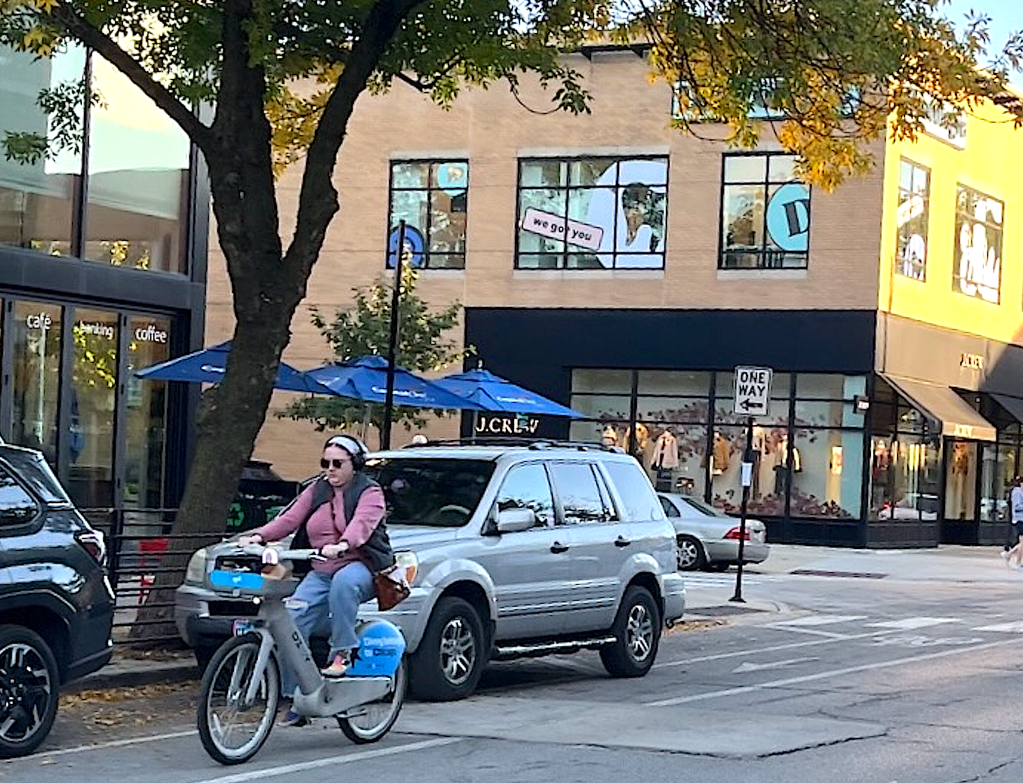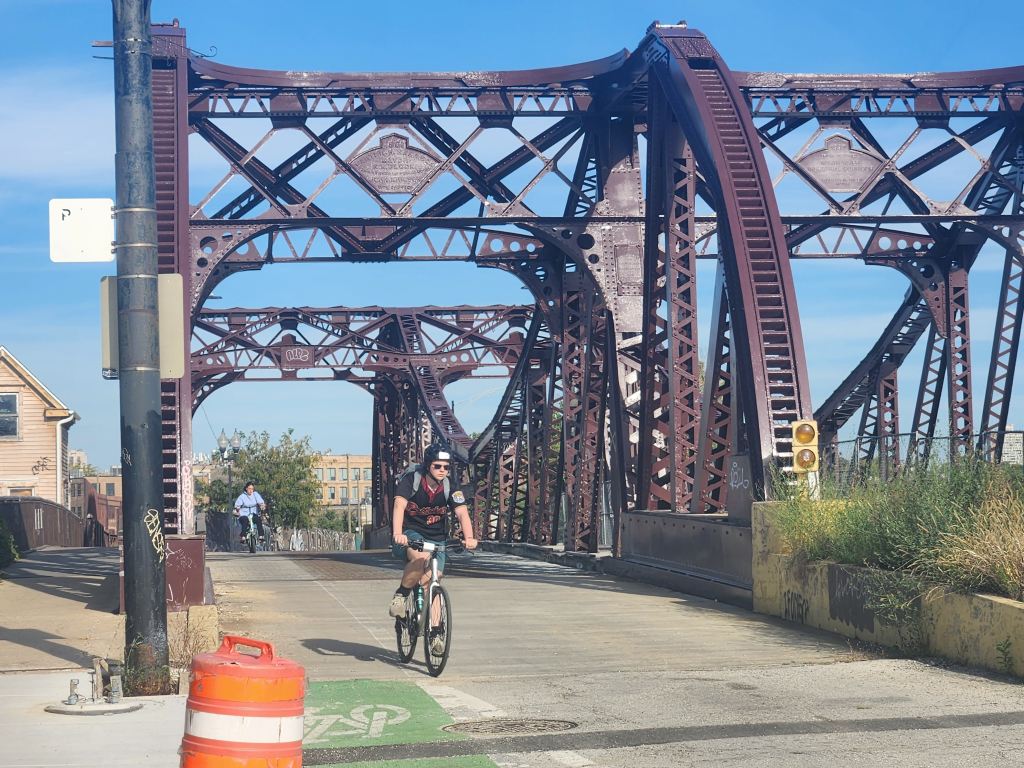
Logan Square’s street reconfiguration with new plazas is awesome. But there are some trouble spots, inspiring calls to “Refine the Redesign.”

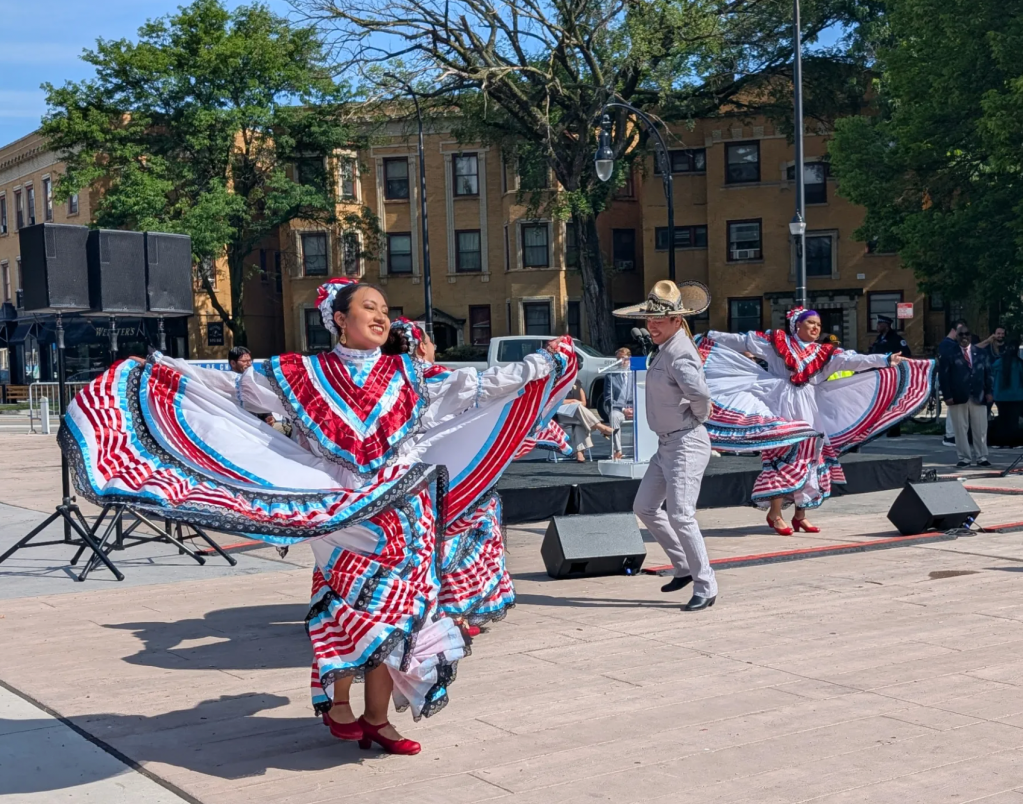

The atmosphere was joyous at Monday morning’s ribbon cutting for the Milwaukee Avenue Streetscape and Logan Square Redesign Project. Over 100 dignitaries, neighbors, performers, and other stakeholders gathered on the linear plaza where Milwaukee Avenue traffic used to rumble.

The promenade is one of three (!) new plazas to emerge from the once-in-a-generation reconstruction of one of Chicago’s most complex intersections. I’m talking about the convergence of Logan Boulevard / Wrightwood Avenue, Kedzie Avenue, and Milwaukee Avenue at Logan Square’s Centennial Monument, which some locals refer to as the “Magic Eagle” column.
It was heartening to hear elected officials and other leaders at the event using language that boils down to the maxim “Streets are for people not cars.”
These sentiments reflect 10 years of broad-based community engagement. Many of the residents who provided feedback wanted safe and comfortable multi-modal options for traveling to and through the heart of the neighborhood, as well as more public space to linger there. Rerouting Milwaukee to knit together the green space around the monument was no small feat.
Neither was wrangling an acre of usable public space from a transportation project anchored by $21 million in federal funding. U.S. Rep. Delia Ramirez received loud applause when she said, “This is how federal funds should be used!”
Countless hands, hearts, and long hours made this project possible. As former 35th Ward alder and current Chicago Park District Superintendent Carlos Ramirez-Rosa reminded the crowd, “Consensus and coalition building are needed to get big things done.”
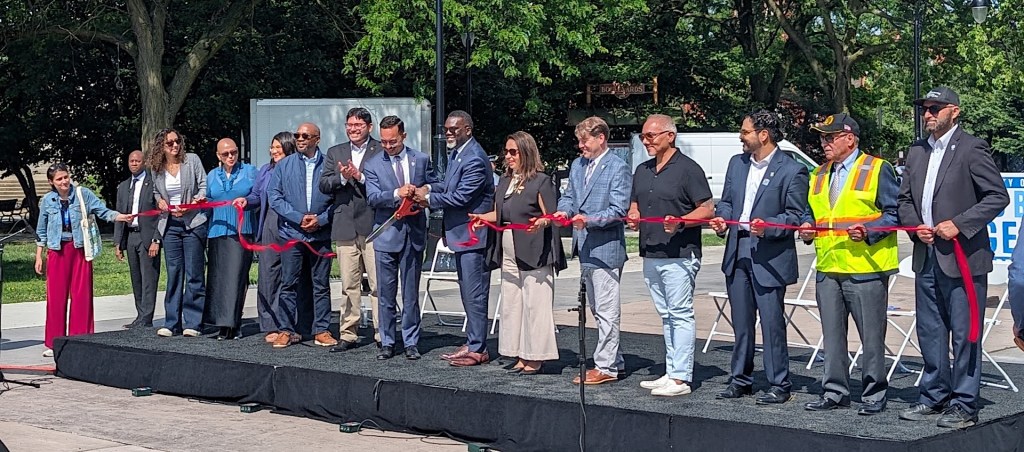
Ramirez-Rosa’s successor Ald. Anthony Quezada was involved with the project from its start in 2017, as a 35th Ward staffer. Quezada spoke to the extraordinary intergovernmental and community cooperation among federal, state, county, and city agencies, plus labor unions, local businesses, and community groups.
In addition to the pedestrianization of Milwaukee in the circle, one of the most exciting aspects of the project is La Placita, a new public space created by reconfiguring Kedzie north of the pillar. The community organization Palenque/LSNA’s vision and leadership were particularly critical to ensuring we not only netted more public space, but also new design elements that honor local history and culture.
Pastor Juan Pablo Herrera underscored this importance when talking about La Placita, whose final appearance was influenced by plazas in multiple Latin-American nations. “Latinx families built this community, bringing traditions, food, music, faith, and dreams,” he said.
While there’s so much to celebrate about the street redesign, there are still some challenges. As someone who has been advocating for calming and de-centering car traffic at this location for 25 years, I can’t help but notice new trouble spots when I am walking, biking, and taking transit there.
For example, while running errands later in the day, I observed some issues at the new three-way intersection of Kedzie and Milwaukee west of the Logan Square Blue Line station. Here, northwest-bound drivers on Milwaukee have a “Right Turn On Green Arrow Only” sign, which should make it safer for pedestrians to cross Kedzie when they have a walk signal. However, I noticed it was common for motorists to ignore the green arrow rule, endangering people on foot.
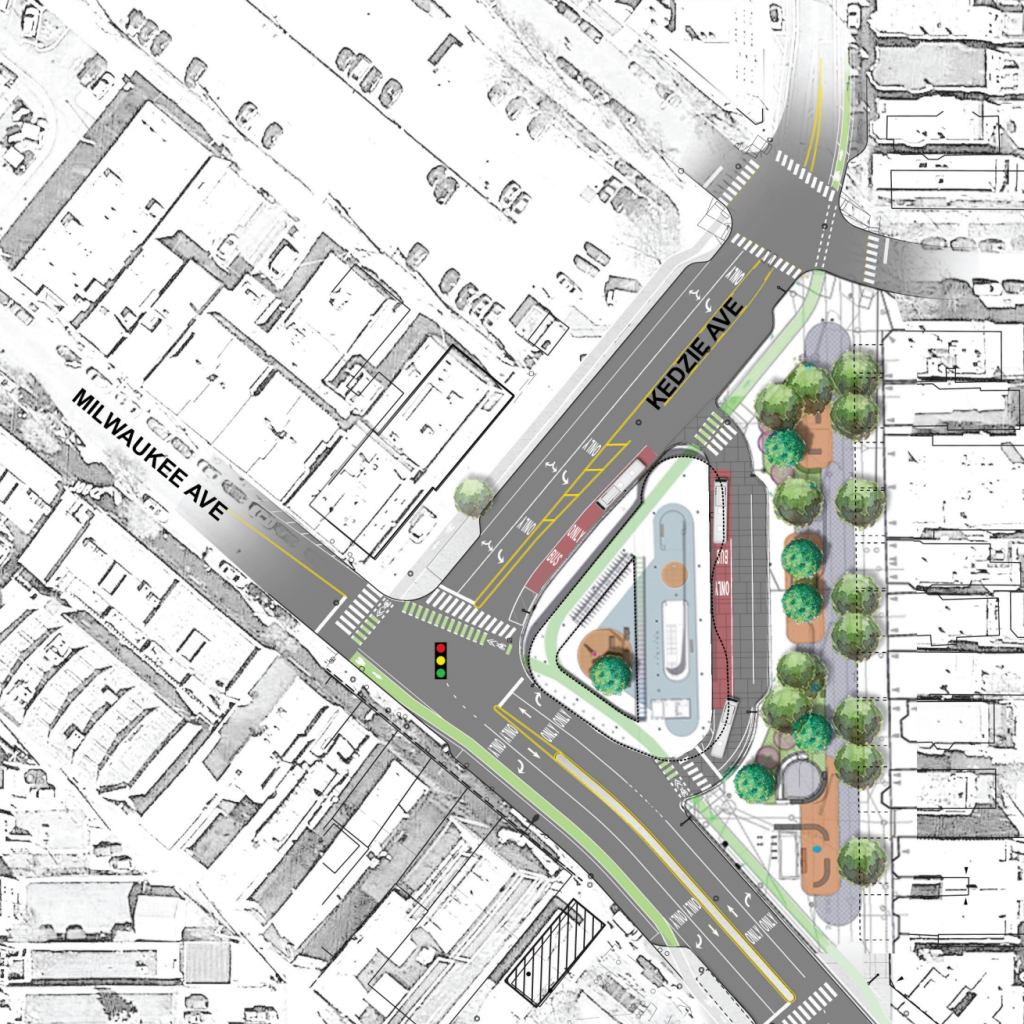
Meanwhile, I saw pedestrians looking for gaps in traffic on Milwaukee so they could make a direct crossing of the south leg of that intersection, which doesn’t have a marked crosswalk. Otherwise, following the new prescribed pedestrian route would require waiting for walk signal to cross northwest across Kedzie, and then waiting for a second walk signal to head southwest across Milwaukee. Predictably, many people on foot don’t bother with that indirect and time-consuming route, even if crossing without a walk signal and marked crosswalk is potentially dangerous.
And during my maiden voyage when the streets reopened last November, I nearly crashed at the new cul de sac near Lula Cafe, 2537 N. Kedzie Ave., where northbound Kedzie’s service road used to connect to Logan Boulevard.
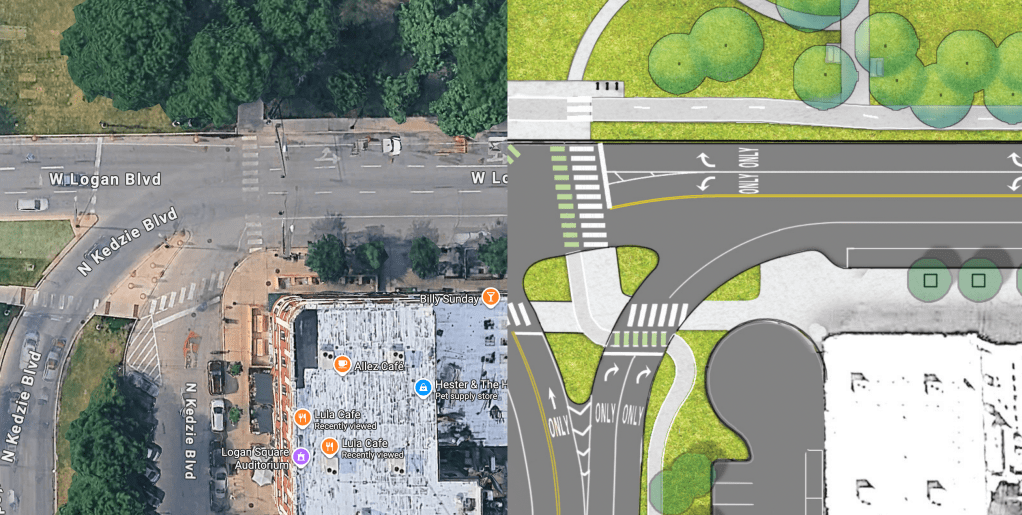
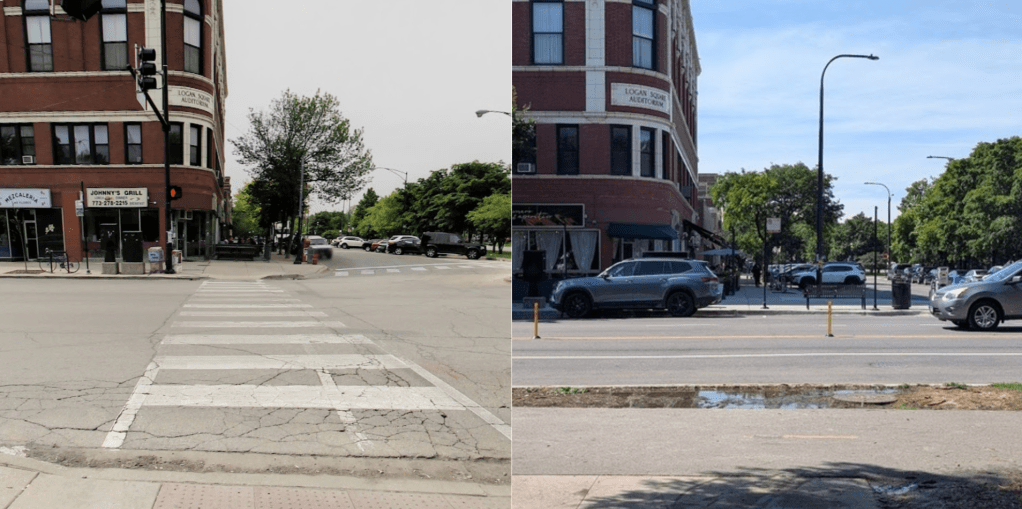
Back in 2003, as a member of the pedestrian advocacy group Logan Square Walks, I helped lobby the City to install a direct crosswalk between Lula and the circle. So it was a shock to encounter a solid curb without a curb cut where that crossing used to be.
I’ve also worked as a transportation planner, so I am keenly aware that a project of this scale and complexity has constraints and requires tradeoffs.
For example, in order to ride a bike from northbound Kedzie to eastbound Logan, you’re now supposed to take the new off-street path around the monument. The problem is, that move requires four street crossings, while you previously only had to cross Milwaukee once.
The planners’ intention was to create a cycling route that would be more comfortable for people of all ages and abilities. But in reality, this itinerary is very circuitous and inconvenient. As a result, many people riding bikes or e-scooters in this direction instead use Logan’s now-narrow travel lanes or the sidewalk. That makes conditions potentially more dangerous than they were before the redesign, for all road users.
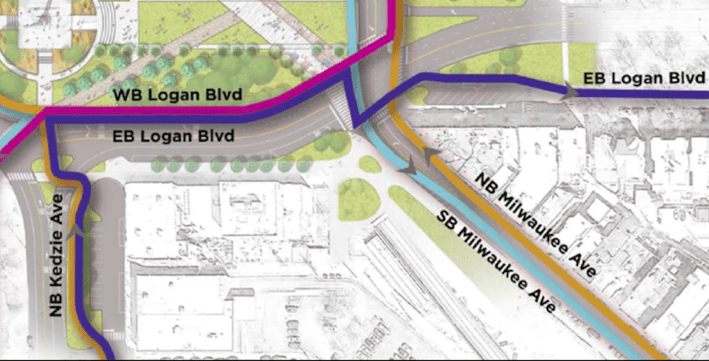
Northbound bike riders on the Kedzie Avenue service drive who want to head east on Logan Boulevard (purple route) are supposed to 1) cross the northeast-bound Kedzie lane west to the triangular traffic island 2) cross Logan north to the off-street path around the monument, 3) cross the Logan south again, and then 4) cross Milwaukee eastbound. Image: CDOT
During the last several months since the streets reopened, I’ve been thinking about possible short-term tweaks and longterm evolution. I’m less concerned about saving a few minutes on my bike commute than I am worried about others getting injured.
It’s human nature to take the most direct route. That’s why people on foot are skipping the two-light crossings by the ‘L’ station. It’s also why eastbound bike and scooter riders are using the street and sidewalk instead of the path.
Now that we’ve had seven months to get used to the reconfiguration, and the finishing touches are nearly complete, I am part of a grassroots “Refine the Redesign” effort to encourage public dialogue about what’s working and what needs a second look. Stage one is soliciting comments via email: info[at]refinetheredesign[dot]org. Let us know how you use the intersection, what you love, what are your pain points, and what you hope to see in the future. We will use these responses to shape a more formal survey. We are also collecting observational data at different locations.
Of course, opinions will vary based on how people interact with the space. We are also reaching out to other stakeholders for input on the types of questions we should be asking, and to help ensure that the responses represent a wide array of experiences and priorities.
The last speaker at Monday’s celebration was Logan Square Chamber of Commerce Executive Producer Nilda Esparza. I couldn’t keep up with all the future events she announced, but my ears really perked up when Esparza mentioned upcoming public debates in honor of election season.
The Logan Square street remix is generally a wonderful asset for our community. Still, it might make sense to add a discussion of the pros and cons of the redesign to the list of debate topics.

On November 12, SBC launched our 2026 fund drive to raise $50K through ad sales and donations. That will complete this year’s budget, at a time when it’s tough to find grant money. Big thanks to all the readers who have chipped in so far to help keep this site rolling to the end of 2026! Currently, we’re at $34,171 with $15,829 to go, ideally by the end of June.
If you value our livable streets reporting and advocacy, please consider making a tax-deductible gift here. If you can afford a contribution of $100 or more, think of that as a subscription. That will help keep the site paywall-free.

Streetsblog has migrated to a new comment system. New commenters can register directly in the comments section of any article. Returning commenters: your previous comments and display name have been preserved, but you'll need to reclaim your account by clicking "Forgot your password?" on the sign-in form, entering your email, and following the verification link to set a new password — this is required because passwords could not be carried over during the migration. For questions, contact tips@streetsblog.org.