Shifting money from roads to public transportation saved Illinois transit. A new map shows how other states can benefit from this approach.

Last October 31, Illinois public transportation boosters rejoiced after state legislators passed a robust transit reform/funding bill with $1.5 billion in new annual funding during the early-morning hours. This legislation rescued Chicagoland bus and train service from a looming fiscal cliff that would have resulted in drastic cuts and layoffs.
How exactly did lawmakers pull off this “Halloween Miracle”? The crux of the funding deal was allocating all state motor fuel sales taxes, roughly $860 million a year, for public transportation, rather than allotting it to the Road Fund. An additional $200 million is coming from a plan to spend Road Fund account interest on transit capital projects.
But that might not have happened if Illinois Governor JB Pritzker hadn’t persuaded clout-heavy road-building unions, such as Operating Engineers Local 150, to sign on. Local 150 had previously voiced opposition to a proposal from transit-friendly legislators to raise highway tolls to fund buses and trains.

But, ironically, the state bill that eventually passed also permits raising roughly $1 billion in higher tolls per year, which can be used for tollway capital projects. Thus, the final legislation got the unions’ blessing. Read more on that subject here.
This feel-good story from the Land of Lincoln helped inspire a recently project by the Rocky Mountain Institute, a nonprofit focused on sustainable energy issues, using data from the Institute for Transportation and Development Policy. The report discusses how much our country could benefit if every state followed the Prairie State’s lead and shifted funds from road expansions to multimodal transportation.

“[In October], Illinois lawmakers brought the Chicago transit system back from the brink of financial insolvency largely by deploying one transformative solution: shifting transport revenues away from excess roadway construction and instead into turbocharging the region’s trains and buses,” RMI Senior Associate Miguel Moravec wrote in a recent blog post.
In addition to the Illinois policy win, the RMI article discusses Virginia’s SMART SCALE process, which Moravec says has increased proportion of state discretionally dollars spent on multimodal sixfold over last few years. The post includes an interactive U.S. map that shows exactly how much money each state is predicted to save by moving money from projects that encourage more driving, to bus, rail, and biking initiatives.
Streetsblog recently caught up with Marovec to talk about the findings. This interview has been edited for clarity and brevity.
John Greenfield: There was good news in Illinois on Halloween when we we passed the transit reform and funding bill. So what have you folks taken from that?
Miguel Moravec: Yeah, you all averted that big transit funding crisis by effectively redirecting dollars away from excess roadway construction and into transit operations. And that is also exactly what we were looking at as a policy framework in our blog post. We were looking what the benefits to society would be if you cut back on road building and instead reinvested those dollars into transit and other multimodal solutions.
So we are super-excited to see that same scenario play out in Illinois. And we think in addition to the everyday cost savings that Illinoisans will receive from having access to more affordable choices, we think in the longer term, there’s even more potential government expenditure savings from not needing to maintain all of the new pavement that would have otherwise built with those roadway dollars.
JG: So you folks created interactive map that illustrates this. Tell me about how that works.
RMI’s interactive map.
MM: That map is based on a report from our friends at the Institute for Transportation and Development Policy. They did a national analysis of what would happen if you shifted roadway dollars into urban transit and other multimodal solutions. And we realize, just like lawmakers did in Springfield, that it’s actually states in the driver’s seat on where these dollars go right. You get a lot of money from the federal government, but ultimately, it’s state and local decision makers who get to pick their infrastructure system, how that money is actually spent.
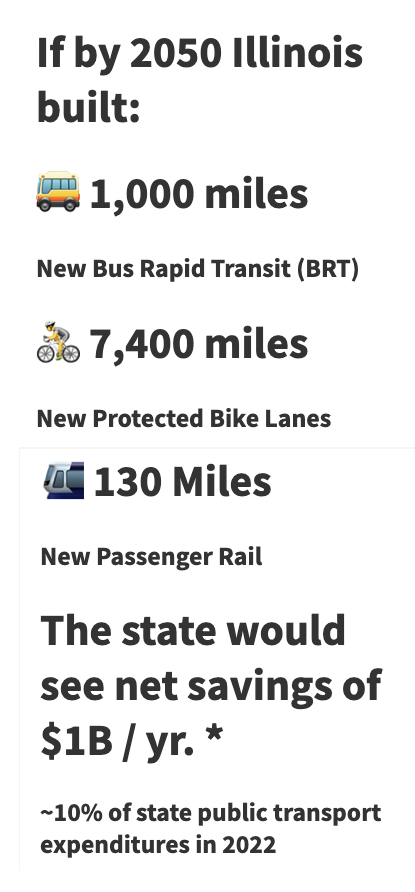
So what the map shows is sort of a maximum feasible buildout of transit and multimodal systems, what we think is reasonable to get built out by 2050. If you click on Illinois, you can see that involves up to 1,000 miles of new bus rapid transit, 7,400 miles of new protection bike lanes, and 130 miles of new urban railways. So that combination of investments, doing that instead of building out new highway expansions, which we know don’t solve traffic, that would save the state about a billion dollars a year in Illinois, which is a really big number, but less than 10 percent of what the state spent, for example, in 2022 on public transportation expenditures. That was $14 billion.
JG: Do you want to give me some examples from other parts of the country of what benefits could be made by shifting the funding?
MM: This general framework of best serving urban travel demand by prioritizing lots of transportation choices, that’s something that’s been done before. One state that’s totally done that was Colorado. They decided to plan this around the climate goals, but in effect, they’re really using more affordable transportation options to hit climate goals and their state department of transportation found that they would save $40 billion net by 2050 by providing more affordable transportation choices, using that to meet new travel demand. So that’s right from the state DOT.
Other states have since followed, like Minnesota, and we’ve done some analysis on, what if all states prioritize their transportation system around giving people more access – what would that look like? For Illinois, that came out to about $2,000 a year per household. If you had access to more transportation choices, if that’s what your state decision makers focused on investing in, households can save something like $2,000 a year in Illinois. So that’s separate from the state transportation savings in this blog, but I think it really speaks to the promise of expanding affordable transportation choices.
Your really big win in Illinois October stabilized the transit system and averted the fiscal cliff. There is still opportunity to expand the transit system and make sure there’s funding for that. I know there’s bill in Illinois called the Transportation Choices Act, which is being carried by Senator [Ram] Villivalam and Representative [Eva-Dina] Delgado as well. So I wanted to mention that, it’s fantastic to have systems stabilize. There is an opportunity to expand. And if you look at our map, you can see the exact benefits that the state accrue by building out specific amounts of new transportation choices.

On November 12, SBC launched our 2026 fund drive to raise $50K through ad sales and donations. That will complete next year’s budget, at a time when it’s tough to find grant money. Big thanks to all the readers who have chipped in so far to help keep this site rolling all next year! Currently, we’re at $13,455 with $36,545 to go, ideally by the end of February.
If you value our livable streets reporting and advocacy, please consider making a tax-exempt gift here. If you can afford a contribution of $100 or more, think of it as a subscription. That will help keep the site paywall-free for people on tighter budgets, as well as decision-makers. Thanks for your support!
– John Greenfield, editor

Read More:
Streetsblog has migrated to a new comment system. New commenters can register directly in the comments section of any article. Returning commenters: your previous comments and display name have been preserved, but you'll need to reclaim your account by clicking "Forgot your password?" on the sign-in form, entering your email, and following the verification link to set a new password — this is required because passwords could not be carried over during the migration. For questions, contact tips@streetsblog.org.