Illinois already killed parking mandates. Chicago should finish the job.


This piece also runs on the website A City That Works, a newsletter about public policy in the Chicago region. Alex Montero is the chairperson of Strong Towns Chicago, an all volunteer advocacy group focused on housing, street safety, and transit. As a guest op-ed, this article does not necessarily reflect Streetsblog Chicago staffers’ perspectives on this issue. This ACTW article was edited for publication on Streetsblog Chicago by John Greenfield.
When state legislators passed the People Over Parking Act last fall, they intended to reduce the number of hoops that local builders, small businesses, and City officials need to jump through to build new housing or set up shop. Unfortunately, Chicago is currently set to implement the new state law into its zoning code in the most cumbersome way possible. There is a better way.
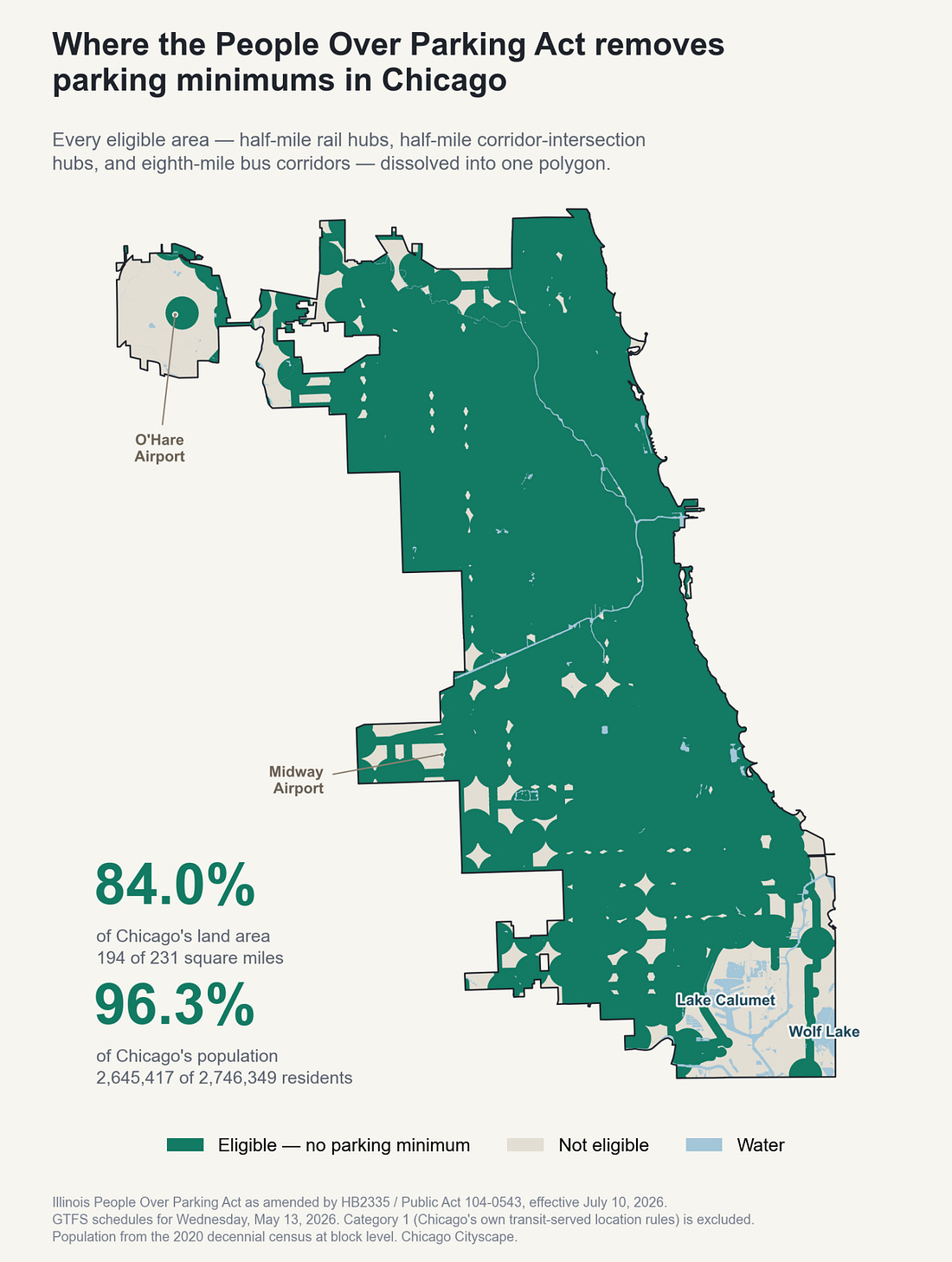
POPA went into effect on June 1, 2026, prohibiting Illinois municipalities from imposing or enforcing minimum parking requirements within a half mile of rail stations and transit centers and within an eighth of a mile of most fixed transit routes. In Chicago, that covers virtually all the areas where people live and do business:
- 84 percent of the land area within the city’s borders
- 96 percent of the city’s population based on the most recent census tract data
- Areas not covered by People Over Parking are nearly all unpopulated, including airport land, cemeteries, lakes, and rail yards
POPA applies to residential and commercial uses, and it covers both new buildings (whether by right or Planned Developments) and changes to existing buildings. This law is the culmination of years of local and statewide reform efforts and a growing recognition among legislators and planners that minimum parking mandates increase the cost of housing (by up to $37K per parking spot in Chicago), hurt local small businesses, and are based on arbitrary standards that fail to predict real demand. Eliminating parking mandates is the most impactful and straightforward “cut the tape” reform that cities can implement, and many have.
But developers and city departments don’t dig through state statutes every time they propose a project or issue a permit or license. Instead, the city zoning code needs to be updated to reflect changes in state law. The simple way to do this for POPA would be to just update the zoning code to eliminate any reference to parking requirements, shortening the code and getting rid of the residual requirement on the last bits of city land.
Instead, the Mayor proposed an ordinance in June that would use an overlay district to supersede the zoning code parking requirements anywhere the People Over Parking Act applies. In effect, it’s a special exception that Chicago’s Department of Planning and Development would need to maintain and other City departments would need to decipher for every building permit application and business license application that they receive. This approach would be a serious mistake for three important reasons.
- It adds another layer of bureaucratic complexity to be administered by city departments that are already short-staffed and taking months to process most permits. Given Northern Illinois Transit Authority’s governance reforms and funding expansion, POPA coverage will continue to grow with new transit stops and routes. To comply with state law, the overlay will need to be updated every time a transit route is added or modified.
- It creates a complex set of eligibility rules that small local builders without teams of zoning attorneys on standby cannot easily understand or untangle. At a time when the City is desperate for middle housing and modest infill on vacant neighborhood lots, this uncertainty will lead some small operators and nonprofit developers to mistakenly pass up projects that pencil without parking requirements.
- It preserves parking requirements in a trivially small portion of the city, mostly made up of industrial land, waterways, and parkland devoid of housing or businesses. In effect, the City is making its zoning code more difficult to enforce and taking on more legal liability to retain the right to require parking for a hotdog stand on runway 28C at O’Hare or a two-flat at the bottom of Lake Calumet. This is madness.

City Council should instead pass a clean repeal of minimum parking requirements from the City zoning code. This makes it simpler to understand the zoning code, minimizes the City’s liability risk, strikes pages of obsolete language, and allows City departments to focus their enforcement efforts on more important zoning matters. It also sends a clear message to builders, small businesses, and housing organizations that Chicago is serious about Cut the Tape, one of the few things that Mayor Johnson and the entire City Council seem to agree on these days.
Fortunately, perhaps sensing the winds of change at the state level, City staff did their homework and drafted a clean repeal in 2024. This language needs to be lightly updated and checked by the city’s Legislative Reference Bureau to catch any references to parking requirements in more recent zoning code changes, but it is basically ready to go and should be the basis of the city’s POPA compliance ordinance.
This is an easy win for Chicago. City Council should pass a full repeal of minimum parking mandates.

If you appreciate Streetsblog Chicago’s livable streets reporting and advocacy, please consider making a tax-deductible donation to support our work. Thank you!

Streetsblog has migrated to a new comment system. New commenters can register directly in the comments section of any article. Returning commenters: your previous comments and display name have been preserved, but you'll need to reclaim your account by clicking "Forgot your password?" on the sign-in form, entering your email, and following the verification link to set a new password — this is required because passwords could not be carried over during the migration. For questions, contact tips@streetsblog.org.