Educational Specialist Hired to Create Programming for the Bloomingdale

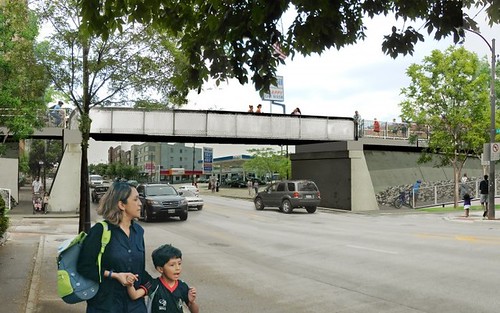
The Bloomingdale Trail, AKA The 606, is not just going to be a great transportation and recreation facility. It’s also going to be an important educational resource for students at the 25 schools located within a ten-minute walk of the 2.7-mile elevated greenway and linear park. Today the Trust for Public Land, which is managing the project for the city and the park district, announced that it has hired Jean Linsner to design and implement educational programming for the trail and its five access parks. The two-year position is funded by Exelon Corporation as part of its $5 million donation to the Bloomingdale project.
“I’m charged with figuring out how to connect teachers, students and families to the trail in new and interesting ways,” said Lisner, who has done similar work for institutions like the Chicago Architecture Foundation, YWCA, Brookfield Zoo, and the Chicago Academy of Sciences. Some 80,000 people, including 20,000 children, live within a half mile of the Bloomingdale, according to TPL. She’ll be working with the nearby schools on strategies for integrating the trail into their curriculum.
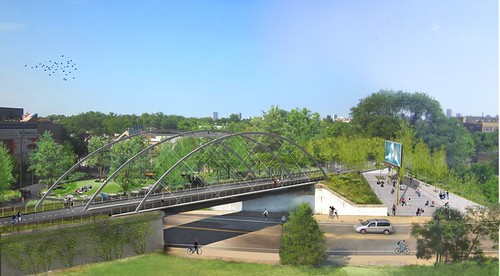
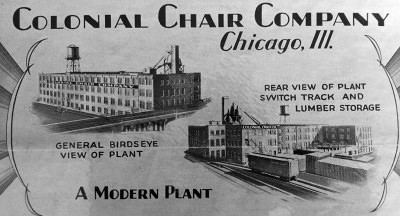
Linsner says the Bloomingdale, which is currently being constructed on an old railroad right-of-way, is going to be a powerful tool for teaching. “Let’s say students are studying Chicago’s industrial past,” she said. “You could look at documents and photos in the classroom. But it might be more exciting for the kids to look at actual physical infrastructure from that era. They could learn about why the rail line was originally built at grade level and why it was elevated, and about the companies that depended on it. There used to be factories along the line making furniture, Schwinn bicycles, musical instrument cases, and even Lincoln Logs.”
Last year TPL brought together a small group of educators from the area to form the 606 Teachers Network, piloting lesson plans that use aspects of the trail to teach science, technology, engineering, arts and math. A teacher from Near North Montessori asked students to write a diary from the perspective of a child from an immigrant family that was involved in building the railroad. “The kids really got into aging and discoloring the documents to look like they came from an archeological dig,” Linsner said.
Another teacher from Ames Middles School had pupils look at the process of developing a park “from gray space to green space,” and come up with their own design for a new park, she said. An instructor from Pritzker Elementary took second graders on a field trip to North Park Nature Center to let them check out a nature trail firsthand. Afterwards the kids created promotional posters for the Bloomingdale. “That project fit in with a small but powerful concept: we need to get kids outside to experience the natural world,” Linsner said.
Linsner has already started meeting with teachers from schools near the line. “We’ll be taking the lesson plans we develop and sharing them with schools across the city,” she said. These educational materials will be available on the resources page of the 606 website. “There are going to be multiple ways teachers are going to engage students with the trail, from its historic past to its exciting present and future,” she said. “We want to build as many curricular on-ramps as we can.”

Read More:
Streetsblog has migrated to a new comment system. New commenters can register directly in the comments section of any article. Returning commenters: your previous comments and display name have been preserved, but you'll need to reclaim your account by clicking "Forgot your password?" on the sign-in form, entering your email, and following the verification link to set a new password — this is required because passwords could not be carried over during the migration. For questions, contact tips@streetsblog.org.