Chicago and Kansas City mayors discussed mobility justice efforts at “The State of Equity” forum

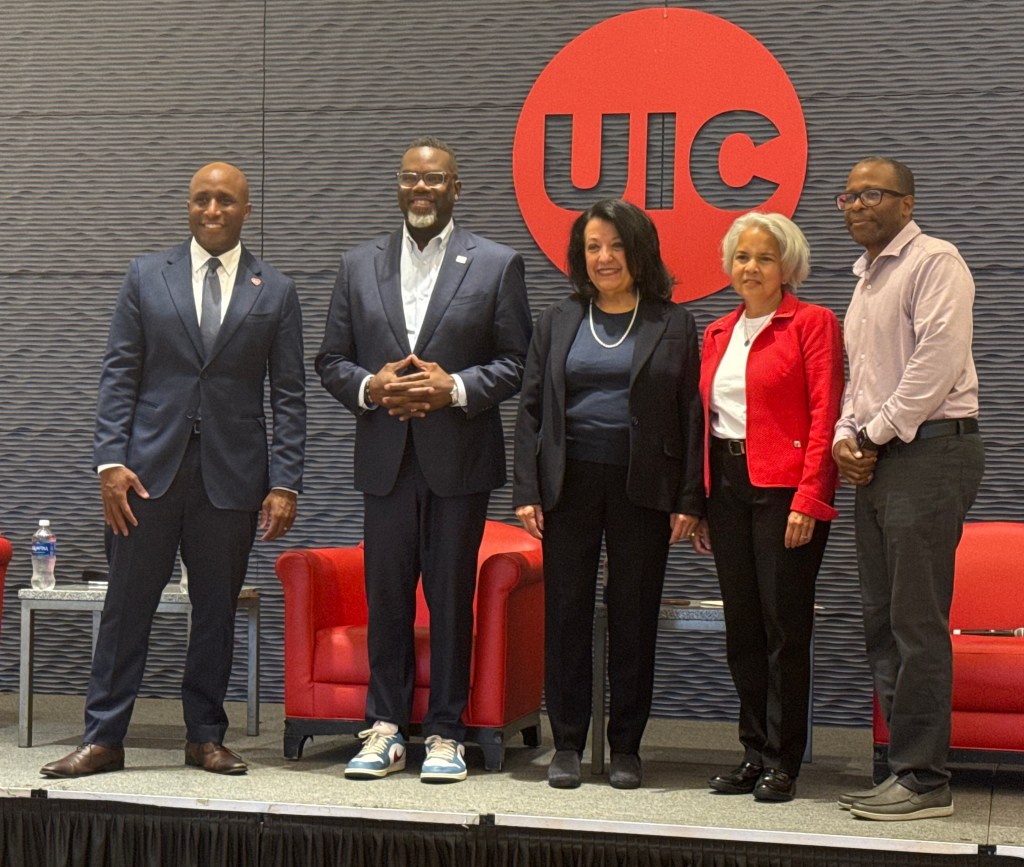

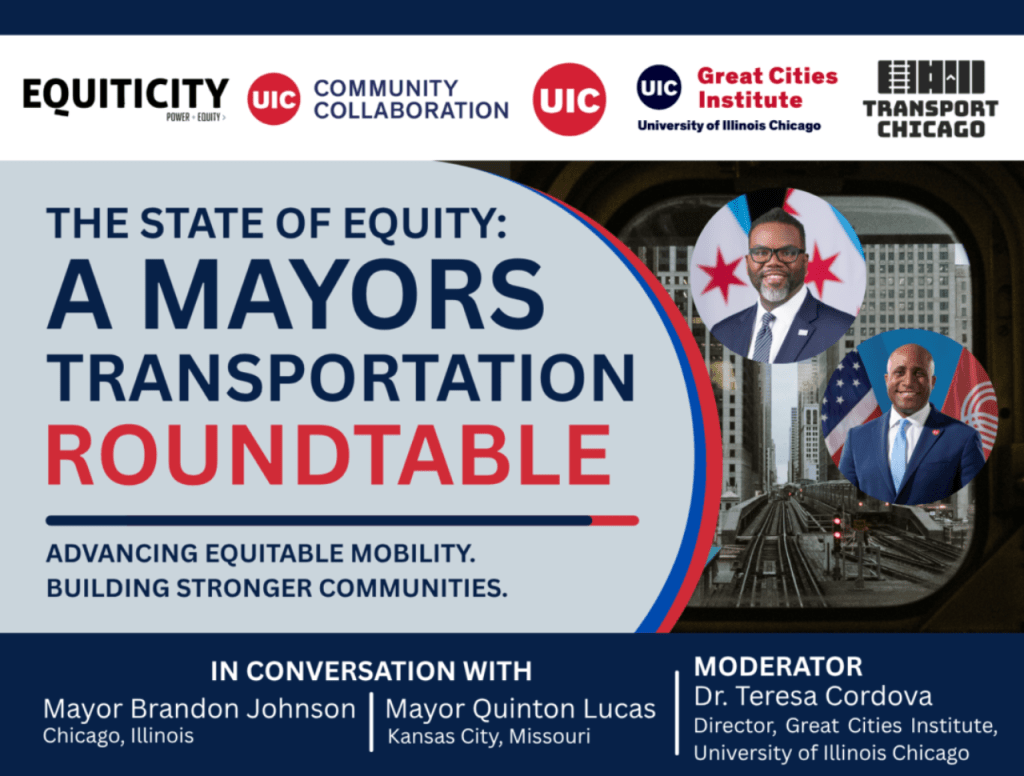
“The State of Equity: A Mayors Transportation Roundtable” featured a discussion with Chicago Mayor Brandon Johnson and Kansas City Mayor Quinton Lucas, moderated by Dr. Teresa Cordova, director of the Great Cities Institute at the University of Illinois Chicago.
Described as “an important dialogue on how mayors can advance equity, strengthen communities, and address systemic challenges through local leadership, the panel took place yesterday at UIC Student Center East. It was followed by the community forum, “Exploring Equiticity’s Neighborhood Mobility Models.”
At the event, Mayor Lucas revealed that he’s also known as “Mayor Q” and “Aldi Brand Obama.” The latter nickname was originally intended to be derogatory, but Lucas quipped, “That’s cool… I like Aldi, and I like Obama.”
Equiticity President and CEO Oboi Reed gave remarks at the start of the forum. “How do we determine whether or not racial equity has been achieved?” he asked. “Too often, we think of equity purely in ideological terms. From this perspective, equity can be attained solely through lofty declarations of sentiment, workplace training presentations, and perhaps the occasional grant program. While none of these things are bad, they miss the key principle behind racial equity, and that is the just distribution of resources with the intent of improving life outcomes for racially marginalized communities.”
Reed then elaborated that instead of corporate task forces or buzz words, equity is found in everyday occurrences, such as a young adult finding a job; families being able to eat healthily and receiving quality healthcare; and safe, reliable, efficient transportation options.
Cordova then asked the mayors to define equitable mobility, and discuss why it is urgently needed. “Public transportation and accessibility is something that is critical to the vibrancy of cities – it’s one of the ways in which the civil rights movement was expressed,” Johnson responded. “When I think about that question, accessibility and affordability are very much linked to my definition because, one, you have to be able to have access to it. Then it has to be affordable, right? And then I would also say reliability is also critical as well.”
“What we cannot have… the type of roller coaster that we’re experiencing right now,” Johnson added. “Where the federal government essentially threatened to withhold dollars that would provide the type of accessibility and affordability and reliability of [transit] being made available for working people.” This was apparently a reference to the Trump administration’s failed attempt to freeze federal funding for the Red Line Extension.
“Let me talk to you about mobility,” replied Lucas. “There is not social mobility without mobility. We can build all the schools and businesses, but if everything is disconnected. If everything is on different edges of the city, if their communities are consistently left out, because people can’t get to where they need to be, you don’t have true social progress long term. So for us, that mobility part of it is part of every discussion about affordability, about progress, about how we build better cities.”
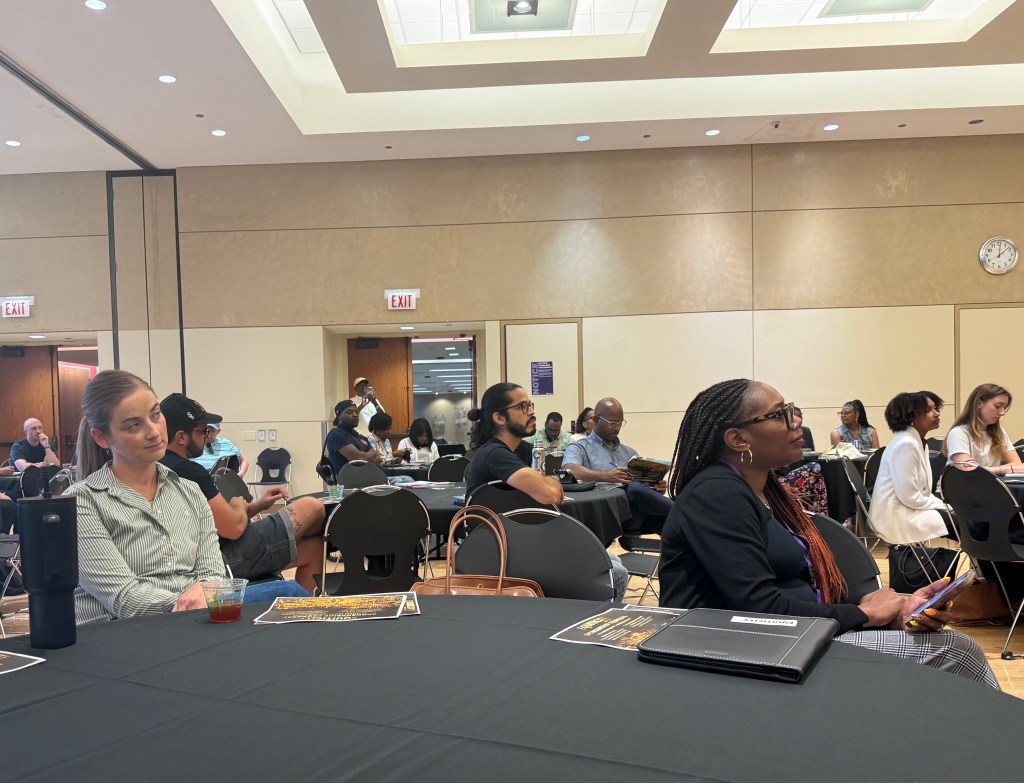
Cordova then asked the two mayors about “bringing people to the table” when it came to decision-making. Johnson said he believes that improving ADA accessibility is critical. He also discussed the need to improve connections to a Metra station on Chicago’s Southwest Side.
“What folks built a century ago obviously is not fitting for today, and so everything that we do today will make it possible,” Johnson added. “We can conservatively get 400,000 more people in our city… We’re at about 2.7 million. Our city is well positioned to get upwards to 3.1, 3.2 million. That’s only going to happen in a safe way, in an equitable way, through the expansion of our public transportation system. And [I’m] looking forward to community partners who will help us develop a public transportation system that will pull us well into the future.”
Lucas later said he wants to hear more positive stories about the relationship between transit systems and the communities they serve. As an example of what he was talking about, the mayor said all the stories he reads about the MTA in New York are negative, with the agency admitting, “Yeah, we’re so broke that we have no plan.” Lucas said that instead transit leaders should share information about their strategies that have been productive and their longterm plans, which would get people excited.
“So that is to me what you have to do – understanding the messaging of transit, the participation,” Lucas added. “And the other thing that I would say, I can’t encourage enough young people, more early career professionals, to get engaged in transit planning as well. It is a wonderful career path. We’re looking for a transit agency director. If any of you are free right now, that is all right. You know, just let me know. Drop your card. But those are the sorts of things we need more people to come into those professions. You are seeing heavy retirements in lots of areas of government. We’d love to see more of you in that soon.”
Attendees Mare Ralph and KiAnna McKee-Steen both work on community accessibility and access issues at UIC. They said they found the forum interesting, especially hearing about what’s going on in Kansas City in comparison to Chicago.
However, Ralph and McKee-Steen said they would have liked to hear the mayors talk more about improving walking and biking access to transit stops. “They did bring up the safety issue,” said McKee-Steen, an associate researcher. “I focus more on sidewalks, so pedestrian safety is very important. And one of those aspects of pedestrian safety is also bike safety and having those separate lanes of travel where everyone could comfortably and safely get to point A to point B. I think it is really important, and I’m appreciative of what they did go over. But I would have liked to hear a little bit more about different aspects that could have been expanded on, especially in the city.”
“I live in South Shore, which is a neighborhood that, correct me if I’m wrong, has zero bicycle infrastructure,” said Ralph, a visiting research associate. “There’s, I think, on 71st there’ll be some painted bike lanes.”
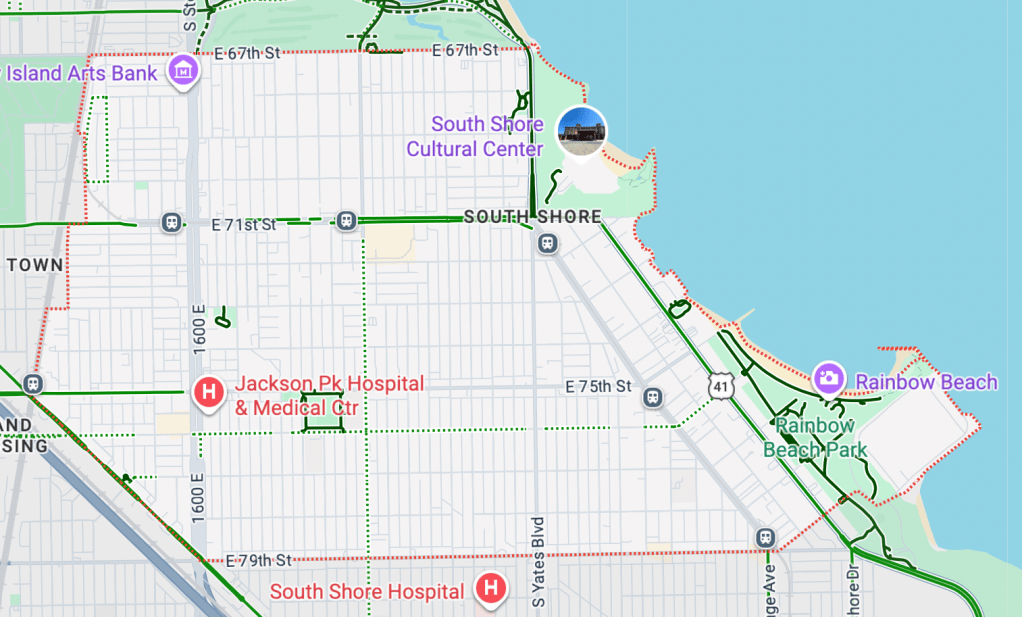
“But we’re also a community with an alarmingly high number of hit-and-runs,” Ralph added. “A few have been fatal recently. Notably, a teenager [Violet Harris, 15] riding a scooter was killed not far from my house in a hit-and-run.”
“I went to UIC for urban planning,” Ralph concluded. “I have a lot of colleagues who now work at the [Chicago Department of Transportation] and other planning agencies. And sometimes it’s frustrating to hear them celebrating how different Chicago looks than a few years ago when it comes to biking infrastructure, because [my neighbors] don’t have the benefit of any of that, and I also know that I have many, many more options for transportation than many of my neighbors.”

If you appreciate Streetsblog Chicago’s livable streets reporting and advocacy, please consider making a tax-deductible donation to support our work. Thank you!

Streetsblog has migrated to a new comment system. New commenters can register directly in the comments section of any article. Returning commenters: your previous comments and display name have been preserved, but you'll need to reclaim your account by clicking "Forgot your password?" on the sign-in form, entering your email, and following the verification link to set a new password — this is required because passwords could not be carried over during the migration. For questions, contact tips@streetsblog.org.