The “Dutch Reach” is not the answer to Chicago’s bike safety problems

Chris Ridgeway is a communications strategy advisor, Chicago cycling advocate, and Co-Chair of the Chicago Bike PAC. This piece was orginally published on his new Substack site Crosstalk Signal. As a guest op-ed, it does not necessarily represent the views of Streetsblog Chicago staffers.
(I wrote this article about the death of Chicago Department of Transportation Planner Riley O’Neil, 35, on June 5. Since then there was news from Boston of a truck driver fatally striking local transportation planner Louisa Gag, 36 on July 9. This piece applies to both of these tragic cases, and many more.)
In early June, we got news in the late afternoon that another person had been killed while bicycling. The details of this one were really rough to absorb. As he rode in the Chicago neighborhood of Bridgeport, a car driver opened a door in the cyclist’s path. While he tried to swerve out of the way, he clipped the door, and was thrown under the rear wheels of an oncoming semi.
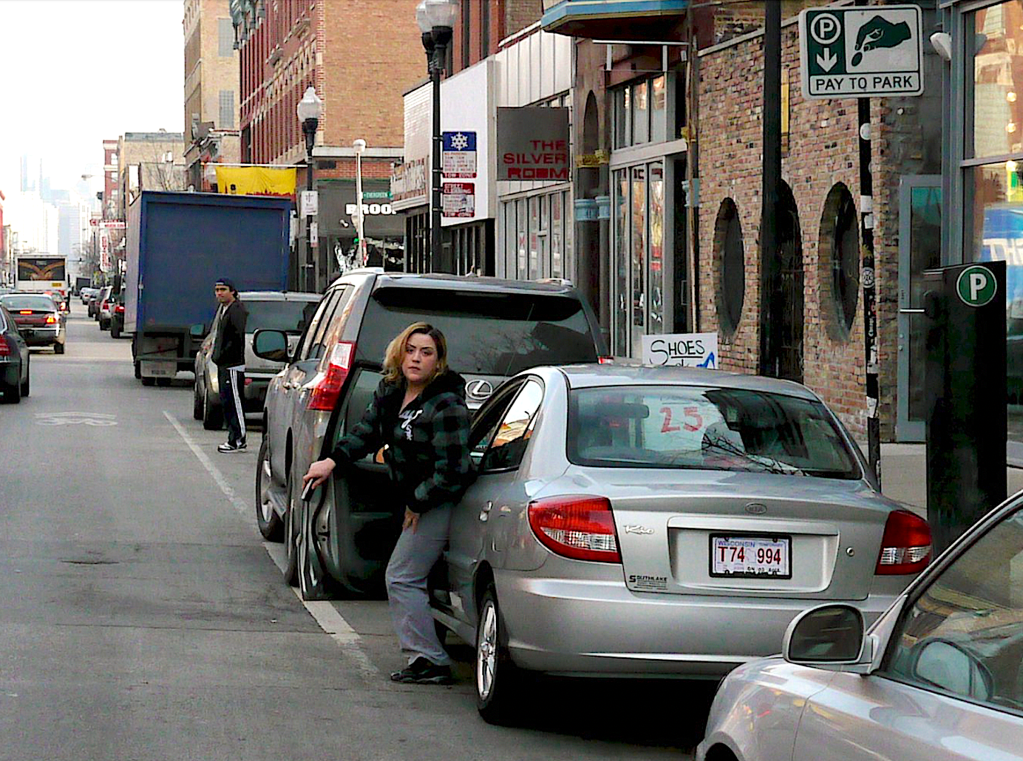
He was riding in a designated bike lane, but the bikeway was simply painted lines along a line of parked cars. This kind of “lane” offers no separation or protection: A cyclist has to be constantly vigilant for opening driver-side doors on their right, and large vehicles on their left. This case involved both.
The bitter irony of the situation? The victim was Riley O’Neil, 35, a professional city planner who worked on bike and bus safety projects with the City of Chicago.
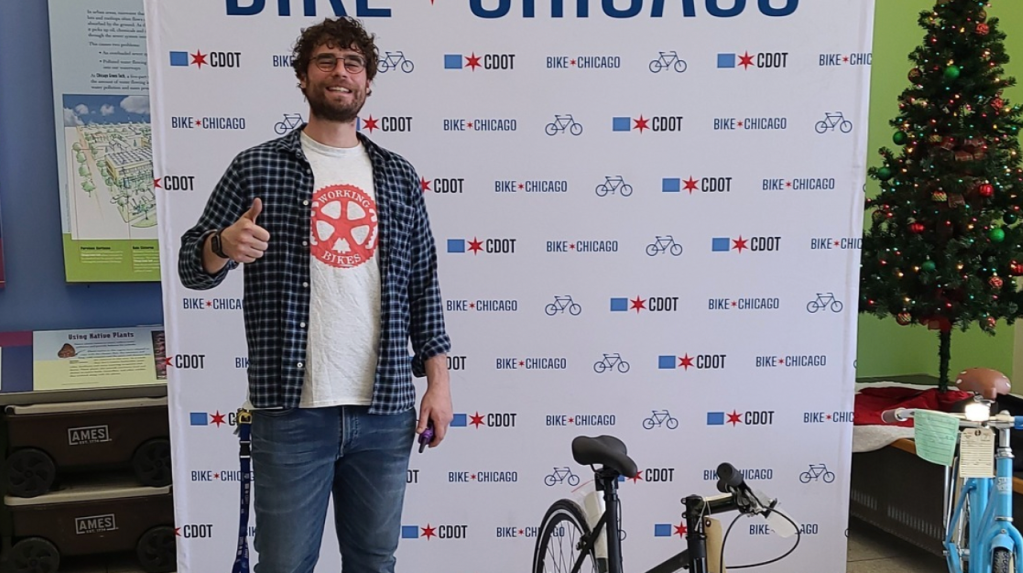
Riley O’Neil. Photo via Working Bikes’ Instagram.
For those of us who advocate for cycling safety in the city, this felt terribly personal. If it could happen to an experienced urban cyclist like Riley… where does that leave the rest of us?
Hundreds of cyclists showed up for a vigil and memorial bike ride in Riley’s honor. I was there, standing somewhere in the middle, draped in a Chicago flag with one Chicago-blue stripe replaced by bike lane green. I didn’t know Riley personally, but knew several who did. Somehow I was introduced to his brave mother, who gave me a hug.
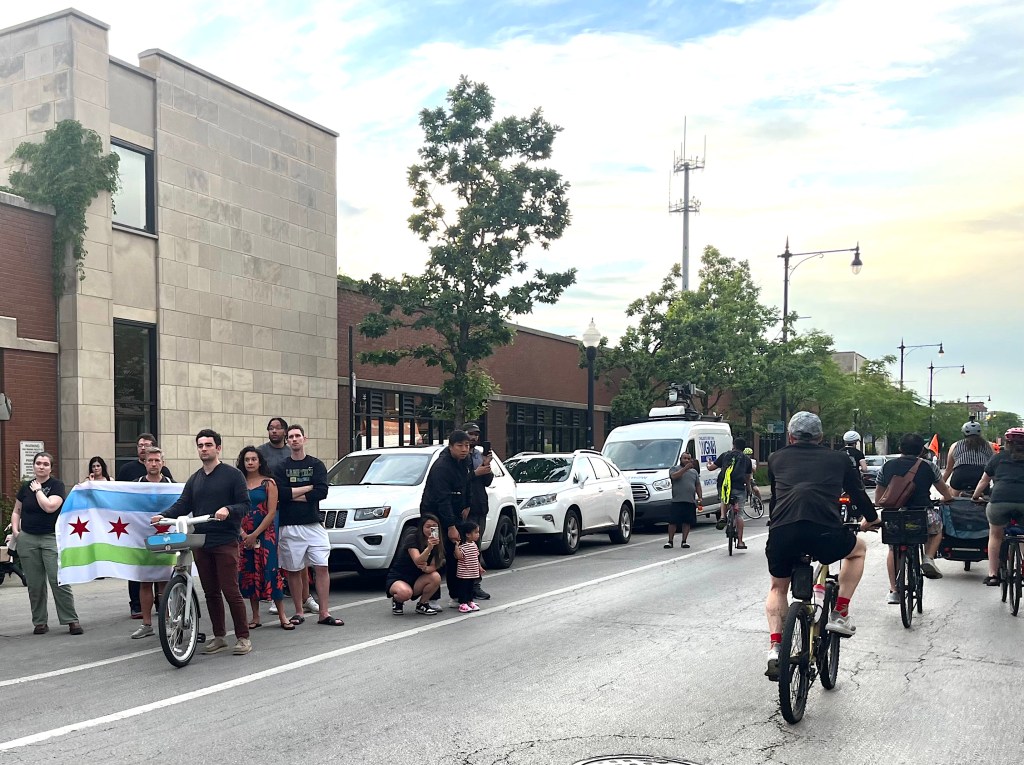
Local elected officials also showed up. Some have been outspoken advocates for better cycling safety, including Ald. Daniel La Spata (1st), whose ward includes parts of Logan Square and West Town, and Ald. Julia Ramirez (12th), who mostly represents Brighton Park. Some of the others have an uneven record on the issue, such as Ald. Nicole Lee (11th) whose district is mostly made up of Chinatown and Bridgeport, including the stretch of Halsted Street where Riley was killed.
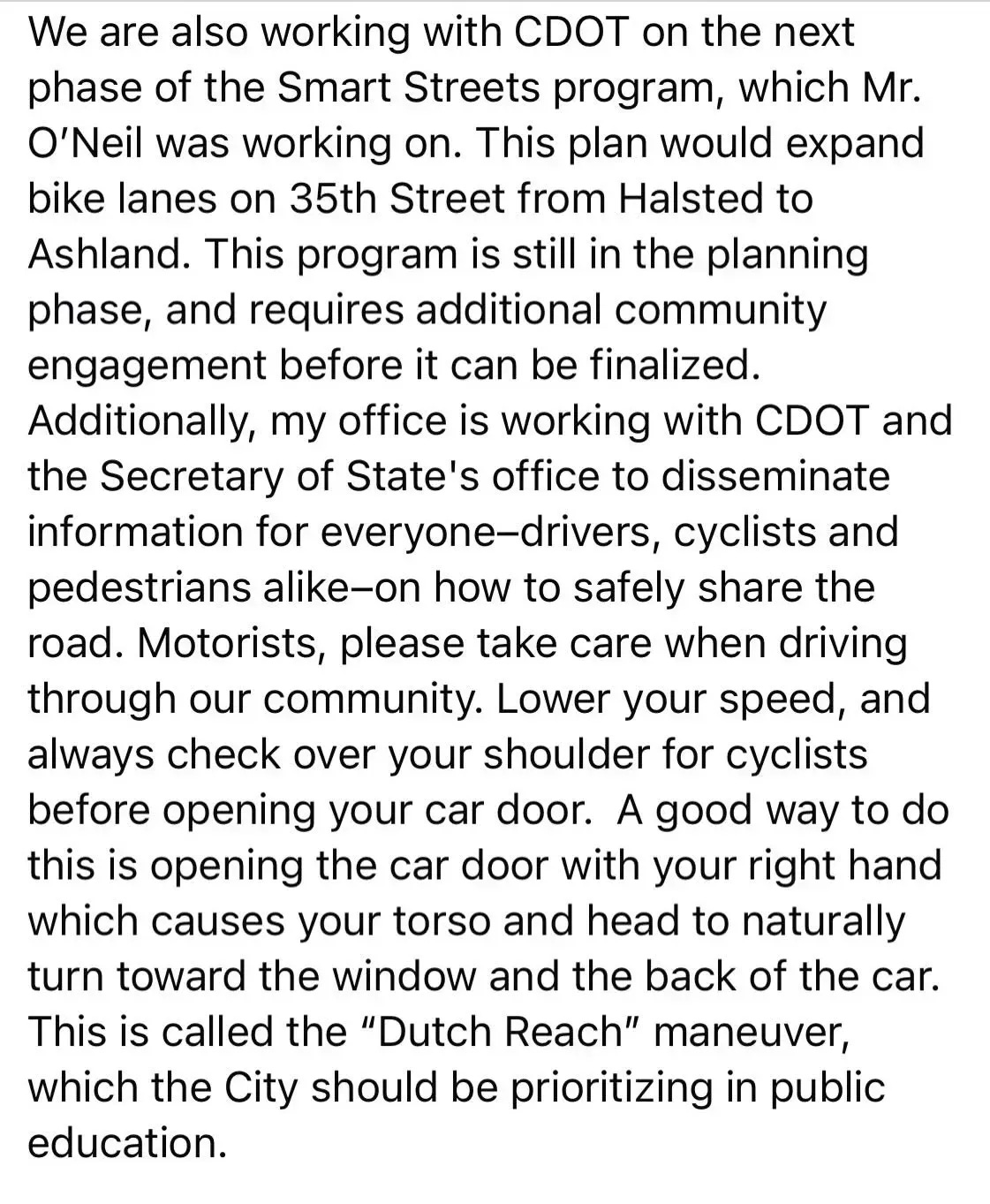
Ald. Lee put out a statement the day after Riley’s death, expressing interest in bike safety. She inaccurately referred to the City’s Complete Streets program as the “Smart Streets” program. (In reality, the Smart Streets pilot uses cameras to enforce laws against drivers parking and standing in bike and bus lanes. Lee should support expanding the coverage area to include her ward.) But then she talked about an oddity called the “Dutch Reach.”
Reaching Dutch
The Dutch Reach is a nickname for a method of opening a car door when exiting. While motorists are expected to check for oncoming traffic before swinging open a door, most don’t.
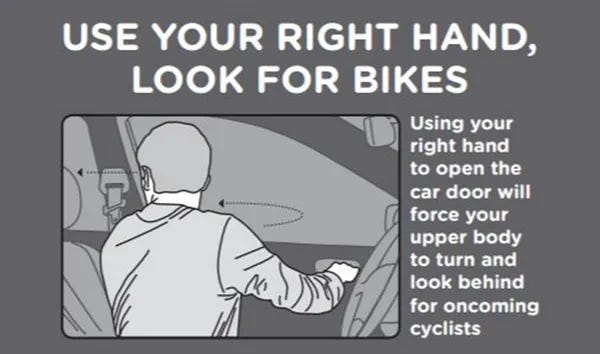
The “reach” is a cross-body reach-around move where the driver opens their left driver’s side door with their right hand. The idea is to force a driver to turn their head and torso, making them more likely to see an approaching cyclist in their peripheral vision or mirror.
The Reach showed up days later in a video from Illinois Secretary of State Alexi Giannoulias, a Chicago mayoral hopeful, who described it from his car while reading a script.
Sustainable transportation advocates and others joined in with similar social media posts. We must educate on the Dutch Reach. Understandable urgency and frustration lay in the subtext. We long for a call to action in a situation that can make us feel helpless.
I feel a similar need for action. But the Dutch Reach? It’s not the right response to Riley O’Neil’s death.
It’s a reach
The term “Dutch Reach” is not from the Netherlands, and it’s less than ten years old. The phrase gained prominence as part of the familiar pattern in which a cycling tragedy launches new attempts at safety advocacy. In this case, the June 2016 death of nursing student Amanda Phillips, 27, in Cambridge, MA, across the Charles River from Boston. Like Riley, she was doored by someone in a private motor vehicle, sending her into the path of an oncoming truck. Her story inspired the Dutch Reach Project website, which promotes the door-opening technique.

As I was writing this article, there was another tragic case in the Boston area on July 9, when a truck driver struck and killed Boston Transportation Department Planner Louisa Gag, 36, as she rode to work in Boston’s Mission Hill neighborhood.

Louisa Gag at a 2018 LivableStreets Alliance event. Photo: LivableStreets Alliance via StreetsblogMASS
The original anti-dooring campaign in the Boston area was successful: Massachusetts added the practice to its official driver’s manual. In 2019, Illinois did as well, followed by a handful of other states. In 2022, the UK added it to its driver education program.
I wish this had made a difference in cyclist safety. I desperately do. But the evidence that this change to drivers’ manuals has saved any lives hasn’t materialized.
Data from the Chicago Data Portal (starting late in 2017 when e-crash data began reporting) shows reported dooring incidents remain about the same after accounting for lower numbers during the COVID-19 pandemic, when fewer people were driving. In 2025, they’ve increased for the last four years while our Illinois Dutch Reach law was in place.1
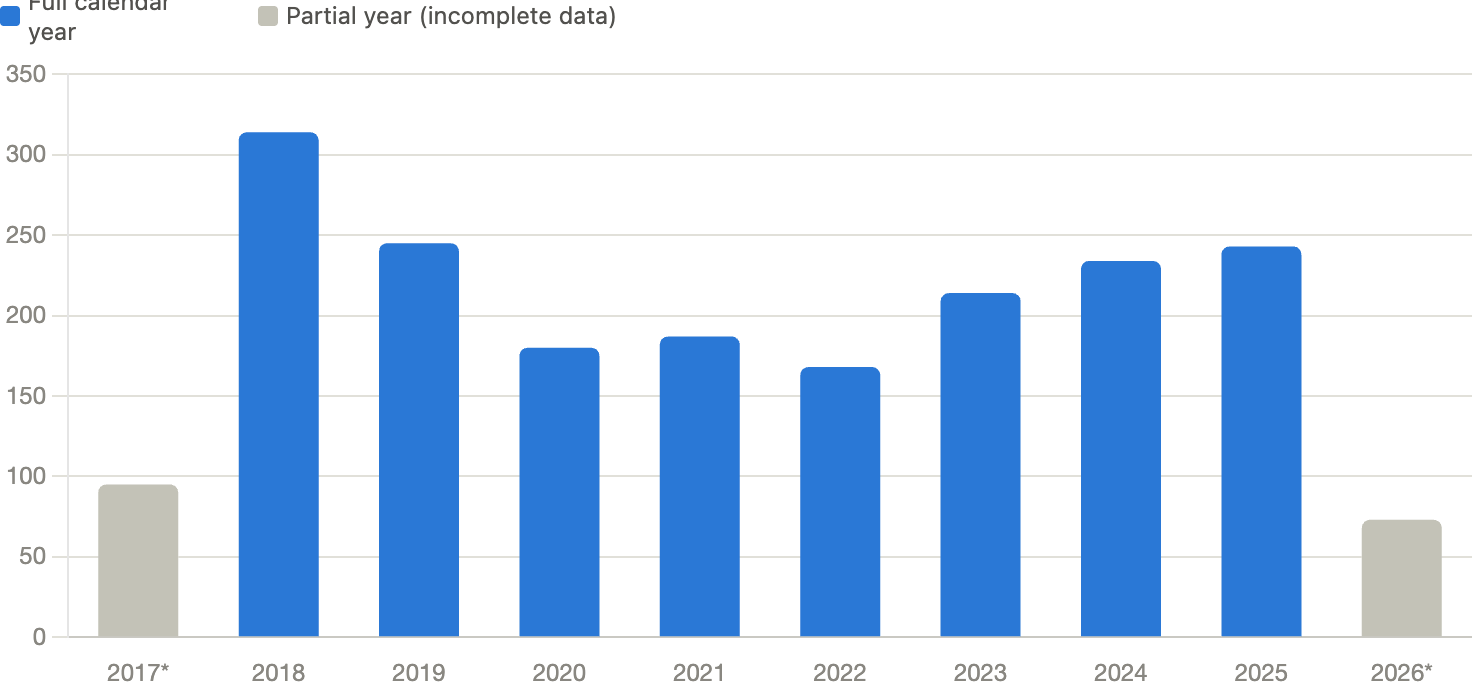
This quick data snapshot would need more rigor but so far, we’re seeing no real change in incidents.
I’m not trying for the cynical take
Maybe I sound overly negative here. One might ask, what complaint can I have about Secretary Giannoulias posting new videos (did I mention the press release) on bike safety?
And how about evidence from the Netherlands? Hasn’t this approach truly been effective there? Why shouldn’t we copy one of the most bike-friendly countries in the world? Perhaps if we give it some more time, we’d see more results.
I’m truly not cynical about the politicians mentioning the Reach. Even if it’s possible Giannoliuas is being opportunistic, it suggests at the very least that someone researched this subject. Plenty of experienced cyclists have also renewed calls for the Reach.
Yet, at best, I see these attempts, as well-intentioned efforts destined to miss their mark. At worst, the emphasis on the maneuver by elected politicians has become political busy work or a choir-preaching shibboleth – a mollifying distraction from the real types of efforts we need to shift the imagination of an entire city.
I’ve been cycling in the city of Chicago for over a decade, and I’ve been involved in the Safe Streets advocacy community for about half that time. But my longer-term interests and academic studies have been in communications with a focus on technology, culture, and ethics. This involves questions such as, How do humans communicate and make meaning with each other? What environments of culture and technology appear invisible to us, like a fish in water? What factors change collective human behavior? 2
There are many approaches to these kinds of issues – legal, political, etc.3 But my most practiced takes are through the lens of communication, culture, and change. So here we go.
The “Nederlandse greep?”

If you appreciate Streetsblog Chicago’s livable streets reporting and advocacy, please consider making a tax-deductible donation to support our work. Thank you!
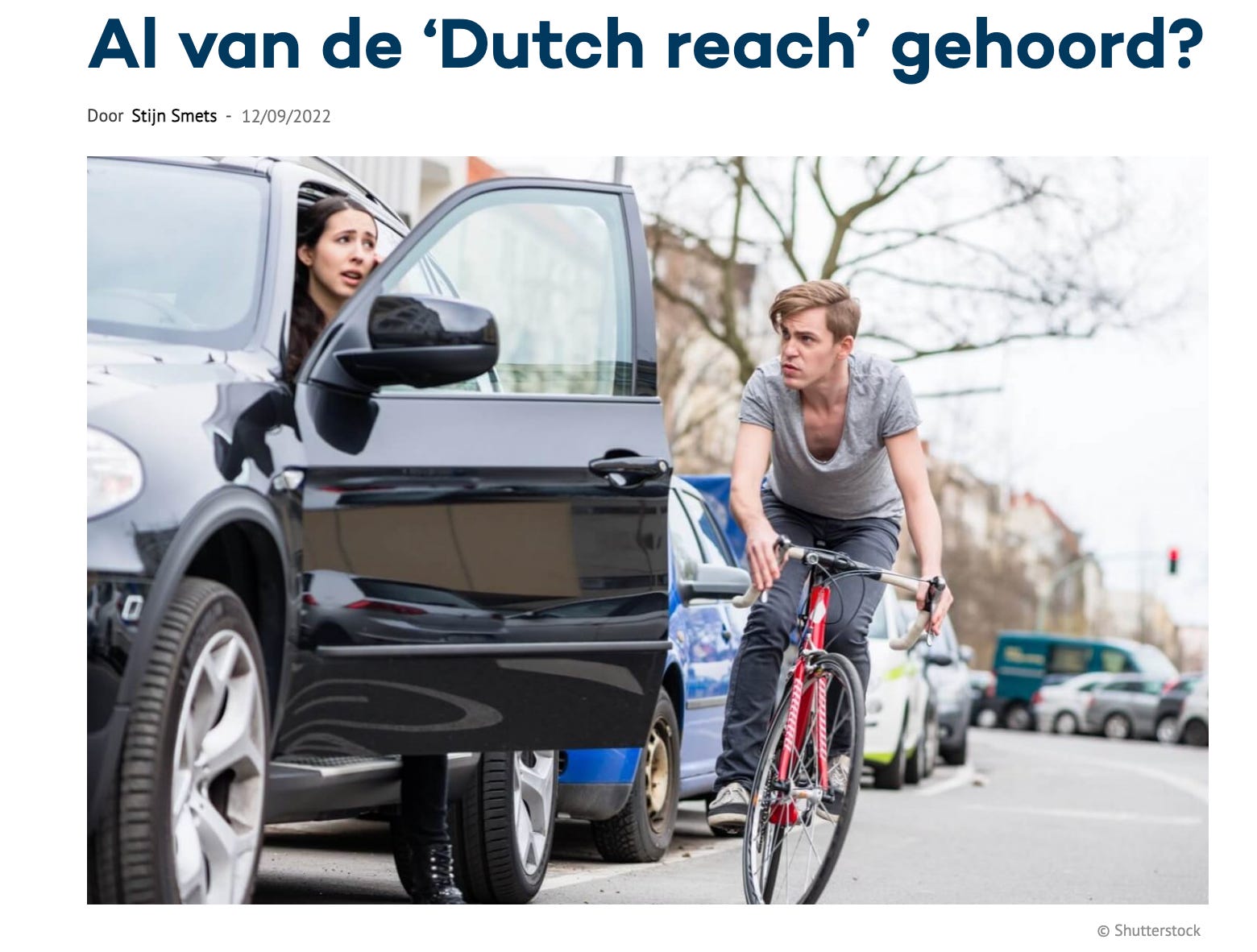
It might be surprising for U.S. bike advocates to learn that in the Netherlands, the “Dutch Reach” isn’t named in law or mandated. During the 2022 campaign in the U.K. to add the maneuver to the code, Dutch media found it ironic that the “Nederlandse greep” was being attributed to the country.
“I have no idea if that works,” said Dutch traffic historian Peter Staal. “But anything that improves road safety is a bonus.”4
The term itself – a re-translation from the original English – is so recent that many Dutch people can’t identify it. While some driving schools say that they teach it in their classes, or that some instructors include it in their driving examination, the Dutch government confirmed to journalists that it’s not a legal requirement.56
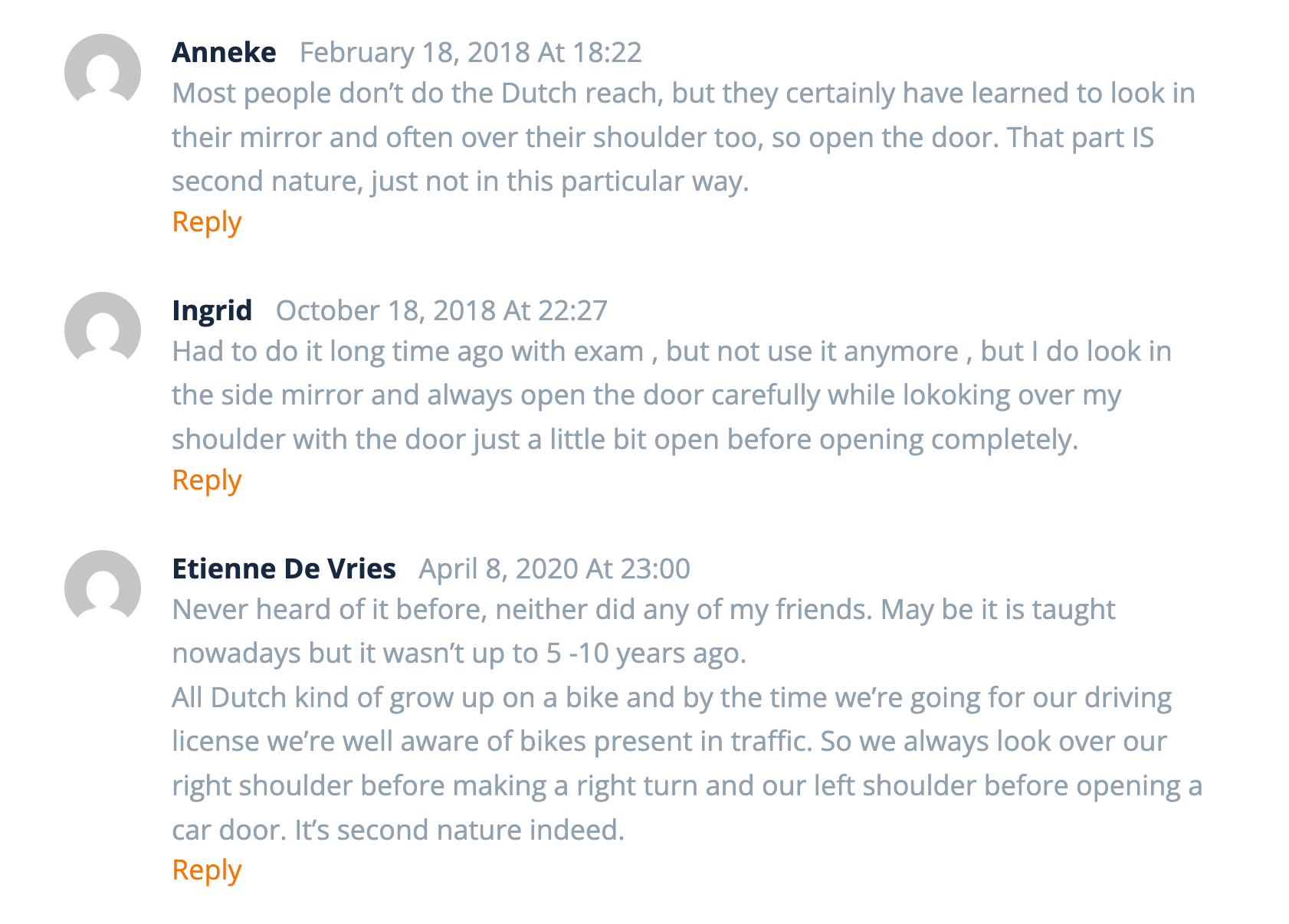
“Most people [here] don’t do the Dutch reach,” commented a person named Annke on a Dutch news site for people from other countries moving to the Netherlands. 7
Have we all been misled? In the Netherlands, the reach-across door-opening method appears to be spottily practiced and not particularly enforced.
But lest we become disillusioned, the Dutch bike safety reality is better and stronger than a driver’s test question with a catchy name.
“All Dutch kind of grow up on a bike, and by the time we’re going for our driving license we’re well aware of bikes present in traffic,” commented Etienne De Vries, “So we always look over our right shoulder before making a right turn and our left shoulder before opening a car door. It’s second nature.”
It’s Second Nature (sorta)
When Dutch commenter Etienne says it’s second nature, he’s unintentionally referring to culture, not nature.
The idea of “culture” is one of the more debated definitions in academia (think art historians versus anthropologists versus pop culture reporters), but my favorite definition is simply that culture = “what’s normal here.”
Culture also conjures visions of art or ritual, the ballet, church, or the Pink Pony Club. But human communication and technologies are the dominant strands that weave the cloak of cultural normalness – whether TikTok or the gasoline engine.
The culture and technology of bikes, roads, and travel in urban settings rises from learned human behavior in the built environment. We absorb it implicitly in our physical and social environments – learning to walk to the right side of the sidewalk or singing “Fast Car” at the start of our road trip.
Culture shift is the most powerful force to change human behavior.8 We change how people act by changing their sense of what’s normal.
In Dutch culture, “what’s normal” is learning to ride a bike when you’re young – not just with other kids, but with all the adults. With cycling being a dominant and preferred method of travel – bikes outnumber cars four-to-one in Amsterdam – Netherlanders don’t need a law or a practiced maneuver to remind them to watch out for bike riders. Awareness of cyclists is ingrained because it’d be weird not to be.
So how do we move Chicago there?
The meta questions are simple to ask and difficult to answer. Can humans take a leading role in changing our culture? Or does our culture (and related technologies) have an intractable and invisible grip on us? How do we even begin to change practices – or lack thereof – so assumed they are proverbial water to fish?
Cultural norms do change, if glacially – slow-moving and silently under our feet. In my 40-something years, I can remember some big changes. Take smoking indoors – it was standard practice for the “Mad Men” and my childhood smoking-section experiences at the IHOP. And nearly everyone will cite the rise of digital communications technology across the internet, mobile, and social media that folks like my parents have adjusted to, but still find themselves wanting to write paper checks.
I’d be foolish to try to bite off an explainer of all cultural change, so let me refocus on the task at hand. That is, what role can a government play in changing cultural norms for the safety of our families and neighbors?
Page 43 isn’t going to do it
With apologies to the Illinois Secretary of State, our nation-leading 2019 law introducing the Dutch Reach into our driver education added a postage-stamp-sized diagram on page 43 of Illinois Rules of the Road (2026), in the section addressed to bicyclists.9
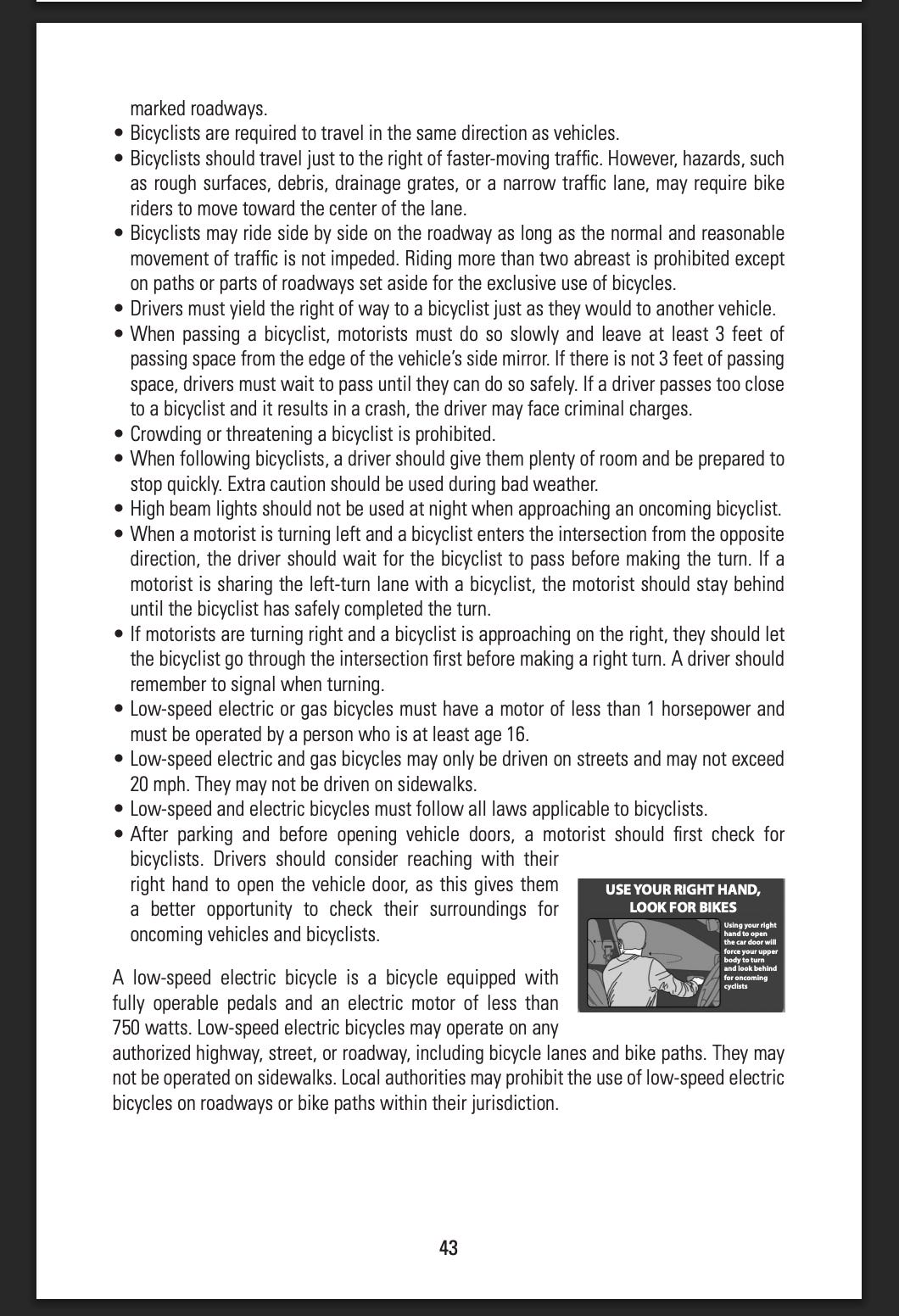
Forget the big cultural change theorists. The social media intern is going to be able to tell you that this has about as much informational traction as my great uncle who figured out Blogger in 2024.
We aren’t surprised by this. Governments at local, state, or federal levels have rarely been the model of how to communicate effectively. (That’s perplexing, since the politicians trying to win elections can be so good at it.) I’ve long believed we need a movement to hold government projects accountable for poor communication practices and user experience, especially around vital services for disinvested communities. (Note to self: write angry rant about website design for Illinois social services.)
Even government-run training – say driver education – is usually untenably behind in the more modest fields of learning management systems and adult pedagogy. Companies have no problem making employees take an online training course on how to spot a phishing email so they don’t click a stupid link generated by a Russian hacker, and can tell when they’ve taken the training and deliver up-to-date info on an annual schedule. So we need to truly consider why so many U.S. drivers on the road were last trained in the 1970s while lacking a fully-formed pre-frontal context. Are we gonna call that task done and good?
that is, drivers shouldn’t be trained only once at 16 years old. Roads, vehicles, technologies, and laws have changed significantly over the years. We can’t rely on folks to read that one annual Block Club Chicago article about new ordinances, much less a downloadable PDF manual. Digital delivery CEUs with up-to-date best practices in accessible adult pedagogy need to be a real thing for ongoing driver’s licensure.10
Yet even if the government can get better at communication around services and even implement up-to-date training frameworks, the point here is that cultural change – the shifting of “what’s normal here” – is a much bigger lift. Government channels as we know them today are unlikely to move the needle.
They certainly can’t just use a wall-of-text Facebook post to persuade folks to start opening their car door with their opposite hand. Please – let’s not even pretend.
Influencer’s reach
What if we could try another tack? Forget Alexi, let’s use a page from the playbook that real brands do: Get an influencer with real reach to teach the Dutch Reach. Chance the Rapper recently participated in a CTA campaign to promote the ‘L’ lines as, in his words, “a pathway to connection and an opportunity for people to build community.” I’d love to meet him and would be happy to produce a video, with him sitting in a driver’s seat with a film crew. Let’s get some real dollars and talent into it and see how viral we can go.
Along the way, we can start measuring communications impact the way real communications groups do it: with conversion rates and impact KPIs (performance indicators) among our target audiences. “Putting the message out there” is not enough. You measure reception and effectiveness.
There’s a lot to say here, but I don’t want to chase this thread, and for a simple reason. Even if we could get the communications strategy right, the Dutch Reach is the wrong message.
In the short term, getting drivers to open their door carefully seems critical in the face of tragedy. But many Chicago sustainable transportation advocates have the primary goal of creating a citywide, connected, low-stress bicycle network, including off-street trails, protected bike lanes on main streets, and bike-and-priority side-street routes called Neighborhood Greenways. This “bike grid” would connect every Chicagoan to schools, jobs, shopping, and socializing. By definition, these routes wouldn’t force people to ride in the “door zone” next to parked cars on major streets.
The more progress we make on a truly safe and low-stress bike network, the less opportunity the average driver will have to understand what it means to door a bike rider. It’s hard to introduce a cultural habit when our primary solution of separating bike traffic from car traffic actively works against the frequency tipping point we’d need.
Even if boosted with celebrity, a “The More You Know”-style PSA campaign against dooring would still wither if there’s no clear and persistent problem narrative with an evident solution.
The formula for cultural change (🚲)
Consider for a moment what helps move us toward a new cultural normal. The formula or recipe is not easily repeated, as scholars across the history of law, sociology, public health, and media reception can attest. Major parts, however, do recur.
Forgive me for assembling my own bike analogy.
A law and policy framework does matter, but rarely advances cultural norms without other social pressures. Since it’s essential but static, let’s call this the bike frame.
A communications strategy is the forward power of any change movement, so I’ll call this the chain. It includes related chain links such as: clear internal communications for advocates and early adopters, integrated digital campaigns for civic engagement, elected-official talking points, earned and paid media, and yes, possibly influencer marketing.
On-street bike infrastructure is more than just cyclist protection: it also serves as a visible part of the cultural shift. Design researcher Don Norman would call these affordances—the physical environments that, if designed properly, human psychology understands how to use without instruction. From doorknobs to protected bike lanes, humans need to perceive possibility before action. Since we’re still stretching analogies, we can call this the handlebars and pedals.
Technological shifts have great power to take a leading role in human events – from the wheel to the printing press to social media – and I’ll label these as the battery-powered pedal-assist for cultural change. Sometimes they feel more like short jabs at the accelerator button – a cultural punctuated equilibria.11
Related but different, minor technological process improvements can amplify the power of a burgeoning cultural change and expand its reach. Let’s make this the gears – each rotation gives us more rotation.
Signs and symbols (also called brands) might be the stickers affixed to the frame. They’re probably part of the communications power-chain, but more fun pictured this way.
And we can’t forget the role of temporary crisis in cultural shifts, a sudden uphill moment of pain that often leads to acceleration on the other side.
I built our analogy on the fly (on the ride?), and I’m sure it could be improved (um, it now occurs to me that I didn’t include wheels). But taking a test spin on our bike of cultural change, let me make some final observations on how this might apply to our local and state government.
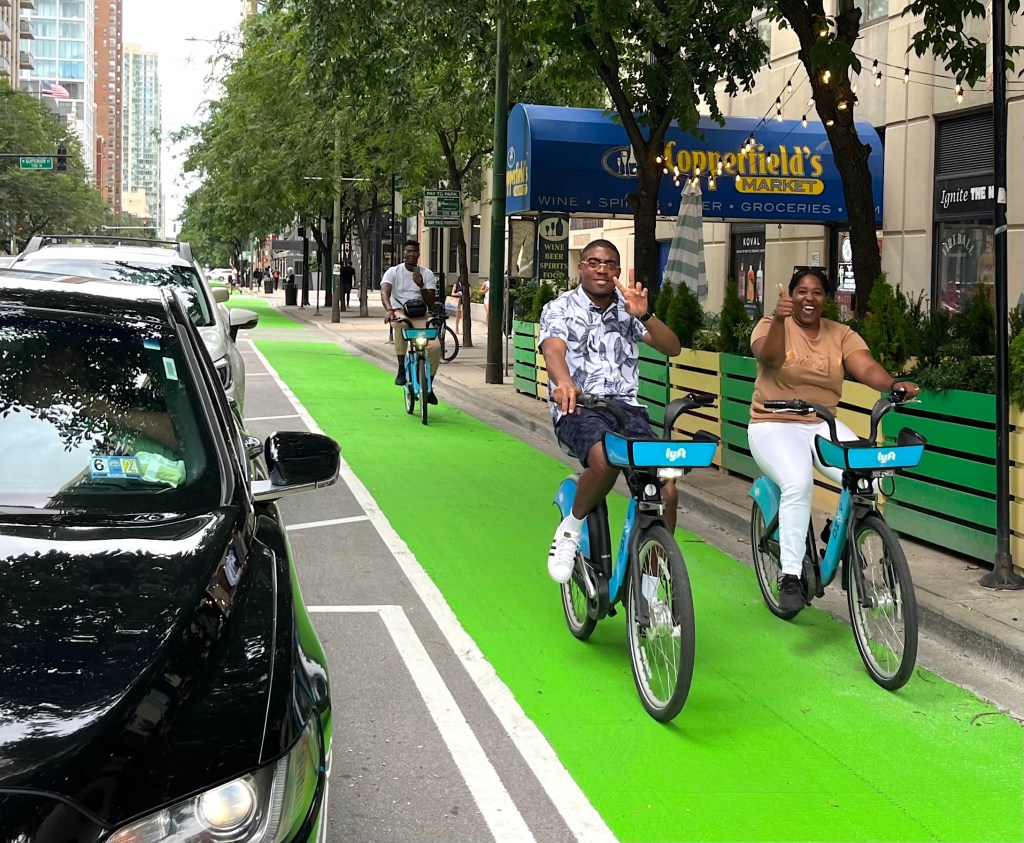
What Chicago government can (and should) do
How do we weave a new cultural normal, where people on bikes and other vulnerable road users (e-scooter riders, parents taking their kids to school, etc.) are protected and not in danger of a car door to the face? Since it appears that a Dutch Reach education campaign is ineffective at best, what will actually pedal this bike?
As they have for centuries, technology and communications (in my analogy, the bike chain and electric power) will play a dominant role. Governments are not good at either, but they have central roles to play in policy (our bike frame) and infrastructure affordances (our handlebars and pedals).
So, dear Chicago elected officials, instead of promoting the Dutch Reach, here’s what would be more effective.
Let crises spur us to action. Tragedies like Riley O’Neil’s death in Chicago or Louisa Gag’s death in Boston can bring new urgency to the Safe Streets movement. Don’t waste it, and definitely don’t talk your way out of it.
Create the law and policy frames. Equitable rules of the road – like when we all agree that a red light means stop – go a long way to allow all sorts of road users to co-exist. Chicago has already made some important modernizing policy moves, such as requiring the Chicago Department of Transportation to use Complete Streets design when repaving streets. 12 We’ve also illustrated how policy provides a frame but doesn’t pedal us forward. Chicago has a penalty for blocking a bike lane with a motor vehicle, but even after raising the fine from $120 to $250, we saw little change in behavior.
Still, we have policies sitting on the table that need immediate attention. In February 2025, the Chicago City Council voted against lowering our default speed limit from 30 to 25 mph, even though that change was found to dramatically reduce crash deaths in peer cities like New York. In Illinois, bike riders are still only legally classified as “permitted” road users, rather than “intended” ones. We need equitable automated enforcement for bike lane blockages, and a clear ordinance mandating a professionally planned low-conflict bike network that can’t be blocked by aldermanic moods across our jigsaw-puzzle wards.
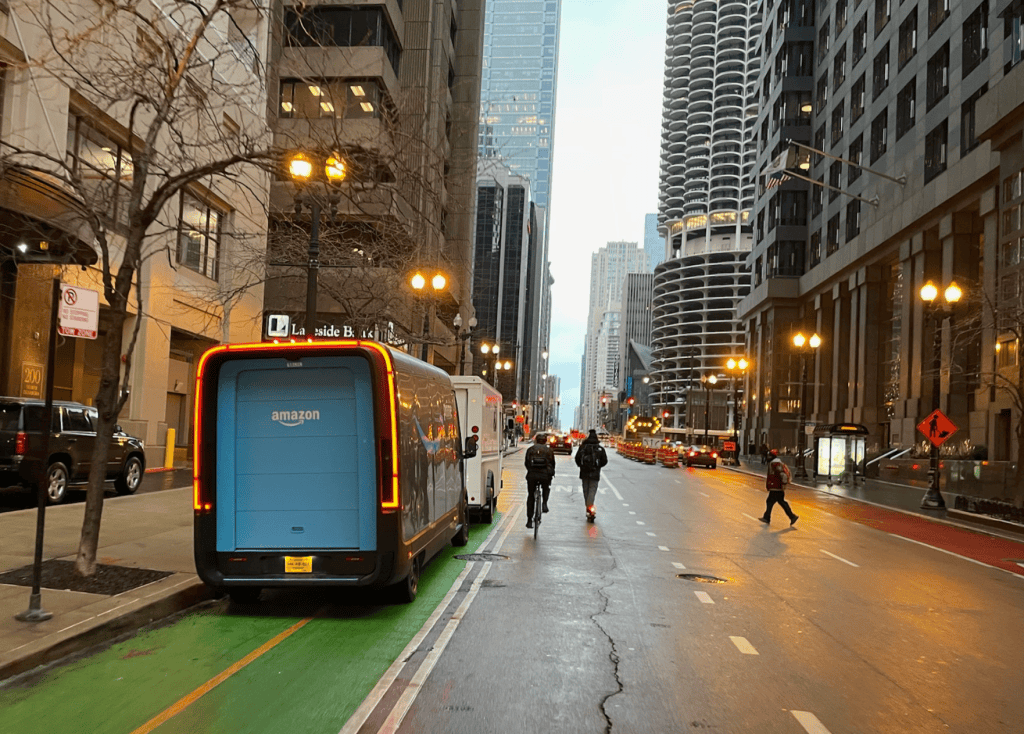
We could be even more effective using policies to shape the behaviors of systems and organizations. Corporations, insurance companies, and delivery fleets respond to direct regulation in a way that individuals don’t. Why is it that we have 18-wheelers on roadways in residential areas? How is it that Amazon feels empowered to look the other way when delivery drivers block crosswalks or bike lanes? What are we going to do about it?
Build physical infrastructure. This is a reminder that if you build it, THEN they will come. Nothing stopped smoking in restaurants like removing the smoking section. Separated bike / micro-mobility lanes and pedestrian safety features should be built first. Motorists don’t drive where there aren’t streets. Many people aren’t interested in riding bikes unless they have a safe, comfortable place to ride.
Frame the argument in terms of problem, vision, and solution. While cultural communication shifts largely happen through storytelling and third-party voices, elected officials have a fundamental communication responsibility. Chicago alders who have done private outreach to business corridors and community stakeholders have seen significantly less public resistance to street safety improvements.
Enable technology enhancements. Blind-spot alert technologies have been around since 2007, but only 25 percent of the roughly 291 million registered vehicles in the U.S. are equipped with that tech. Yet we can do much better: newer technologies with 77GHZ radar can detect bikes or e-scooters specifically, and Tesla vehicles can lock the door and issue an alert. In the EU, pedestrian and cyclist safety detection systems became mandatory as of July 7.13 There is nothing similar in the U.S.
In our analogy, we noted that while tech enhancements don’t kick off cultural change, they can shift momentum into higher gear.
TLDR
I sat down to write a quick complaint about how Dutch Reach education isn’t a good response to dooring deaths. Instead, I wrote 4,000 words of rant. My apologies. The summary:
While possibly well-intentioned, elected officials” call for the “Dutch Reach” maneuver when opening a car door isn’t an effective response to cyclist deaths. The Netherlands is safer for cyclists because bike safety is a powerful cultural norm. Large-scale cultural change must be our goal. Culture shift is driven by communications and technology, built on a policy and infrastructure framework. Government isn’t great at the first two, so it should concentrate on the second half, while the rest of us work on changing minds and hearts.
And possibly plan a summer visit to the Netherlands.
The Chicago data was so much easier to see via Streetsblog Chicago cofounder Steve Vance’s Chicago Traffic Crashes map.
These questions and insights can be explored across communications sub-disciplines in media studies, historical media ecology, classical rhetoric, ICT, and political communications, as well as further-reaching fields such as urban design and user experience. I figured just listing these would get too boring here, but I hope to explore these overlaps further as it applies to sustained urban change in Chicago
I’m referring to political rhetoric, nonprofit advocacy, sociology of law, or municipal policy to name a few.
https://nos.nl/artikel/2414805-de-dutch-reach-vanaf-morgen-moeten-britten-anders-uit-de-auto-stappen (2022), accessed Jul 7, 2026
https://topgear.nl/autonieuws/nederlandse-greep-hier-niet-verplicht-soms-onveiliger/, (2022) accessed Jul 7, 2026
https://magazine.vab.be/op-weg/hoe-zit-dat/de-dutch-reach/ (2020 December), accessed July 7, 2026
https://dutchreview.com/culture/cycling/practice-reach-dutch-reach-actually-thing/, accessed July 7, 2026
The business world isn’t wrong when it quips “culture eats strategy for breakfast,” often (mis) attributed to management consultant Peter Drucker. Who knows who really said it first?
To be fair, the Dutch Reach is mentioned in the Illinois Rules of the Road (but there’s no illustration) one other place for drivers in a section entitled “Lane Usage” – where they instruct the gentle reader to turn to page 43.
There’s a limited amount of this for driver’s with violations, but an ongoing training model is successful when it prevents traffic violence, not responds to it. The State of Illinois just reduced its testing requirements of the oldest set of drivers, which doesn’t move us in the right direction. Further, there are few examples of ongoing education requirements in other states
Popularized by Stephen Jay Gould and others—the idea borrowed from biological evolution that technological shifts happen in spurts.
If you appreciate Streetsblog Chicago’s livable streets reporting and advocacy, please consider making a tax-deductible donation to support our work. Thank you!

Streetsblog has migrated to a new comment system. New commenters can register directly in the comments section of any article. Returning commenters: your previous comments and display name have been preserved, but you'll need to reclaim your account by clicking "Forgot your password?" on the sign-in form, entering your email, and following the verification link to set a new password — this is required because passwords could not be carried over during the migration. For questions, contact tips@streetsblog.org.