Even Though The 606 Is CMAQ-Funded, It Doesn’t Have to Be Open 24/7

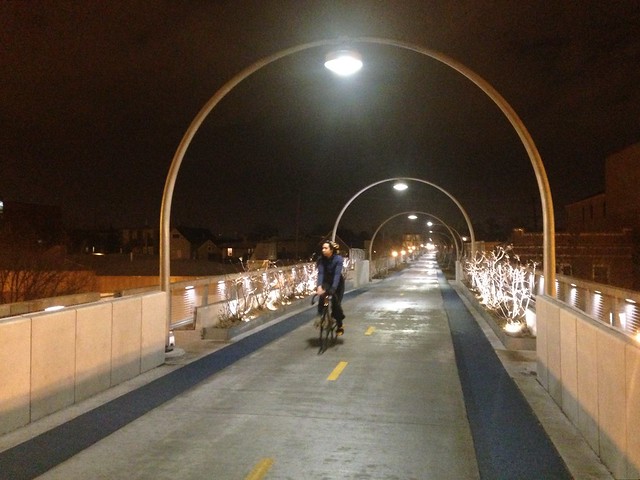

Although the Chicago Park District says nonstop commuting on the Bloomingdale Trail, aka The 606, is legal during park curfew hours of 11 p.m. to 6 a.m., the Chicago Police Department disagrees, and they currently clear the path of all users at 11.
Some bike advocates have asked if it’s even legal to close the Bloomingdale at night. Unlike New York City’s popular High Line elevated trail, which doesn’t allow cycling, much of The 606’s $95 million cost was funded by federal Congestion Mitigation and Air Quality Improvement funds.
The justification for the grant was that, since The 606 functions as a useful car-free commuting route, it helps reduce the number of automobile trips. So shouldn’t it be open 24/7, just like other transportation corridors?
Unfortunately, there don’t seem to be any rules that would prohibit limited access hours for CMAQ-funded bike paths. Federal Highway Administration spokesman Doug Hecox says FHWA CMAQ experts think the funding source doesn’t preclude an off-street bike facility from being closed at night. “Many bike/ped networks must use parks, forest preserves or other public lands to complete a transportation corridor and we presume some of these parks and forest preserves are closed to the public during overnight hours,” Hecox says.
Brian Housh, Midwest policy manager for the Rails-to-Trails Conservancy, had a similar response. “I believe there can be good reasons for limiting the access of a facility by hours,” he says. “Funding programs are not very prescriptive and there’s reluctance to second-guess local authorities, such as police trying to prevent crime.”
“Certainly, I like to see trails open and accessible,” Rush adds. “However, the goals of CMAQ pertain to relieving traffic congestion and mitigating air quality burdens, both of which are primarily related to daytime driving.”
Unfortunately, it looks like another argument will be needed to get the police to change their misguided policy.
This post is made possible by a grant from the Illinois Bicycle Lawyers at Keating Law Offices, P.C., a Chicago, Illinois law firm committed to representing pedestrians and cyclists. The content is Streetsblog Chicago’s own, and Keating Law Offices neither endorses the content nor exercises any editorial control.

Read More:
Streetsblog has migrated to a new comment system. New commenters can register directly in the comments section of any article. Returning commenters: your previous comments and display name have been preserved, but you'll need to reclaim your account by clicking "Forgot your password?" on the sign-in form, entering your email, and following the verification link to set a new password — this is required because passwords could not be carried over during the migration. For questions, contact tips@streetsblog.org.