Eyes on the Street: Pedestrian Islands Taking a Beating From Drivers

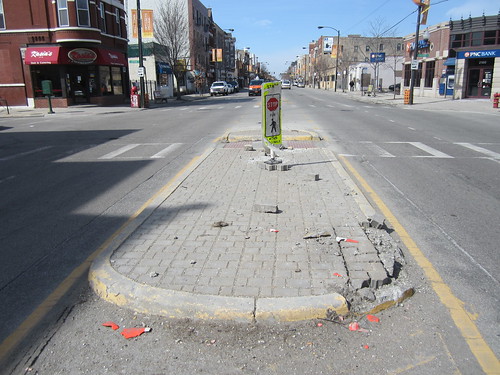
Pedestrian islands make walking across a street safer and easier. At signalized intersections, they allow individuals who might have trouble crossing the street in a single walk cycle, such as people with disabilities, seniors and parents with small children, to make a partial crossing and then safely wait for the next cycle. At unsignalized crosswalks, they allow everybody to cross half of the street when there’s no oncoming traffic to the left, and then wait safely until the coast is clear on the right. However, Chicago drivers sure dish out plenty of abuse to these concrete refuges.
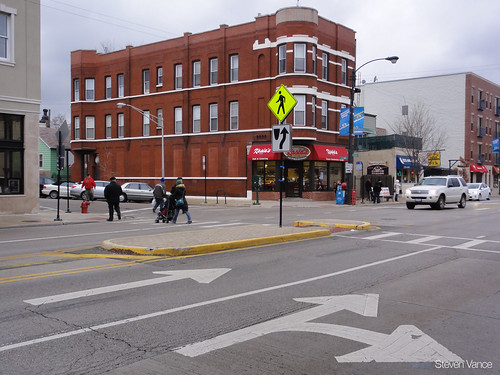
The Chicago Department of Transportation installed this island at Chicago and Hoyne in Ukrainian Village in 2009. Drivers knocked out the diamond-shaped pedestrian sign on the island in the above photo on at least two occasions. More recently, CDOT replaced that sign with a “Stop for Pedestrians Within Crosswalk” placard, which is designed to bounce back up when struck. When I dropped by Monday, that has also been torn out of the brickwork, and several bricks were missing from the corner of the island.
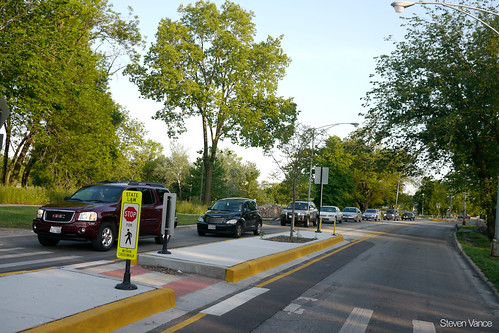
In 2011 CDOT installed pedestrian refuges as part of a road diet on Humboldt Boulevard through the eponymous park. These make it easier to cross between the two sides of the park on foot, and the removal of travel lanes helped calm traffic. Unfortunately, the new configuration also created pinch points that make it unsafe for drivers and cyclists to share the remaining travel lanes. As you can see from comparing these before and after photos, motorists have also done a number on these islands, knocking out traffic candles and “Stop for Pedestrians” signs.
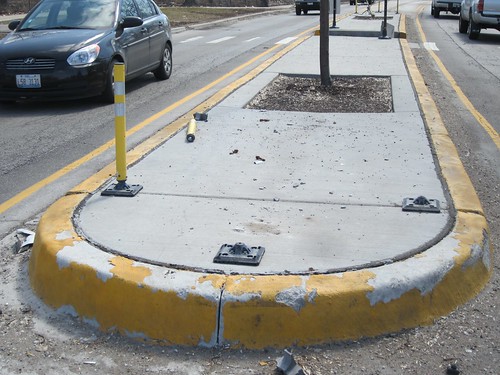
This refuge island shown below, at Clark and Berteau in Ravenswood, was installed as part of the Berteau Greenway, completed last fall. In addition to making it easier to walk across Clark, it includes a cutout, which allows eastbound, contraflow bike traffic from the greenway to turn north on Clark. At the northwest corner of the intersection, a bumpout and bioswale further shortens the crossing distance, tightens the turning radius for drivers turning west onto the side street, and absorbs storm water.
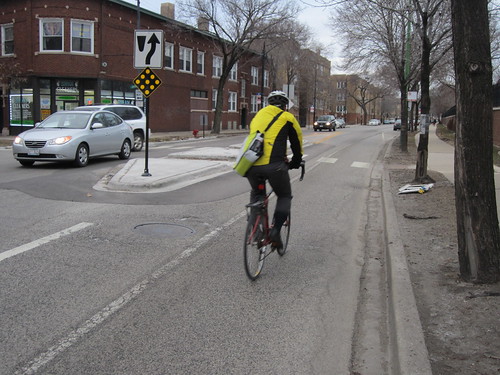
Unfortunately, this refuge island also creates a pinch point for cyclists on Clark, making it advisable to take the lane here to avoid being passed too closely by motorists. Shortly after the greenway opened, a driver flattened one of the warning signs; it has since been reinstalled. Several chunks of concrete are missing from the north end of the island, and a motorist busted the curb around the bioswale — debris from this crash still sits in the planter.
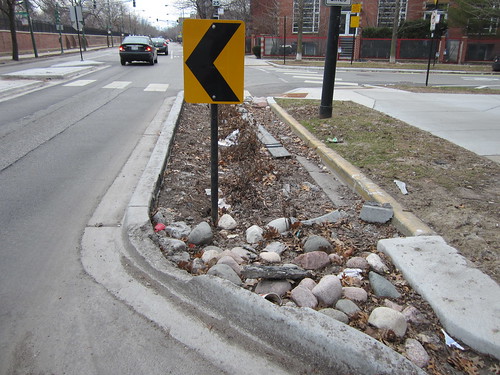
I’m not sure what lesson can be learned from all this battered infrastructure. It’s clear that these islands are doing their job protecting pedestrians, but perhaps more needs to be done on these streets to reduce car speeds. One thing’s for certain: one should never underestimate the recklessness of the Chicago driver.

Read More:
Streetsblog has migrated to a new comment system. New commenters can register directly in the comments section of any article. Returning commenters: your previous comments and display name have been preserved, but you'll need to reclaim your account by clicking "Forgot your password?" on the sign-in form, entering your email, and following the verification link to set a new password — this is required because passwords could not be carried over during the migration. For questions, contact tips@streetsblog.org.