Skip to content

Transport Chicago Conference
No Comments

Eyes on the Street: Milwaukee PBL Construction Starts Sooner Than Expected

IMG_6893

Looking southeast at Milwaukee/Ogden - a buffered lane is already rideable. Photo by John Greenfield.

It was quite a surprise to come upon fresh white thermoplastic stripes on Milwaukee Avenue this evening. Many Chicagoans have been eagerly anticipating new protected bike lanes on Milwaukee, the city’s busiest bike street, which will be the missing link between existing PBLs on Kinzie and Elston. At a public meeting about the bike lanes at Intuit arts center on April 30, Chicago Department of Transportation staff said this stretch of Milwaukee would be repaved in May and the lanes constructed in June, pending continuing community outreach and final approval. At that meeting, a vocal minority of local business owners and residents complained about CDOT’s proposal to relocate about half of the street’s curbside parking spaces to side streets, as well as other details of the plan that they feared would make it harder to drive.

Last week crews began tearing up sections at the north and south ends of the project site for repaving. CDOT Spokesman Pete Scales said the department hopes to finish this work by this Monday. I noticed a few patches in the middle had been recently patched, which seemed odd, since I was under the impression CDOT would be redoing the entire stretch. The new striping on this section indicates that this middle segment will not be completely repaved – no biggie, since the asphalt here is reasonably smooth. More importantly, new striping suggests that the PBL plan is now a done deal, and we can look forward to seeing the finished product sooner than later. We’ll get you more details on the status of the project soon; here’s a quick tour of what’s on the ground so far.

IMG_6881

West side of Milwaukee south of Ogden. Photo by John Greenfield.

IMG_6882

Continuing south on Milwaukee - a floating parking lane. Photo by John Greenfield.

IMG_6884

Continuing south on Milwaukee. Photo by John Greenfield.

IMG_6886

A contractor measures the street width on a section of Milwaukee north of Grand that is already partially repaved. Photo by John Greenfield.

5 Comments

New York’s Experience Shows Ashland Bus Lanes Won’t Cause Carmaggedon

On stretches of First Avenue in New York City, one general traffic lane was converted to a bus lane and another was converted to a protected bike lane without affecting traffic volumes or speeds. Photo: NYC DOT

Converting a travel lane in each direction on Ashland Avenue to center-running bus lanes, greatly improving transit performance on the corridor, won’t lead to Chicago’s own version of Carmageddon (which actually never materialized).

Data from New York City’s Select Bus Service on First and Second Avenues – where two travel lanes gave way to bus lanes and bike lanes – shows myriad improvements. Trip times fell, crashes were reduced, and ridership increased — all goals that the Emanuel administration has outlined in the Chicago Forward Action Agenda.

Let’s check off the similarities:

  • The M15 bus runs on 1st Avenue (northbound) and 2nd Avenue (southbound) and carries more passengers than any other bus route in New York City and had long boarding times because of the high ridership. The 9/Ashland bus has the highest ridership in Chicago and also suffers from long boarding times. Check.
  • The M15 runs on streets that see huge traffic volumes, especially during rush our as car commuters enter and leave Manhattan. The 9/Ashland bus battles congestion at many choke points caused by clusters of retail, housing, and offices, and because of adjacent traffic backups caused by outdated intersection signal phasing and highway on-ramps (think Ashland/North). Check.
  • NYC Transit kept the M15 local route, which does not stop at the Select Bus Service stops. The 9/Ashland would also run but alongside and not in the 9/Ashland-BRT lane.

In New York, on some segments of these avenues, two general traffic lanes — not just one — were converted to more efficient modes. The left lane became a parking-protected bike lane or buffered bike lane, while the right lane became a bus lane for six hours each day.

So, how did it work out? Here are the results, courtesy of NYC DOT’s progress report [PDF]:

  • Travel times on M15 Select Bus Service are 15 percent faster than the old M15, and 18 percent during the peak period.
  • Ridership increased 12 percent on the M15 route.
  • The number of crashes and injuries decreased on First and Second Avenues, in part because of new pedestrian islands and protected bike lanes.

Ashland BRT renderings by CTA

Ashland BRT renderings by CTA.

We can expect even better transit improvements on Ashland, where buses will run in the center of street, instead of by the curb like in NYC. The Chicago Transit Authority projects the average bus speed will increase 83 percent [PDF], and the share of transit trips on Ashland will increase from 17 percent to 26 percent. While the Ashland BRT project won’t introduce bikeways to the street, there will be pedestrian islands at many additional intersections, reducing crossing distances. Additionally, left turns across Ashland won’t be allowed, bringing the potential for further reductions in car-pedestrian crashes.

As for Carmaggedon, it didn’t happen in NYC. What happened to the cars? The average speed, as measured by GPS in taxis, increased. Traffic volumes increased in some places and decreased in others. NYC DOT met its goal of increasing bus ridership (which had stagnated thanks to the slow speed of buses), while car traffic stayed more or less the same. Or, as NYC DOT put it, “traffic flow was maintained.”

Read more…

Streetsblog.net 5 Comments

Memphis to Add 15 Miles of Protected Bike Lanes

Memphis is making waves today with the announcement that the city will install 15 miles of protected bike lanes.

Over the last few years, Memphis has been rushing to add bike lanes. Now the city plans to take it to the next level. Image: Memphis Flyer

Led by Mayor A.C. Wharton, a few years ago Memphis embarked on an ambitious campaign to add 55 miles of bike infrastructure. Then the city inspired envy when last year it was one of six selected by the Green Lane Project to receive technical assistance toward building protected bikeways.

Now the Green Lane Project blog is reporting that Memphis is raising the bar again:

The bicycle-friendly mayor, who is credited with reversing Memphis’ reputation from worst city for bicycling to most improved, reaffirmed his reputation today, stating “We’re working hard to make sure we’re not just building quantity, but that we’re building quality bike lanes. We want all our citizens, young and old, to be able to make the choice to bicycle and feel safe and comfortable when doing so. Green lanes are how we’re going to take the next step to make Memphis the most bike-friendly city in Tennessee.”

To put Memphis’ plan for 15 miles of future green lanes into perspective, Memphis currently has zero green lanes, and between 1874 and 2011, only 62 such protected bike facilities were built nationwide. Memphis is playing an influential role in the exponential growth of protected bike lines nationwide; by the end of 2013, more than 200 green lanes will be on the ground. The Green Lane Project is supporting this growth.

Elsewhere on the Network today: Bike Portland reports that the Oregon Department of Transportation is taking additional measures to move away from a “highway-centric” approach. Milwaukee Rising explains that the Wisconsin Department of Transportation is not only planning an unnecessary double-decker highway, but is planning to put it at eye level to neighboring homeowners. And Rebuilding Place in the Urban Space reports that a Washington-area firm is doing the kind of development that might be described as retrofitting the suburbs.

Streetsblog NYC 1 Comment

Pledge to Streetsblog and This Awesome Elly Blue Collection Could Be Yours

Have you given to Streetsblog’s spring pledge drive yet? If not, may I suggest that this is the week to do so. In addition to supporting livable streets journalism and putting yourself in the running to win a Dahon folding bike, you could take home a sweet collection of books and zines courtesy of eminent bike-ologist Elly Blue.

If you make a habit of reading Streetsblog and you value the work we do to make the case for transforming our streets, please make a tax-deductible donation so we can keep on doing it.

We’ll send one donor who gives by midnight Friday this Elly Blue library, including Bikenomics, Taking the Lane, and the brand new Bikes in Space: A Feminist Science Fiction Anthology (sample story: “in Elizabeth Buchanan’s classic pulp tale of postapocalyptic Appalachia, a gripping bicycle-truck chase gives a young woman a surprising new hope”).

No Comments

Today’s Headlines

  • Records Show Daley Staff Knew About Meter Contract Problems Years Ago (Sun-Times)
  • IDOT, AAA Oppose Raising Interstate Speed Limit to 70 for Safety Reasons (Tribune)
  • Man Killed in Palatine Motorcycle-Car Crash (Tribune)
  • 1 dead in Skyway Crash at 84th Street (Tribune)
  • Man Dies After May 4 Lemont Crash (Tribune)
  • Second Person Dies From Sunday Morning Collision in Washington Heights (DNA)
  • 5 Injured in Car-Bus Crashes in Marquette Park, Irving Park (Tribune, CBS)
  • Driver’s Reclined Seat Position May Have Caused Albany Park Bike Crash (Kevenides)
  • How to Deal With a Hit-and-Run (Kevenides)
  • Bike Buddies Service Helps Make Newbies More Comfortable on City Streets (Active Trans)
  • Could Prague’s “Love Subway Cars,” Designated for Singles, Work in Chicago? (Tattler)
  • Avoiding Eye Contact is a Great Way to Get Peds to Yield Right-of-Way (LSD)

Get national headlines at Streetsblog Capitol Hill

53 Comments

Enforcement Events Educate Drivers and Cyclists – If They’re Done Right

f395ac04-0b1b-43cb-aae9-adcd6710f9f4

Sergeant Joe Giambrone speaks with a cyclist. Photo by John Greenfield.

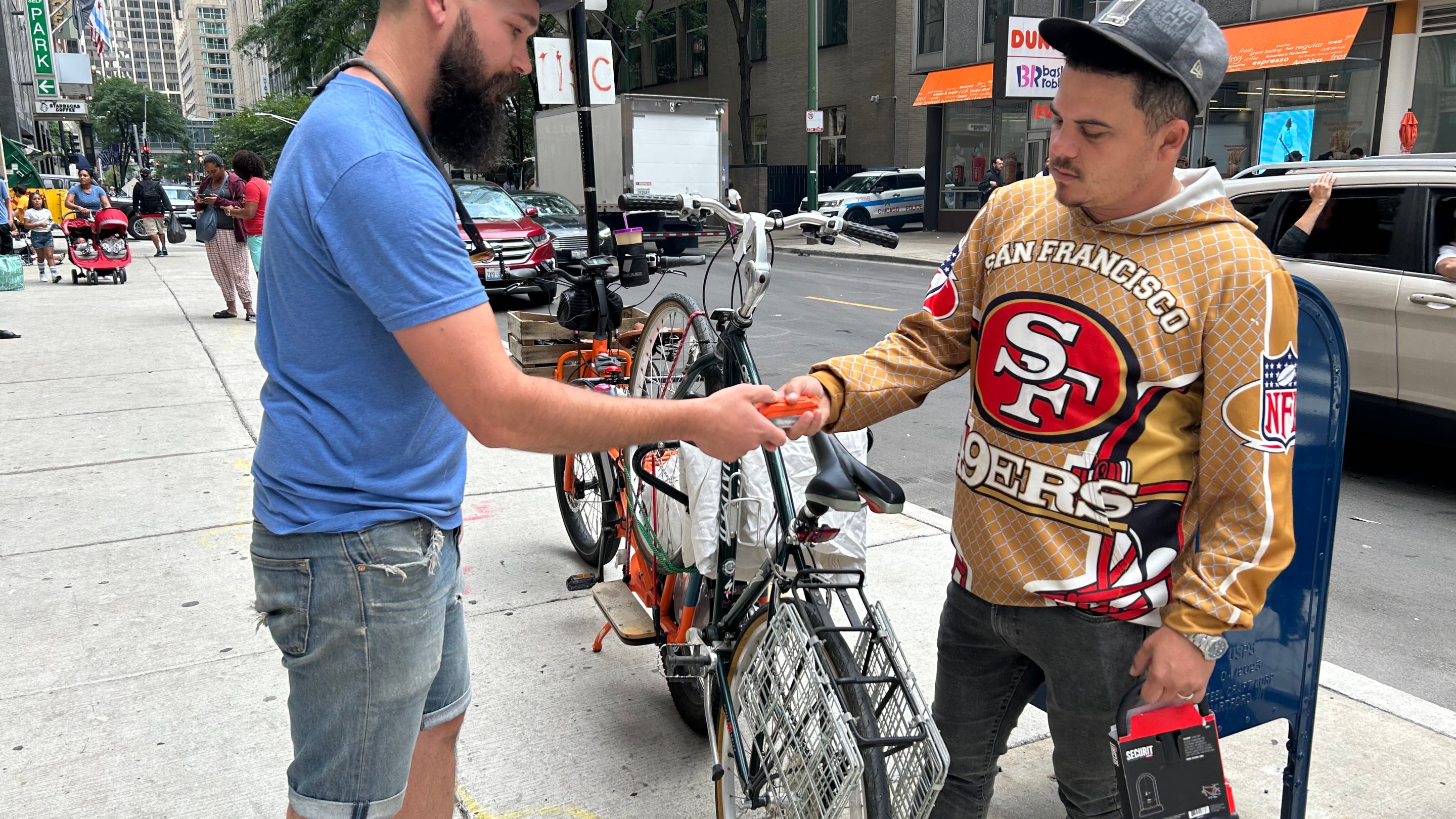
Last week while pedaling downtown on Milwaukee, I came across Chicago Department of Transportation Bicycling Ambassadors and 14th District police officers doing safety outreach to people on bikes and people in cars. The ambassadors were handing flyers to motorists and cyclists reminding them not to use phones while driving and to obey traffic signals while biking. The police were flagging down adult cyclists who rode on the sidewalk or who ran red lights and giving them seemingly polite warnings that what they did was illegal.

Carlin Thomas, CDOT’s enforcement coordinator, said the response from people in cars had been mostly positive. “Most motorists are rolling down their windows at first wave, and often we’re finding that motorists are also cyclists,” she said. “So sometimes they don’t even want our free information. They’re like, ‘I’m a cyclist too. I don’t talk on my cell phone [while driving].’ Every now and then we’ll get a driver who’ll quietly put down their phone and take a flyer and apologize.”

I asked Thomas if this enforcement event was related to the recently proposed Bike Safety Ordinance 2013, which would raise fees for traffic violations by bicyclists from $25 to $50-200, as well as double the fine for motorists who open car doors on cyclists to $1,000. “We’ve been doing enforcement work for the past four years,” she said. “So we’re continuing to [raise awareness of] the most dangerous behaviors out on the roadway… The ordinance proposal certainly complements what we’re doing.”

675cf966-84f5-4708-bfdf-33b1c905acab

Carlin Thomas, left, offers a driver tips for safely sharing the road with bikes. Photo by John Greenfield.

“The officers here are patrolling with a bike ambassador and pointing out people’s behavior that may increase the likelihood of a [crash] without having to write a ticket,” said Sergeant Joe Giambrone. “You see all the white ‘ghost bikes’ that are littering the neighborhood?” Giambrone said. “That’s because of the prevalence of all these motor vehicle-bicycle [crashes]. I can’t reach and pluck the [cyclist] out of harm’s way, but by our positive enforcement events we can hopefully raise the awareness of both the motorist and the cyclist to help prevent that.”

Later this month, First Ward Alderman Joe Moreno and 32rd Ward Alderman Scott Waguespack are sponsoring outreach events where people cycling at night without lights will be stopped by the police, then approached by ambassadors who will offer to install free lights on their bikes so they can avoid tickets. “That’s a very positive interaction,” Giambrone said. “Today tends to be a ‘slap and tickle’ – some people who don’t want to hear our advice are still going to ride badly,” he added.

I’ve heard grumbling from cyclists about the enforcement events in the past so, for a different perspective, I posted on The Chainlink, a local bike social networking website with over 8,500 members, asking whether people feel the events are helpful for encouraging safe behavior. Out of the dozen or so folks who responded, opinions on the usefulness of the stings ran about fifty-fifty.

Read more…

Streetsblog DC 1 Comment

Capital Bikeshare Members Reduced Their Driving 4.4 Million Miles Per Year

According to a survey of CaBi members, the average subscriber drove 198 fewer miles per year after joining the bike-share system. Photo: Capital Bikeshare

We’ve noted before that it can be challenging to figure out exactly how much driving is avoided when someone rides a bike. But here we have it straight from the horse’s mouth – nearly 7,000 horses, in fact. According to a November 2012 survey of Capital Bikeshare members, released today, the average subscriber drove 198 miles less per year after joining the system. Multiply that by 22,200 members and that’s 3.7 million pounds of CO2 that won’t get belched into the atmosphere. Nice work, CaBistas!

Some other takeaways from the member survey:

Capital Bikeshare both enhances access to transit and shifts trips away from transit. Almost a quarter of CaBi users had used bike-share to get to the bus in the past month, and 17 percent had used it six or more times to access the metro system. At the same time, transit is the mode most likely to get replaced with bike-share trips: 61 percent of respondents say they ride Metrorail less often and 52 percent ride a bus less often. On the plus side, though, 50 percent drive less often.

For any given trip, if bike-share hadn’t been available, 44 percent would have taken a bus or train, 38 percent would have walked, 5 percent would have ridden their own bike, and 4 percent would have driven.

Bike-share members drive less. According to the survey report, “a quarter (26 percent) reduced their driving miles since joining Capital Bikeshare; 11 percent reduced driving by more than 1,000 miles. Two-thirds (65 percent) of respondents who reported their mileage made no change in driving miles; only 9 percent increased their driving miles.” CaBi members were never big drivers, but they reported driving an average 1,805 miles per year before joining Capital Bikeshare and 1,607 miles per year since joining, “for a reduction of about 198 miles annually” per person – or a cumulative 4.4 million miles.

Of the 4.4 million miles not driven… more than half are commuting miles, which often occur at peak hours. That’s a significant amount of car traffic taken off Washington’s streets by these snazzy red bikes. In total, 58 percent of members use it to go to and from work, and 40 percent commute via bike-share “often.” All together, about half of bike-share trips are work-related.

CaBi saves members money. An average of $15.39 per week, in fact – or about $800 annually, per person.

Read more…

Streetsblog.net 41 Comments

The Granddaddy of Sprawl Subsidies, Illustrated

See the white pinpoints where central cities are? That's where the federal mortgage interest deduction is helping people the least. Meanwhile, residents of sprawling suburbs are raking in the subsidies. Image: Pew Center on the States

Despite the ruinous housing crisis just a few years ago, the federal government still keeps the suburban sprawl machine humming.

About 85 percent of federal subsidies for housing flow to single family homes, according to a recent report from Smart Growth America, though only about 65 percent of Americans are homeowners and the majority of renters live in multi-family housing. The ultimate sprawl subsidy just might be the mortgage interest deduction. Not only is this baby completely regressive — the vast majority of subsidies flow to households with incomes greater than $200,000 — as you can see in the above map, this money tends to flow to areas where everyone is dependent on a car.

Network blog West North writes:

See those donut holes? Inner-city areas with low rates of homeownership, low incomes (and thus fewer residents who itemize deductions), and relatively lower property values are receiving far less of America’s fattest housing subsidy — the mortgage-interest personal income tax deduction (see previous discussion) — than their better-off suburbs. The sprawl subsidies continue apace.

The bigger picture is that this is a subsidy that overwhelmingly benefits wealthy people who have expensive houses, and big mortgages to match — and thus benefits “coastal elites” more.

Elsewhere on the Network today: Human Transit reports that Google Maps is planning some big improvements to its transit directions feature. Mobilizing the Region reports that New Jersey is the newest state to consider reducing speed limits to 20 miles per hour in residential areas. And Better Institutions comments on a unorthodox new plan to shore up the federal infrastructure bank.

No Comments

Today’s Headlines

  • Red Reconstruction Is a Political Gamble for Emanuel (Tribune, Sun-Times)
  • Pageviews on CTA’s Red Rehab Help Website Have Skyrocketed (Sun-Times)
  • No Surprise: CTA Pass Increases Hit Poor and Minority Riders the Hardest (Tattler)
  • Green Line Peddler Has No Complaints About Red Shutdown (Sun-Times)
  • Water Taxi Service Expands to North Avenue on May 28 (Tribune)
  • NW Indiana Man Threatens Cyclists With Gun (Sun-Times)
  • Tweets From People Unclear on the Red Rehab Concept (RedEye)
  • Cycling Is for All Body Types (Ding Ding)
  • How to Pack a Messenger Bag As Carry-On Luggage (Tiny Fix)
  • Sure, I Like Biking, But City Streets Are for Cars (LSD)

Get national headlines at Streetsblog Capitol Hill

4 Comments

NACTO Workshop Visits Indianapolis to Help It Become a Better Cycling City

DSC_0340

Workers from Eli Lilly and Co. ride the Cultural Trail on company bikes. Photo by Jack Cebe.

Guest author Jack Cebe is a planner and designer with Alta Planning + Design in Chicago, a firm dedicated to creating active communities where bicycling and walking are safe, healthy, fun, and normal daily activities.

Last week, I traveled to Indianapolis to attend the National Association of City Transportation Officialsseventh Cities for Cycling Roadshow. The Roadshow gathers leaders in bicycling transportation from the country’s top bicycle-friendly cities to provide technical assistance for cities that have shown a dedication to improving cycling as a transportation option. It includes presentations and discussions with local political leaders, engineers, planners and advocates; and is intended to both offer encouragement and share knowledge with citizens and officials.

The two-day workshop was led by four nationally recognized experts in the design, planning, and advancement of livable communities: David Vega-Barachowitz, sustainable initiatives program manager with NACTO; Nicole Freedman, director of bicycle programs with the city of Boston; Robert Burchfield, city traffic engineer with the Portland Bureau of Transportation; and Mike Amsden, project manager with The Chicago Department of Transportation. Jamison Hutchins, Indianapolis bicycle coordinator, was the head organizer of the event.

On Thursday, the workshop began with a presentation to city government and transportation leaders. Indianapolis has implemented several world-class bicycle facilities and amenities such as the Cultural Trail separated bike lane network, Indy Bike Hub Bike parking centers, an extensive greenway network, and an upcoming bike-share system. The main message was that Indianapolis had already accomplished much of the hard work in striving to become a more bicycle-friendly city; now it’s time to go after the “low-hanging fruit” projects that will make the network more complete and encourage more people to ride.

IMG_3865

An Indy Bike Hub parking center. Photo by John Greenfield.

Roadshow leaders identified that this is a pivotal moment for increasing biking in Indianapolis. Under Mayor Greg Ballard the city currently has strong leadership that understands the importance of cycling. While future administrations may not be as supportive of active transportation as current leaders, roadshow leaders offered encouragement by pointing out that it’s much easier to prevent transportation progress than to undo it, and if the programs you initiate now are successful, then subsequent leaders will be supportive of them.

Later that day, the Cities for Cycling Roadshow biked to the Indianapolis Department of Public Works for an afternoon workshop. The purpose of this seminar was to educate department planners and engineers on best practices for bicycle facility design, with a focus on advanced facilities and concepts such as cycle tracks, neighborhood greenways (also known as bike boulevards), intersection markings, and bike signalization. The Roadshow was met by a very welcoming and attentive audience. Around 40 staff members were in attendance, many who were asking questions and taking notes throughout the presentations. Lori Miser, director of IDPW and Andy Lutz, deputy director, emphasized throughout the workshop that bicycling accommodation is a priority for the department.

Read more…